Choropedia
Understanding Choro: Brazilian Music's Unique Style
Discover the essence of Choro, its history, and musical structure. Learn why this genre is both specific and expansive.
Definition
The choro — also called chorinho — is the first typically Brazilian urban musical expression. It originated in Rio de Janeiro around 1870 when popular musicians began playing European ballroom dances in their own unique way: syncopated, swinging, with an expressiveness not found in the original scores — a rhythmic heritage derived from African rhythms, especially from lundu and the batuques of enslaved people. What began as a way of playing gradually evolved over decades into a musical genre with its own form, instrumentation, and language.
Today, the concept of choro carries at least three distinct meanings — all correct, each corresponding to a different moment in its history:
- A way of playing — the syncopated interpretive style that chorões applied to imported music.
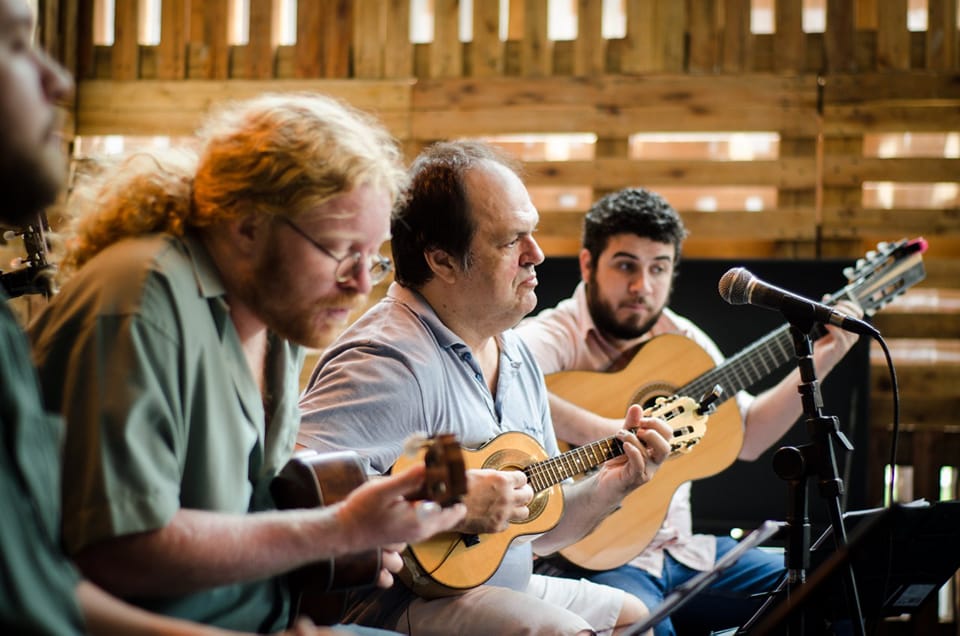
- A group and an event — the ensemble of musicians (originally the terno: flute, guitar, and cavaquinho) and the celebration where they played.
- A musical genre — the structured form in rondo, with three or two distinct themes, as we know it today.
Understanding these three meanings is not only a matter of historical curiosity; it is the key to understanding why the choro is both so specific in form and so broad as a language.
The Three Historical Meanings of Choro
1. Choro as a Way of Playing (c. 1870)
It all begins with the polka. From 1844 onwards, European ballroom dances — polka, waltz, mazurka, schottisch — arrived in Brazil and became fashionable. In the salons of the elite, they were played in the European style. However, at popular dances in the suburbs of Rio, middle-class musicians played these same songs differently.
They incorporated the syncopated groove of lundu and African batuques. They "softened" the rhythmic rigidity of the polka. They phrased with a melancholic, crying expressiveness. This way of playing is what named the phenomenon: choro.
For José Ramos Tinhorão, the word designated the feeling of melancholy conveyed by the improvisational bass lines of the guitar. For Henrique Cazes, it came from the "crying way of phrasing" that chorões applied to European dances. Regardless of the exact origin of the word — historians differ, as will be seen later — the fact is that it initially named a style, not a genre.
2. Choro as a Group and Event (c. 1870–1910)
At the same time it designated the style, the word "choro" began to refer to the very group of musicians who played in this manner and to the parties where they performed. The journalist Alexandre Gonçalves Pinto, in his book O Choro (1936), uses the term exactly like this: "the competent choro" that enlivened a particular gathering was the group of musicians, not the genre.
The most classical formation of this group — referred to as terno or pau e corda — was made up of three instruments:
- Flute — the quintessential solo instrument
- Guitar — harmony and counterpoint (the "low notes")
- Cavaquinho — rhythm and high-pitched harmony
Over time, other instruments were incorporated: pandeiro, seven-string guitar, mandolin, clarinet, saxophone, and trombone. However, the original core remained as a reference.
3. Choro as a Structured Musical Genre (from c. 1910)
With contributions from Joaquim Callado, Chiquinha Gonzaga, Ernesto Nazareth, and, primarily, Pixinguinha, choro began to acquire its own formal characteristics and ceased to be merely a style of interpretation. In the recording industry, the word "choro" only started appearing as a genre designation around 1910–1911.
The classical choro, as it has consolidated, has these structural characteristics:
- Metric: predominantly binary (2/4)
- Form: two or three themes (A and B, or A, B, and C), always organized in rondo — the A theme returns after each new theme: A–A–B–B–A or A–A–B–B–A–C–C–A
- Each section: typically 16 measures
- Modulations: the B section usually goes to the relative or the dominant; the C section, when it exists, goes to the homonymous
- Character: essentially instrumental
The choro with three themes (A, B, and C) is most associated with the genre in its classic phase, but the choro with two themes (A and B), following the same principle of return — A–A–B–B–A — is also legitimate and very frequent in the repertoire.
The Etymology of the Word — Four Theories
The exact origin of the word "choro" is one of the most debated topics in Brazilian musicology. The main researchers support four different explanations, none definitively proven:
| Theory | Origin | Author(s) |
|---|---|---|
| African / sociological | Derives from xolo, a dance of enslaved people on colonial farms | Câmara Cascudo, Renato Almeida |
| Colonial / professional | An abbreviation of choromeleiros, corporations of instrumental musicians from the colonial period | Ary Vasconcelos |
| Musical / affective | A melancholic and "crying" way of playing; or the feeling of melancholy from the guitar's bass lines | José Ramos Tinhorão, Lúcio Rangel |
| Linguistic | Aglutination of the verb chorar with Latin chorus (choir) | Maestro Batista Siqueira |
The safest approach, considering the current state of research, is to recognize the controversy as part of the very mixed and multiple character of the genre — a name that carries many meanings because it was born from many sources.
How Choro Appears in Musical Practice
In the choro circle: The most traditional space for practicing the genre is the roda — an informal gathering where musicians play from memory, taking turns in solos, supporting each other, and improvising within the form. The roda requires knowledge of the classical repertoire, the ability to accompany without rehearsal, and sensitivity to the ensemble.
In the regional: The most consolidated ensemble formation in the 20th century is the choro regional, featuring flute (or mandolin, clarinet), cavaquinho, six-string guitar, seven-string guitar, and pandeiro. Each instrument has a clear function: the soloist plays the melody, the cavaquinho and the pandeiro maintain the rhythm, the six-string guitar harmonizes, and the seven-string guitar provides the bass lines.
In composition: Writing a choro involves mastering the rondo form, the characteristic modulations between sections, and the syncopated rhythmic language. Composers like Nazareth and Pixinguinha expanded these boundaries, but always within a recognizable vocabulary.
How to Recognize While Listening
When listening to a choro, pay attention to:
- Syncopation: the displacement of the accent to the weak beat or subdivision — it's the characteristic "groove" that differentiates choro from a European polka played "as written"
- Rondo form: notice when the music changes themes and tonalities; each theme typically has 16 measures, and the return to theme A is clearly perceptible
- Dialogue between instruments: in a well-played choro, the accompanying instruments are not merely support — the seven-string guitar improvises bass lines, the cavaquinho punctuates, and the pandeiro breathes with the soloist
- Soloist ornamentation: flourishes, groups of notes, appoggiaturas — the melody is rarely played "clean"; the phrasing is expressive and personal
How to Study Practically
For beginners, the most effective path is:
- Learn the repertoire by ear — before reading the sheet music, listen to historical recordings and try to sing the melody
- Learn the form — identify the themes and modulations in each piece you study
- Learn to accompany — regardless of the instrument, learning to play the accompanying role in a roda is as important as knowing the solo
- Attend rodas — choro is an oral and collective practice; no book can replace the experience of playing together
Common Misunderstandings
"Choro is only for wind instruments and guitar." No. Any instrument can be part of a roda de choro — piano, mandolin, trombone, saxophone. The classic formation with flute is historical, not mandatory.
"Choro is sad and mournful." The name may suggest this, but the repertoire is enormously varied. Brejeiro, by Nazareth, is lively and humorous. Um a Zero, by Pixinguinha, is euphoric. Apanhei-te, Cavaquinho is festive. Melancholy exists in some choros, but not in all.
"Every choro has three parts." The form with three themes (A, B, and C) is very common, but the choro with two themes (A and B) — which follows the same rondo principle, with A returning after B — is also legitimate and very present in the repertoire. Brasileirinho, by Waldir Azevedo, is a well-known example of choro in two themes. Both forms have coexisted in the tradition since the beginning.
"Choro and samba are the same thing." They are distinct genres with partially common roots. Choro is essentially instrumental; samba is predominantly vocal. The rhythm, form, and social practice of the two are different, although they have historically dialogued.
"Choro has stagnated over time." The genre experienced periods of neglect, but it has never ceased to be practiced and renewed. The generation of the 1970s (with musicians like Raphael Rabello, Maurício Carrilho, and Egberto Gismonti) and the revival movements of the following decades demonstrate a genre that is alive and evolving.
Connections Within the Choropedia
Central Composers: → Joaquim Callado · Chiquinha Gonzaga · Ernesto Nazareth · Pixinguinha
Related Concepts: → Syncopation · Rondo Form · Baixaria · Choro Regional · Choro Wheel · The Chorões
Instruments: → Flute · Seven-String Guitar · Cavaquinho · Pandeiro · Mandolin
Reference Repertoire: → Flor Amorosa (Callado) · Odeon (Nazareth) · Carinhoso (Pixinguinha) · Brasileirinho (Waldir Azevedo)
Sources
- TINHORÃO, José Ramos. História Social da Música Popular Brasileira. Editora 34, 1998. — A fundamental reference for the historical and social origins of choro, including the etymological thesis based on the guitar's bass lines.
- CAZES, Henrique. Choro: do Quintal ao Municipal. São Paulo: Editora 34, 1998. — A reference work on the evolution of choro as a musical and social practice, from its origins to the 20th century.
- VASCONCELOS, Ary. Raízes da Música Popular Brasileira. Rio de Janeiro: Rio Fundo Ed., 1991. — Source of the etymological thesis of the choromeleiros.
- PINTO, Alexandre Gonçalves. O Choro: reminiscências dos chorões antigos. Rio de Janeiro, 1936 (reed. FUNARTE, 1978). — A period chronicle; historical use of the term "choro" to designate the group and the event.
- SÈVE, Mário. Vocabulário do Choro: estudos e composições. Rio de Janeiro: Lumiar, 1999. — A technical reference on the form, harmony, and language of the genre.
- DINIZ, André. Joaquim Callado: o pai do choro. Rio de Janeiro: Jorge Zahar, 2008. — A study on Callado's role in the consolidation of the genre.
- Enciclopédia Itaú Cultural — Entry "Choro": historical overview with detailed bibliographical references.
- Musica Brasilis — musicabrasilis.org.br: article on choro with historical and formal synthesis.
Note: The word "choro" and its etymology remain subjects of debate among musicologists. This entry presents the main theories without ranking them, respecting the current state of historical research.
Suggested course
Move from editorial context into guided study with synchronized score and structured steps.
All courses
Browse the public course catalog connected to the content hubs.