Choropedia
The History of Choro
Explore the origins and evolution of choro music in Brazil.
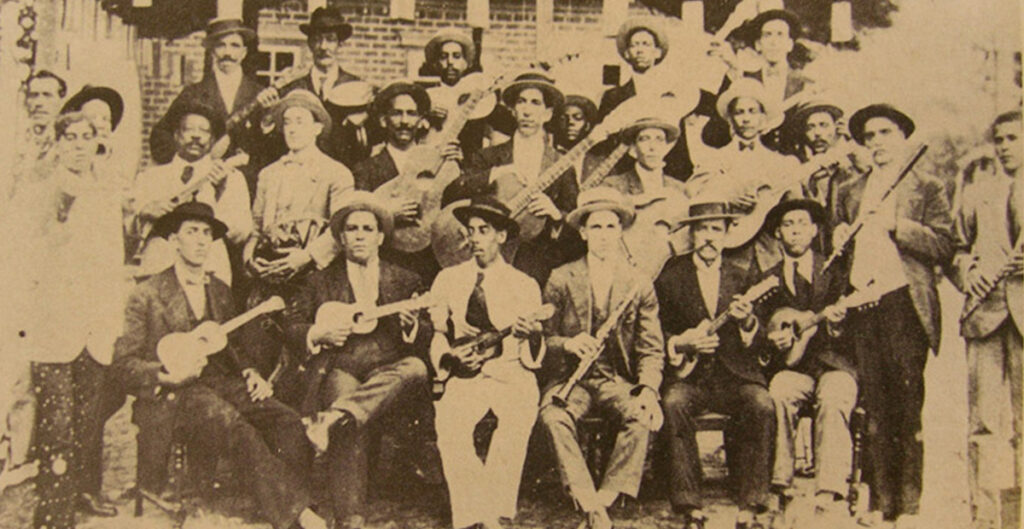
Introduction
Choro did not arrive fully formed. Before it became a recognized genre — with its own repertoire, recurring formal structures, and consecrated lineage — it was a Brazilian way of playing. It was in Rio de Janeiro in the second half of the nineteenth century, a musically restless city, that European salon dances such as the polka, waltz, mazurka, and schottisch began to acquire a different swing in the hands of local musicians. As these pieces came into contact with Afro-Brazilian rhythms and sensibilities, with the practice of wind bands, with salons, theatres, and the music of the streets, they were gradually Brazilianized until they formed a language with a flavour entirely their own.
This is precisely where choro becomes fascinating. It is not the product of a single, clean, almost bureaucratic origin. It was born of mixture, of coexistence, of adaptation, of attentive listening, and of invention. For that reason, its history is not only the history of a musical genre — it is also the history of a city, of its musicians, and of a Brazilian way of transforming repertoires into language.
Before the Genre: Ensemble, Environment, and a Way of Playing
In the second half of the nineteenth century and the early twentieth, the word "choro" did not yet carry a single stable meaning. It could name the musical ensemble, the gathering where those musicians played, or even the repertoire performed at such meetings. In other words: before it clearly designated a genre, "choro" named a practice. This helps to avoid a common mistake — imagining that choro appeared already defined, with a birth certificate and ready-made boundaries.
The etymology of the word itself remains open. Proposed derivations include the Latin chorus, the Portuguese verb chorar (to weep), a connection to the words xolo or xoro, and a corruption of choromeleiros (colonial-era guilds of wind musicians). The wisest approach is not to choose one of these hypotheses as absolute truth, but to recognize that the term settled into meaning alongside the very musical practice it came to name.
The so-called symbolic birth of choro in the 1870s also does not mean that everything began there from nothing. Small pau e corda ensembles (literally "wood and string") were already circulating in Rio de Janeiro's festive life before Callado. Joaquim Callado did not invent choro single-handedly — what he did was crystallize, give more visible and stable form to something that was already fermenting in the everyday musical life of the city.
Joaquim Callado and the First Crystallization of the Style
Joaquim Antônio da Silva Callado occupies a founding position because his Choro Carioca became a reference point for both formation and musical language. He assembled the first ensemble with the basic instrumental constitution of choro, bringing together flute, two guitars (violões), and cavaquinho. This was not merely a matter of combining instruments: it was a matter of defining a balance between solo melody, harmonic support, pulse, and rhythmic response that would prove decisive for the subsequent tradition.
Callado was a respected flautist, a professional musician, and a professor at the Imperial Conservatório. With him, choro began to acquire a more recognizable face. His polkas enjoyed enormous success, and the performance of Lundu Característico in 1873 exemplifies that moment in which elements from different worlds — the salon, the concert hall, and popular practice — came into contact without asking permission.
Chiquinha, Nazareth, and Anacleto: Expansion, Refinement, and Diffusion
After Callado, the history of choro opens out in several directions simultaneously.
Chiquinha Gonzaga helps to show how this music circulated between theatre, dance, music publishing, and urban life. Her trajectory broke through social barriers and broadened the reach of written popular music in Brazil, at a moment when the instrumental and dance repertoire was at the centre of Rio de Janeiro's social life.
Ernesto Nazareth occupies a different position: that of refinement. His piano works, especially the so-called tangos brasileiros, do not belong to choro in a simple or literal sense, but they came to be absorbed into its imaginary and its repertoire. In Nazareth, Brazilian urban music acquires formal finish, textural sophistication, and a melodic elegance that would leave a deep mark on subsequent generations. He is less a chorão de roda in the most direct sense, and more an architect of that urban sensibility that choro incorporated.
Anacleto de Medeiros reveals another essential dimension: that of wind bands and recording. His leadership of the Fire Brigade Band (Banda do Corpo de Bombeiros) and his participation in some of the earliest recordings at the Casa Edison in 1902 help to show that choro did not grow only through intimate gatherings, but also in public spaces, musical institutions, and the nascent phonographic industry.
The *Chorões*, the City, and Everyday Life
The carioca chorões were, for the most part, men of the urban lower middle class — many of them civil servants or employed in city services. They were highly competent musicians, but not always full-time professionals. They played out of pleasure, out of sociability, for the esteem of their peers, to supplement their income, and out of expressive necessity. Choro, in this light, was not only a musical achievement: it was also a form of social life.
This changes the way the history is told. Instead of imagining a tradition made solely of isolated geniuses, we come to see a network of practices: music shops, parties, private homes, bands, serenades, rodas, recordings, and radio programmes. Choro was built within this urban fabric, where playing well also meant knowing how to listen, accompany, respond, improvise, and coexist.
Pixinguinha and the Consolidation of the Language
If Callado helped lay a foundation, Pixinguinha is the great name of consolidation. He is the bridge between the choro of the nineteenth century and that of the twentieth — and this is more than praise. In Pixinguinha, the genre matures definitively as a language of composition, arrangement, counterpoint, and collective invention. He reorganizes the role of the ensemble, deepens the force of the countermelodies (baixarias), and brings choro to a new level of musical density.
Os Oito Batutas were also decisive in this process. Their work showed that choro could already engage with spectacle, with the market, and with international circulation without losing its accent. Pixinguinha had an ear open to the mixture of tradition and modernity — an openness that was decisive in allowing choro to become not only an inheritance but also an artistic project.
From the *Terno* to the *Regionais*
The accompaniment of choro already displayed, in the early decades of the twentieth century, features that we now strongly associate with the seven-string guitar (violão de sete cordas). The six-string guitar in the choro ternos was already producing marked bass lines and low melodic figures in a function very close to what would later become emblematic of the seven-string — which demonstrates continuity, not abrupt rupture, in the history of choro accompaniment.
With radio and the professionalization of urban popular music, the format expanded and reorganized itself in the regional ensembles. Benedito Lacerda is a decisive figure in this stage: in 1930, with the ensemble Gente do Morro, he helped give the regional its definitive form, which stabilized with greater emphasis on plucked strings and the pandeiro. Later, the combination of Benedito, Canhoto, Dino, and Meira became a model of sonority and organization that would leave a deep mark on choro and on accompanying practice in Brazilian music more broadly.
Canhoto is central to this chapter. His work on the cavaquinho de centro helped consolidate a school of accompaniment. From that point on, choro made it ever clearer that its greatness resides not only in the brilliant soloist, but also in the fine engineering of the accompaniment — where every instrument thinks together.
Jacob, Waldir, and the New Shape of the Genre
In the post-war period, Jacob do Bandolim and Waldir Azevedo represent two different expansions of choro.
Jacob brought the genre to an extreme level of rigour, organization, and chamber-like attentiveness. His concern for the future of choro — expressed as early as 1955 — and the founding of the Conjunto Época de Ouro mark a moment in which choro asserted itself as music of the highest artistic demands.
Waldir Azevedo, on the other hand, extended the reach of the cavaquinho as a solo instrument. His Brasileirinho, composed in the late 1940s, became one of the genre's greatest emblems. With him, the cavaquinho stepped definitively out of the shadow of mere accompaniment and acquired national presence as a solo voice of wide popular impact.
Decline in Centrality, Continuity, and Revival
Choro lost ground in the mainstream media from the late 1950s onward, as other musical languages came to dominate the market. But it would be wrong to speak of disappearance. The genre continued to live in rodas, bars, smaller circuits, programmes dedicated to the older generation, and in the active memory of musicians and listeners. The history of choro looks less like a straight line than like a covered ember: sometimes less visible, but still glowing.
In the decades that followed, there was a revaluation — new clubs, recordings, preservation projects, and growing institutional recognition. Today, this work of memory rests on two fundamental pillars: the Casa do Choro, which maintains an archive of more than 10,000 titles by composers of the nineteenth and twentieth centuries, and the Instituto Moreira Salles, which holds important musical collections including those of Chiquinha Gonzaga, Ernesto Nazareth, and Pixinguinha. This did not freeze choro — on the contrary, it gave it firmer ground to continue living.
Connections within Choropedia
Central composers: → Joaquim Callado · Chiquinha Gonzaga · Ernesto Nazareth · Anacleto de Medeiros · Pixinguinha · Jacob do Bandolim · Waldir Azevedo
Related concepts: → What is Choro · Roda de Choro · Regional de Choro · Rondo Form · Syncopation · Baixaria
Fundamental works: → Fundamental Works of Choro
Sources
- TABORDA, Marcia E. "As Abordagens Estilísticas no Choro Brasileiro (1902–1950)" [Stylistic Approaches in Brazilian Choro (1902–1950)]. Historia Actual Online, 2010. — Central reference for the discussion of the meanings of the word "choro" before its stabilization as a genre, the continuity of accompaniment practice, and the role of musicians in carioca urban life.
- CAZES, Henrique. Choro: do Quintal ao Municipal [Choro: From the Backyard to the Concert Hall]. São Paulo: Editora 34, 1998. — The essential reference work on the evolution of choro as a musical and social practice, from its origins through the twentieth century.
- TINHORÃO, José Ramos. História Social da Música Popular Brasileira [Social History of Brazilian Popular Music]. Editora 34, 1998. — Historical and social contextualisation of the period of the genre's formation.
- Instituto Casa do Choro — Composer entries and historical text on the formation of choro and the regionais. Source for Callado, Benedito Lacerda, Canhoto, and the archive of 10,000 titles.
- Instituto Moreira Salles / Rádio Batuta — Collections of Chiquinha Gonzaga, Ernesto Nazareth, and Pixinguinha; historical texts on Os Oito Batutas and the formation of Brazilian urban popular music.
- Dicionário Cravo Albin da Música Popular Brasileira — Entries for the composers cited; etymological hypotheses on the word "choro"; record of Jacob do Bandolim's concern for the future of the genre in 1955.
Suggested course
Move from editorial context into guided study with synchronized score and structured steps.
All courses
Browse the public course catalog connected to the content hubs.