Choropedia
Six-String Guitar in Choro
Explore the vital role of the six-string guitar in choro music.
Definition
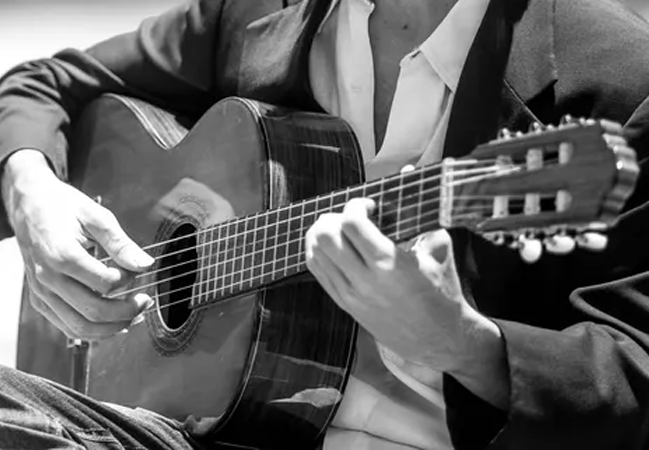
In choro, the 6-string guitar occupies a central place in shaping the ensemble’s sound. Although it is often remembered above all as an accompaniment instrument, its role goes far beyond simply “playing chords.” In the regional ensemble, the 6-string guitar performs harmonic, rhythmic, and contrapuntal functions, actively participating in the pulse, the leading of inner voices, and the collective musical design.
Situated in the middle range of the sonic spectrum, it also serves an important balancing function: it helps connect the higher frequencies of the cavaquinho with the lower frequencies of the 7-string guitar, giving cohesion to the ensemble and often functioning as the true “glue” of the regional.
Playing 6-string guitar in choro, therefore, is not merely a matter of accompanying. It is about supporting, organizing, anticipating, responding, and dialoguing.
The place of the 6-string guitar in the regional ensemble
Within the choro regional ensemble, the 6-string guitar often forms, alongside the cavaquinho, the harmonic center of the group. At the same time, it remains in constant dialogue with the 7-string guitar, either complementing its role or avoiding unnecessary duplication in the lower register.
This intermediate position makes the instrument strategically important. The 6-string guitar should sound neither too heavy, competing with the 7-string guitar, nor too light, disappearing among the other instruments. Its ideal role is that of an element that supports the form, shapes the groove, colors the harmony, and participates in the counterpoint, always in service of the collective music-making.
The four fundamental functions of the 6-string guitar
The role of the 6-string guitar in choro can be understood through four integrated musical skills: harmony, groove patterns, chord inversions, and bass counterlines.
Harmony
The 6-string guitar is one of the pillars of choro’s harmonic foundation. Its job is to sustain chord progressions with clarity, security, and naturalness, without excesses that might compromise the genre’s fluency.
In choro, this requires the guitarist to develop highly refined harmonic insight. It is not enough to memorize chord symbols. One must quickly recognize the clichés of the repertoire, anticipate modulations, understand the formal logic of the sections, and perceive where the music is heading. In many contexts, this reading happens in real time, “by ear,” within the roda or the regional ensemble.
Knowing the traditional form of choro is a direct help in this task. Understanding how the sections are usually organized, where the most common modulations occur, and which progressions tend to recur allows the guitarist to predict chords more confidently and accompany with far greater musicality.
Part of this function also involves understanding the nature of the genre’s characteristic chords. In general, the harmonic language of choro works with richness and motion, but without relying on excessive tensions or harmonic solutions foreign to the style. In this case, the best accompaniment is not the most “sophisticated” in a modern sense, but the one most appropriate to the language.
Groove patterns and rhythmic drive
If harmony organizes the ground of the music, the groove pattern is the engine that makes it move.
In choro, the 6-string guitar plays a central role in the rhythmic drive of the regional ensemble, especially through the work of the right hand. In dialogue with the cavaquinho and the pandeiro, it articulates syncopated patterns, accents, muted strokes, swing, and variations that give shape to the genre’s characteristic pulse.
These groove patterns are not all the same. They change according to the type of piece, the composer, the period, the tempo, and the interpretive intention. The guitarist must master accompaniment designs connected to matrices such as lundu, polka, maxixe, and waltz, as well as variations associated with choro sambado and the so-called choro varandão.
For this reason, accompanying well in choro does not simply mean “marking time.” It means knowing how to mark it, when to vary, and how much to intervene. A good groove sustains the music’s inner dance without making it rigid. It pulses, but it breathes.
Chord inversions and voice leading
One of the most refined functions of the 6-string guitar in choro lies in the use of chord inversions.
The guitarist does not always need to play the root of the chord, especially when a 7-string guitar is more active in the lower register. By working with inversions, the 6-string guitar gains the freedom to create shorter bass lines, whether diatonic or chromatic, producing what are often called walking bass motions and organizing the harmony with greater elegance.
This resource is essential because it allows the instrument to act in complementarity with the 7-string guitar. Instead of repeating the same low-register information, the 6-string guitar can move away from the 7-string guitar’s line, fill tonal gaps, and trace its own trajectories. The result is a richer texture, less redundant and more characteristic of the regional ensemble’s language.
In other words, the 6-string guitar helps control the harmony without always having to occupy its most obvious position.
Bass counterlines and counterpoint
Although the 7-string guitar has become the main symbol of bass counterlines in choro, the 6-string guitar also actively participates in this domain.
These bass counterlines are melodic and contrapuntal lines built generally in the low or middle-low register of the instrument. They do not serve merely to “decorate” the accompaniment. Their function is to dialogue with the main melody, answer phrases, fill spaces, lead modulations, and enrich the musical fabric of the ensemble.
In the context of the regional ensemble, the 6-string guitar often responds to the 7-string guitar’s phrases by forming true bass counterline duets, in intervals such as thirds, sixths, octaves, or unison. At other times, it acts independently, creating its own phrases, arpeggios, scales, or characteristic effects such as the so-called gemedeira, produced by sliding on the middle-low strings.
In addition to complementing the 7-string guitar, the 6-string guitar may also perform what musicians call obrigações, that is, bass lines or passages already established within certain compositions. In pieces such as Ingênuo, by Pixinguinha, or Benzinho, by Jacob do Bandolim, these interventions are not merely interpretive possibilities: they are part of the musical identity of the work.
The relationship with the 7-string guitar
The interaction between the 6-string and 7-string guitars is one of the richest aspects of choro practice.
When both instruments play together, the ideal result is not duplication, but complementarity. The 7-string guitar tends to take on a more prominent role in low-register lines and in more exposed counterpoint, while the 6-string guitar organizes the harmonic center, articulates the groove, and contributes inversions, responses, and complementary bass counterlines.
This relationship requires fine listening. A good 6-string guitarist must know when to occupy space and when to leave space. They must be aware of the register in use, avoid unnecessary clashes in the lower notes, and understand that in choro accompaniment is not a neutral background: it is organized conversation.
When the 6-string guitar is the only guitar in the group
When there is no 7-string guitar in the ensemble, the role of the 6-string guitar expands considerably. In this context, it also takes on part of the space left by the lower instrument, assuming more contrapuntal responsibilities and greater presence in bass counterlines.
This is where what many musicians call “6/5 guitar” playing appears: a way of playing in which the 6-string guitar, even without the seventh string, incorporates more low-register and melodic functions into the accompaniment. This requires even greater command of inversions, greater awareness of voice leading, and a stronger ability to balance harmonic support with contrapuntal elaboration.
In such cases, the player must be even more complete, since they are now responsible, alone, for a larger portion of the regional ensemble’s musical architecture.
Complexity and musical demands
The sum of all these functions makes the 6-string guitar in choro an instrument of high musical complexity.
Good accompaniment depends on technique, of course, but not only on that. It also requires:
- harmonic perception;
- knowledge of repertoire;
- command of groove patterns and stylistic conventions;
- flexibility in reacting to what is happening in the group;
- musical intuition;
- the ability to anticipate formal directions;
- and, above all, collective rapport.
In choro, playing well does not mean playing alone with isolated brilliance. It means participating in the intelligence of the ensemble.
Synthesis
The 6-string guitar is one of the great sustaining forces of choro language. Its role is not limited to accompaniment in the simplest sense of the term: it organizes the harmony, drives the groove, leads inner voices, dialogues with the 7-string guitar, performs bass counterlines, executes obrigações, and, when necessary, takes on even broader functions within the regional ensemble.
For this reason, understanding the role of the 6-string guitar means understanding an essential part of choro’s very sound. Without it, the regional ensemble loses center, glue, and swing. When it is well played, everything gains shape, direction, and unity.
Suggested course
Move from editorial context into guided study with synchronized score and structured steps.
All courses
Browse the public course catalog connected to the content hubs.