Choropedia
Seven-String Guitar in Choro
Discover the function and history of the seven-string guitar in choro, from Tute and China to Dino Sete Cordas.
Definition
In choro, the violão de 7 cordas (7-string guitar) plays a decisive role in shaping the ensemble's sound. More than simply extending the instrument's bass range, it introduces a distinctive way of driving the music: through baixarias (bass counterpoint lines), contracantos (counter-melodies), bass voice-leading, and the rhythmic articulation of the accompaniment.
Within the regional, its function goes well beyond reinforcing root notes or marking the beat. The 7-string guitar actively participates in the musical discourse, dialoguing with the main melody, linking harmonies, preparing cadences, and propelling the internal movement of the piece.
Playing the violão de 7 cordas in choro, therefore, is not merely about "covering the low end." It means sustaining, responding, anticipating, leading, and dialoguing.
The role of the 7-string guitar in the regional
Within the regional, the 7-string guitar tends to take greater responsibility for the bass register and the contraponto, while the violão de 6 cordas (6-string guitar) generally occupies a more central range within the harmony. But this division should not be understood rigidly. The ideal in choro is not duplication, but complementarity.
When the ensemble is well balanced, the 7-string guitar leads and comments, while the 6-string guitar sustains, colors, and articulates the levada (rhythmic groove). The cavaquinho and the pandeiro, in turn, reinforce the rhythmic center of the group. It is from this interplay of distinct functions and mutual listening that the characteristic fluidity of the regional is born.
This position makes the 7-string guitar a strategic element. It is not an isolated instrument within the ensemble, but a central mechanism in the collective musical conversation.
The fundamental functions of the 7-string guitar
The role of the violão de 7 cordas in choro can be understood through four integrated musical dimensions: baixarias, bass voice-leading, rhythmic pulse, and dialogue with the ensemble.
Baixarias and contraponto
The most distinctive feature of the 7-string guitar in choro lies in its baixarias. These bass lines do not merely fill space or reinforce the harmony. They constitute a true contraponto to the main melody, with their own melodic contour, their own rhythmic direction, and a strong structural role in shaping the musical phrase.
In their most characteristic form, baixarias comment on the melody, prepare resolutions, connect chords, and help organize the architecture of the accompaniment. In many cases, these are not fixed phrases but idiomatic elaborations, constructed in real time from the repertoire, the harmony, and the style of the piece.
It is precisely this capacity to transform the accompaniment into melodic discourse that has made the 7-string guitar one of the most recognizable signatures of the choro language.
Bass voice-leading and harmonic continuity
The 7-string guitar also plays a decisive role in bass voice-leading. This means it does not function merely as a static harmonic support, but as a living line capable of connecting chords with clarity, elegance, and motion.
Well-executed bass voice-leading helps the ensemble breathe. It organizes transitions, reinforces section changes, prepares modulations, and creates continuity. Rather than simply "announcing" the chords, the instrument participates in the way they are linked together and made audible within the music.
For this reason, playing the 7-string guitar well demands far more than knowing chord charts. It requires harmonic perception, command of the repertoire, attentive listening to the melody, and the ability to choose, at every moment, between sustaining, responding, simplifying, or elaborating.
Pulse, attack, and levada
Although the 7-string guitar is most often remembered for its melodic and contrapuntal function, it also plays an important role in the pulse of the regional. Its attack, articulation, and timbre directly affect the ensemble's sense of swing.
In the traditional school of choro and samba, the instrument typically produces a firm, dry, and incisive sound, favoring rhythmic clarity and acoustic presence. In this context, the right-hand technique is decisive: the attack must be precise, firm, and musical, without losing mobility.
In certain situations, especially in samba, this rhythmic dimension intensifies further. A famous example is the technique known as "violão tamborim", associated with Dino Sete Cordas, in which the instrument takes on a shorter, more percussive and muted stroke, approaching the behavior of a rhythmic base element.
Dialogue with the ensemble
The 7-string guitar should not be understood as an instrument of constant display. Its traditional function in choro depends, above all, on a sense of ensemble.
The skilled 7-string player knows when to speak and when to remain silent. Knows when to draw a more exposed phrase and when to simply sustain the foundation. Knows when to respond to the melody, when to step back from it, and when to leave space for the 6-string guitar, the cavaquinho, or the soloist.
In choro, the instrument does not exist to dominate the roda, but to organize its sonic depth. Its greatest virtue lies not only in the brilliance of its baixarias, but in the intelligence with which it participates in the whole.
History and consolidation of the instrument
The remote origin of the 7-string guitar is a matter of debate. In the context of Brazilian music, however, the names most often cited in its introduction and early establishment are Tute (Arthur de Souza Nascimento, 1886–1957) and China (Otávio Littleton da Rocha Vianna, 1888–1927), musicians active in the early decades of the twentieth century. China, brother of Pixinguinha, was a member of the Choro Carioca and the Oito Batutas; Tute participated in the Grupo Chiquinha Gonzaga and other ensembles of the period, and was admired by Luperce Miranda as a "pé-de-boi" guitarist — steady and reliable in accompaniment.
Through their work, the instrument entered the world of choro and samba on a lasting basis. Even so, its use remained relatively limited for some time, and its musical language was not yet fully consolidated.
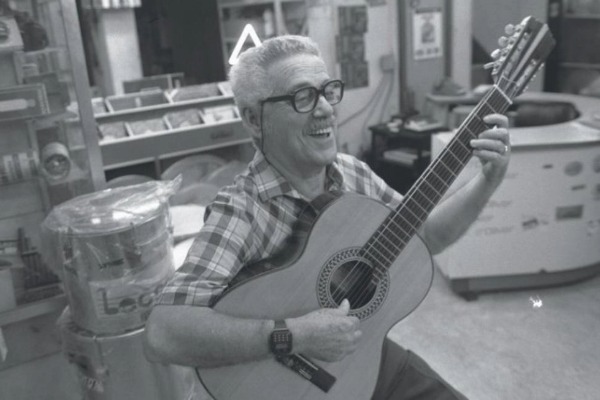
The great historical turning point comes with Dino Sete Cordas (Horondino José da Silva, 1918–2006). Around 1952, inspired by Tute's sound and driven by the need to fill the bass register left vacant by Pixinguinha's departure from the Regional de Benedito Lacerda, Dino commissions his 7-string guitar. After approximately one year of adaptation, he begins using it systematically in recordings. From that point on, the 7-string guitar acquires a more defined language and a far more prominent presence in Brazilian music. Dino reworks earlier references and builds a true school of accompaniment, grounded in the richness of his phrasing, rhythmic precision, variety of melodic solutions, and the intimate relationship between bass line and main melody.
His importance, therefore, lies not only in virtuosity, but in the fact that he consolidated a syntax. To a large extent, the modern tradition of the 7-string guitar in choro and samba passes through him.
Technique and sonority
In the traditional school of the 7-string guitar, the instrument was historically associated with steel strings, the use of a dedeira (thumb pick), and a firm, dry, and percussive sonority. This configuration favors projection, definition, and rhythmic clarity — qualities especially important in acoustic settings and regional formations. The seventh string itself was, in Dino's practice, a cello string — an adaptation he devised to control the vibration amplitude and minimize fret buzz.
Another distinctive feature of this tradition lies in the tuning of the seventh string. Historically, C tuning became the standard most closely associated with the Brazilian 7-string guitar, although other solutions, such as B and even A, also appear in contemporary practice, depending on the repertoire, the instrument, and the player's sonic conception.
In many traditional settings, players also sought a less resonant and more controlled sound in the bass register, which reinforced the percussive and articulated character of the instrument.
This materiality is not a secondary detail. On the 7-string guitar, technique, timbre, and language move together. The way the instrument is strung, attacked, and sonically controlled directly affects how the baixaria is perceived within the ensemble.
Two schools of the 7-string guitar
Today it is possible to speak, in broad terms, of two major schools of the violão de 7 cordas.
The first, more traditional, is rooted in the technical and sonic standard developed by Dino. It is characterized by steel strings, the use of the dedeira, and a strong orientation toward accompaniment in choro and samba.
The second, more recent, is closer to the classical guitar tradition. It employs nylon strings and favors greater tonal homogeneity, greater timbral variation, and a more frequent presence in chamber and solo contexts. This school takes concrete form in 1983, when the luthier Sérgio Abreu builds, on commission from Luiz Otávio Braga, the first 7-string guitar designed for nylon strings — developed so that its timbre would match the other guitars in the Camerata Carioca of Radamés Gnattali.
This second school finds its most influential figure in Raphael Rabello. With Raphael, the 7-string guitar decisively expands its artistic horizon: without abandoning the accompaniment tradition, it also asserts itself as a solo, concert, and chamber music instrument.
Dino and Raphael, in this sense, represent two fundamental poles in the history of the instrument. One consolidated the language of accompaniment. The other expanded its technical and expressive boundaries.
Complexity and musical demands
The sum of all these functions makes the violão de 7 cordas in choro an instrument of exceptionally high musical demands.
Good accompaniment depends on technique, of course, but not on technique alone. It also requires harmonic perception, command of the repertoire, mastery of baixarias and stylistic conventions, flexibility to react to what is happening in the ensemble, control of timbre and articulation, collective listening, and, above all, musical maturity.
The tradition of the 7-string guitar in choro is deeply tied to orality. Historically, much of its learning took place through listening, imitation, interaction with more experienced musicians, and direct practice in rodas and regionais. More than repeating formulas, the player must develop deep listening and a sense of ensemble. The 7-string guitar demands quick harmonic perception, memory of idiomatic patterns, knowledge of the repertoire, and the ability to formulate baixarias in real time based on what is happening around them.
In choro, playing the 7-string guitar well is not about playing as much as possible. It is about participating in the intelligence of the ensemble with clarity, musicality, and a sense of proportion.
Summary
The violão de 7 cordas is one of the pillars of the choro language. Its importance lies not merely in the additional string, but in the construction of a distinct musical function: transforming the accompaniment into a space of contraponto, melodic voice-leading, pulse, and dialogue with the main melody.
From the pioneers Tute and China to the consolidation achieved by Dino Sete Cordas, and from the aesthetic expansion led by Luiz Otávio Braga and Raphael Rabello to contemporary practice, the instrument has built in Brazil a singular tradition.
To understand the role of the 7-string guitar in choro is to understand one of the most refined mechanisms in the sound of the regional.
Sources
- BRAGA, Luiz Otávio. O Violão de Sete Cordas: teoria e prática. Rio de Janeiro: Lumiar Editora, 2002. — Reference work on the technique and language of the 7-string guitar, including information on the development of the nylon-string instrument.
- PELLEGRINI, Remo (Tarazona). Análise dos Acompanhamentos de Dino Sete Cordas em Samba e Choro. Master's dissertation, UNICAMP, 2005. — Primary source for Dino's biography, testimonies from leading guitarists, history of the instrument, and motivic analysis of his accompaniments.
- TABORDA, Marcia. Dino Sete Cordas e o acompanhamento de violão na música popular brasileira. Master's dissertation, UFRJ, 1995. — Pioneering study on Dino's work and the function of the accompaniment guitar.
- CARRILHO, Maurício. Violão de 7 Cordas. Essay prepared for the project Músicos do Brasil: Uma Enciclopédia. — Source on the instrument's function in the regional and its tradition.
- Dicionário Cravo Albin da Música Popular Brasileira — Entries on Tute, China, and Dino Sete Cordas. Available at: dicionariompb.com.br
Suggested course
Move from editorial context into guided study with synchronized score and structured steps.
All courses
Browse the public course catalog connected to the content hubs.