Choropedia
Meira - Brazilian Choro Musician
Meira, a key figure in choro music, was a guitarist, composer, and teacher, influencing generations of musicians.
Introduction
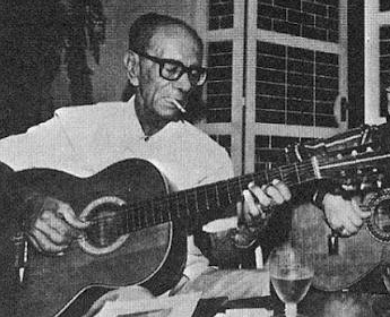
Jayme Thomás Florence, known as Meira (Paudalho, Pernambuco, October 1, 1909 — Rio de Janeiro, November 8, 1982), was a guitarist, composer, and teacher whose activity was decisive in the history of choro (the traditional Brazilian instrumental genre that emerged in late 19th-century Rio de Janeiro), samba, and the regionais (the small accompanying ensembles typical of Brazilian radio, usually built around guitar, seven-string guitar, cavaquinho — a small four-string instrument akin to the ukulele —, pandeiro — the Brazilian tambourine —, and a lead instrument such as flute or mandolin). His trajectory ran through the major accompanying ensembles of Brazilian popular music, from the Regional de Benedito Lacerda to the Regional do Canhoto, in a historic partnership with Dino Sete Cordas.
His importance to choro is tied to three dimensions that rarely come together with such force in a single musician: the art of accompaniment; a catalog of compositions that remain in the Brazilian instrumental repertoire, particularly the choro Arranca Toco, also known as Primavera; and a teaching activity that shaped generations of guitarists, among them Baden Powell, Raphael Rabello, João de Aquino, and Maurício Carrilho. At this crossing of performance, creation, and transmission, Meira consolidated a model of Brazilian guitar whose influence still organizes the language of contemporary choro.
Training and Musical Context
Meira began his relationship with music while still in Pernambuco. His brother Robson was one of his first references on the guitar, offering him initial contact with the instrument and with the popular repertoire of the region. In Recife, he joined the ensemble Voz do Sertão, led by the mandolinist Luperce Miranda — a practical school for the young guitarist, tied to Brazilian instrumental music and to the world of the regionais.
In 1928, he moved to Rio de Janeiro. In the federal capital, he came close to central figures of the Brazilian guitar, among them João Pernambuco, and became part of the musical environment of Vila Isabel. He also performed at the Casa de Caboclo, a space linked to popular theater, samba, and Rio's urban music. This phase put Meira in direct contact with the network of musicians, composers, and settings that sustained choro in the city at the end of the 1920s and the beginning of the 1930s.
From the 1930s onward, he began working professionally in Rio de Janeiro. In 1937, he joined the Regional de Benedito Lacerda, one of the most important accompanying ensembles in Brazilian popular music. The lineup brought together Benedito Lacerda on flute, Canhoto on cavaquinho, Dino on seven-string guitar, and Meira on six-string guitar. The group accompanied singers, soloists, and recording sessions during a period of intense activity for radio and the recording industry.
After Benedito Lacerda's departure, the ensemble became known as the Regional do Canhoto. Meira remained in the group and consolidated his role as an accompanist, forming with Dino Sete Cordas one of the most important partnerships of the 20th-century Brazilian guitar: while Dino developed baixarias (the bass-line counter-melodies typical of Brazilian guitar accompaniment in choro) and counterpoint on the seven-string guitar, Meira sustained the harmonic and rhythmic foundation on the six-string, defining a sound that became a reference for choro accompaniment.
Musical Style
Meira's style is defined by the meeting of a mastery of accompaniment, harmonic clarity, and a compositional voice rooted in the genres of urban popular music. Some of his most characteristic traits are:
Accompaniment as craft: This is the central mark of Meira's language. In choro, the accompanying guitarist must know the melody, anticipate modulations, sustain the rhythm, and dialogue with the cavaquinho, the pandeiro, the flute, the mandolin, or the voice. Meira commanded that function with absolute security, turning accompaniment into a sophisticated musical practice.
Harmonic language: Harmony is the structural axis of his work. Meira mastered the tonal vocabulary of choro and samba — secondary dominants, modulations, extended cadences — with a sense of harmonic motion that let him support soloists in any key, transpose at sight, and anticipate harmonic paths.
Rhythm and syncopation: Rhythmic precision was another pillar of his practice. In the accompaniment of the regionais, Meira sustained the swing of choro and samba with regularity and nuance, articulating the rhythmic cells typical of the genre without metronomic rigidity, always in dialogue with the pandeiro and the cavaquinho.
Dialogue with the seven-string: His partnership with Dino Sete Cordas illustrates the collective dimension of his language. While Dino developed baixarias, counter-melodies, and melodic responses on the seven-string guitar, Meira sustained the harmonic and rhythmic structure on the six-string, in a division of roles that became a paradigm for later generations of accompanists.
Instrumentation and texture: Although historically remembered for the six-string guitar, Meira also played cavaquinho and mandolin, and worked as a solo guitarist. This broader instrumental range fed his understanding of the ensemble: he knew each of the voices of the regional from the inside, which translated into greater sensitivity in accompaniment.
Typical forms: His compositional output articulates choros, sambas, sambas-canção (a slower, more lyrical form of samba), valsas, baiões (a rhythm and dance form from Northeastern Brazil), and batucadas (percussion-driven pieces rooted in Afro-Brazilian rhythmic practice), with structures close to those adopted by the Rio choro tradition and by the urban popular music of the first half of the 20th century. Partnerships with Augusto Mesquita, Dino, Canhoto, Leonel Azevedo, and Altamiro Carrilho make up an important part of that catalog.
Innovations and distinctive aspects: Meira's most singular contribution lies in the way he affirmed the six-string guitar as a fully organizing voice within the regional, alongside the seven-string. Rather than being a mere foundation, the guitar in his hands was direction, anticipation, response, and support — a practice that became a pedagogical model and shaped how the instrument came to be taught and heard within choro.
Important Works
Below is a selection of compositions and partnerships representative of Meira's catalog, spanning choros, sambas, valsas, baiões, and batucadas:
| Title | Genre | Notes |
|---|---|---|
| Arranca Toco (also Primavera) | Choro | Meira's best-known piece; incorporated into the Brazilian instrumental repertoire, with multiple recordings over time. |
| Molambo | Samba-canção | Partnership with Augusto Mesquita; Meira's greatest success as a composer, with several recordings. |
| Minha Flauta de Prata | Choro | A work tied to the instrumental tradition of the regionais. |
| Aperto de Mão | Samba | Partnership with Dino and Augusto Mesquita. |
| Deixa pra Lá | Choro | Partnership with Augusto Mesquita. |
| Pra Me Esquecer | Samba | Partnership with Augusto Mesquita. |
| Prêmio de Consolação | Samba | Partnership with Augusto Mesquita. |
| Quando a Saudade Apertar | Valsa | Partnership with Leonel Azevedo. |
| Teco-Teco | Baião | Partnership with Canhoto. |
| Viagem à Lua | Batucada | Partnership with Altamiro Carrilho. |
Musical Example
Arranca Toco, also known as Primavera, is the most useful piece for introducing the listener to Meira's work as a composer. A choro in a traditional structure, it became part of the Brazilian instrumental repertoire and received different recordings over time. Attentive listening reveals the harmonic vocabulary, the shaping of the melodic line, and the sense of rhythmic swing that characterize Meira's language.
To hear Meira as an accompanist — the central dimension of his contribution — the path is through the recordings of the Regional de Benedito Lacerda and the Regional do Canhoto, in which his partnership with Dino Sete Cordas is most audibly at work. In these recordings, Meira's six-string guitar sustains the harmonic and rhythmic foundation while Dino articulates the baixarias, revealing a division of roles that became a paradigm for accompaniment in choro.
Influences and Connections
Influences on Meira:
- Robson Florence — Brother and one of his first references on the guitar, in the early Pernambuco years.
- Luperce Miranda — Pernambuco mandolinist who led the ensemble Voz do Sertão, in which Meira played in Recife. One of the main practical schools of his early career.
- João Pernambuco — Central reference of the Brazilian guitar, to whom Meira grew close in his first years in Rio de Janeiro.
- The tradition of the regionais — The world of accompanying ensembles, of radio, and of the recording industry in 1930s Rio provided the practical horizon in which Meira built his language.
Dialogues and partnerships:
- Dino Sete Cordas — Historic partner in the Regional de Benedito Lacerda and the Regional do Canhoto. The Meira–Dino pairing is one of the most important references of accompaniment guitar in Brazilian choro.
- Benedito Lacerda — Flutist and composer, leader of the regional Meira joined in 1937.
- Canhoto — Cavaquinho player with whom Meira shared, for many years, the rhythmic-harmonic foundation of the regionais, first under Benedito Lacerda's leadership and later in the ensemble that came to be known as the Regional do Canhoto. Co-author of Teco-Teco.
- Augusto Mesquita — His main compositional partner, co-author of Molambo, Aperto de Mão, Deixa pra Lá, Pra Me Esquecer, and Prêmio de Consolação.
- Altamiro Carrilho, Leonel Azevedo — Partners on specific compositions, extending his network of collaborations in the world of choro and Brazilian instrumental music.
Students and successors:
- Baden Powell — One of Meira's most celebrated students, whose guitar language became an international reference.
- Raphael Rabello — Student from the age of twelve, who would go on to reinvent the seven-string guitar in the 1980s.
- João de Aquino, Maurício Carrilho — Guitarists whose training passed through Meira, and who would become central names of choro and Brazilian instrumental music in the following generations.
Legacy
Meira occupies a position of reference in the history of Brazilian choro. His work as an accompanying guitarist helped establish that role as a sophisticated and essential musical practice — not as a passive foundation, but as active listening, harmonic direction, and constant dialogue with the other instruments of the regional.
Alongside musicians such as Canhoto and Dino Sete Cordas, he took part in an ensemble that shaped the history of the regionais and defined standards of accompaniment that influenced later generations of guitarists. The Meira–Dino pairing, with their six- and seven-string guitars in dialogue, became a model of how to articulate complementary functions within the ensemble — a reference still studied by musicians devoted to choro.
As a composer, he left works that remain in the repertoire of Brazilian popular music. Arranca Toco is the most remembered among them, but Molambo, Minha Flauta de Prata, and the set of partnerships with Augusto Mesquita reveal a varied catalog that crosses choros, sambas, valsas, baiões, and batucadas.
The pedagogical dimension of his trajectory further extends the reach of his legacy. By training Baden Powell, Raphael Rabello, João de Aquino, and Maurício Carrilho, among others, Meira contributed to the continuity and renewal of the language of the guitar in choro and in Brazilian popular music. Each of these students followed his own path, but all carry the mark of a solid formation in technique, reading, repertoire, accompaniment practice, transposition, and harmonic understanding.
Meira remains a reference for the study of accompaniment, of regional practice, and of the formation of the Brazilian guitar in the 20th century. His work shows that the greatness of a musician may be measured not only by the brilliance of the solo, but by the solidity of what he offers to those playing beside him.
Reference Recordings
The most audible dimension of Meira's work is found in the recordings he made with the regionais in which he played, alongside soloists and singers from radio and disc. In addition, his compositions — especially Arranca Toco and Molambo — received multiple recordings over time:
- Recordings by the Regional de Benedito Lacerda (from 1937 onward), with Benedito Lacerda, Canhoto, Dino Sete Cordas, and Meira.
- Recordings by the Regional do Canhoto, the successor formation, with Meira and Dino Sete Cordas on the guitar foundation.
- Recordings of Arranca Toco / Primavera, incorporated into the Brazilian instrumental repertoire by different performers over time.
- Recordings of Molambo, one of the most remembered sambas-canção in Meira's output, in partnership with Augusto Mesquita.
Sources
The following sources are relevant to the study of Meira and the musical context in which he worked:
- Instituto Casa do Choro. Entry "Meira." — Central documentation on his life, work, and trajectory, with biographical, discographic, and institutional data.
- Cravo Albin Dictionary of Brazilian Popular Music. Entry "Meira / Jayme Thomás Florence." — Reference biographical and discographic entry, with a list of works, recordings, and partnerships.
- Instituto Moreira Salles / Discografia Brasileira. — Reference for phonographic records of the Regional de Benedito Lacerda, the Regional do Canhoto, and the recordings of works associated with Meira.
Suggested course
Move from editorial context into guided study with synchronized score and structured steps.
All courses
Browse the public course catalog connected to the content hubs.