Choropedia
K-Ximbinho: A Innovator of Brazilian Choro
K-Ximbinho was a clarinetist and composer who blended jazz with Brazilian choro.
Introduction
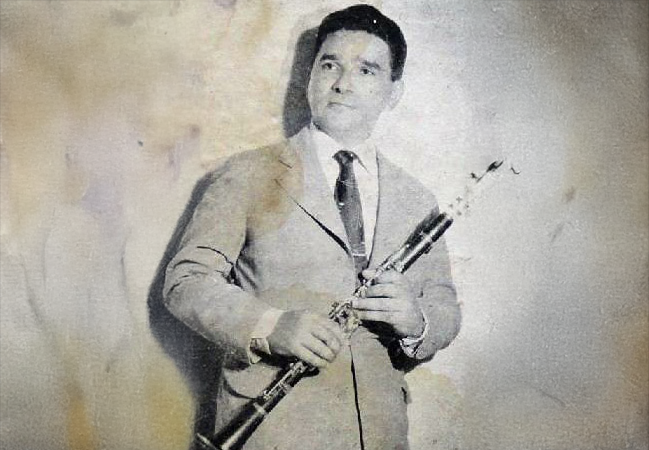
Sebastião de Barros, known artistically as K-Ximbinho (Taipu, RN, 20 January 1917 – Rio de Janeiro, RJ, 26 June 1980), was a clarinettist, saxophonist, composer, arranger, and conductor who occupies a singular place in the history of Brazilian choro. His name is linked to a generation of instrumentalists who expanded the genre's vocabulary without breaking with its identity, bringing choro closer to the harmonic and timbral language of urban orchestras and jazz.
More than a wind virtuoso, K-Ximbinho was a composer of very distinctive personality. The maestro Paulo Moura described him as "the most original among the instrumentalists who dedicated themselves to the urban popular orchestra" — a formulation that captures his position well: he was not merely a great soloist, but an author who helped expand the expressive field of Brazilian instrumental music.
Training and Musical Context
K-Ximbinho began his studies in clarinet and music theory as a child, in contact with the band of his hometown. Later, already in Natal, he joined the band of the Associação dos Escoteiros do Alecrim and took part in a student jazz group called Pan Jazz. This detail is decisive for understanding his work: from early on, his formation was not confined to a single tradition, but was built at the intersection of band music, urban popular music, and jazz repertoire.
During military service he moved to the saxophone, an instrument that helped give rise to the nickname by which he would become known. In 1938 he joined the Orquestra Tabajara, a decisive experience in his career. His time with the Tabajara — first in João Pessoa and then in Rio de Janeiro — brought him into direct contact with the musical world of the great popular orchestras and with musicians who moved between dances, radio, recording studios, and concert halls. He later performed with the orchestras of Fon-Fon and Napoleão Tavares, returned to the Tabajara as lead saxophonist, worked at Rádio Nacional, and consolidated a career deeply linked to the orchestral world.
Between 1951 and 1954 he studied harmony and counterpoint with Hans-Joachim Koellreutter, which helps to explain the growing sophistication of his writing. This should not be read as a break with choro, but as the technical deepening of an already experienced musician who began to deploy with greater awareness the resources of harmonization, voice-leading, and orchestration. In the following decade he worked as an arranger at Odeon and then at Polydor, and later joined the Orquestra Sinfônica Nacional da Rádio MEC and the orchestra of TV Globo, confirming a career of remarkable professional versatility.
Musical Style
K-Ximbinho's place in choro is linked above all to the way in which he reconciled two tendencies that are often treated as opposites: on one side, the melodic, rhythmic, and formal tradition of choro; on the other, harmonic and phraseological procedures associated with jazz and the modern orchestras. Academic studies of his work show that his compositions range from choros of more traditional character, such as Sonoroso and Sonhando, to others of a more openly jazz-inflected sensibility, such as Catita.
Synthesis of choro and jazz: this reconciliation does not produce a new genre, nor does it dissolve choro into something else. It is precisely because K-Ximbinho preserves the intelligibility of choro while absorbing new harmonic and timbral possibilities that his work became so influential. Rather than undermining the genre, he showed that choro could renew itself from within, without losing its pulse, its singability, or its instrumental logic.
A double profile: sources describe him simultaneously as a widely respected chorão and as a jazz practitioner at a time when jazz was still little performed in Brazil. K-Ximbinho belongs not only to the lineage of great clarinettists and saxophonists, but to that of the composers who succeeded in repositioning choro in dialogue with the musical modernity of the twentieth century.
Key Works
| Title | Notes |
|---|---|
| Sonoroso | His first recorded composition, written in collaboration with Del Loro and released by the Orquestra Tabajara in 1946. It became a classic of the genre. |
| Sonhando | Also written in collaboration with Del Loro; established itself as a work of enduring circulation among performers and in rodas de choro. |
| Sempre | Another work with stable circulation in the Brazilian instrumental repertoire. |
| Catita | Frequently cited as an example of his most harmonically and idiomatically adventurous side; an explicit dialogue with jazz. |
| Perplexo · Tudo Passa | Recorded by K-Ximbinho as clarinet soloist during the 1950s. |
| Ternura · Teleguiado · Eu Quero é Sossego · Velhos Companheiros | Works that complete the portrait of a composer of expressive output and highly personal style. |
| Manda Brasa | Winner of the choro competition promoted by TV Bandeirantes in 1978; identified as his final composition. |
A Listening Guide
Sonoroso is the most natural entry point into K-Ximbinho's work. Already present in it are the features that would define his language: a melody of strong identity, a harmony denser than traditional choro permitted, and an ensemble treatment that reveals the composer's orchestral experience. It is a piece that sounds simultaneously familiar and surprising — a good summary of the balance between tradition and invention that marks his entire output.
For the more adventurous side of K-Ximbinho, Catita provides the necessary contrast. There the jazz language appears in more explicit form, without the piece ceasing to be recognizable as choro. The two titles together show the breadth of a body of work that is not defined by a single position, but by a conscious movement between different musical vocabularies.
Influences and Relationships
Formation and context:
- Associação dos Escoteiros do Alecrim and Pan Jazz — Formative experiences in Natal that established, from an early stage, K-Ximbinho's dual attachment to the band tradition and to jazz repertoire.
- Orquestra Tabajara — Joined in 1938; a decisive environment for contact with the great popular orchestras and with the professional circuit of dances, radio, and recording.
- Hans-Joachim Koellreutter — With whom he studied harmony and counterpoint between 1951 and 1954, deepening the technical resources that would underpin his more elaborated writing.
Professional and artistic relationships:
- Del Loro — Collaborator on Sonoroso and Sonhando, two of the most enduring titles in his catalogue.
- Paulo Moura — Musician and conductor who described him as "the most original among the instrumentalists who dedicated themselves to the urban popular orchestra" — a judgement that became a reference point in assessments of his legacy.
- Rafael Rabello, Paulo Sérgio Santos, Zé Bodega — Performers who took part in the LP Saudades de um Clarinete (1980), recorded with arrangements by K-Ximbinho himself and released in the year of his death.
Legacy
The legacy of K-Ximbinho in choro operates on two levels.
On one side, he left compositions that have entered the Brazilian instrumental repertoire on a stable footing. Sonoroso, Sonhando, Catita, and Sempre are pieces that performers continue to play not out of historical obligation, but because they work musically — and because they carry a voice that cannot be mistaken for any other.
On the other, he showed that choro could engage with a denser harmonic language, with new instrumental formations, and with the experience of the great orchestras, without losing its character. In this sense, K-Ximbinho is less an exception than a point of inflection: a musician who revealed, with rare clarity, how tradition and invention can coexist within choro itself.
The LP Saudades de um Clarinete (1980) captures this trajectory well. Released in the year of his death, with arrangements by the composer himself and performers from the new generation of choro, it functions as a late synthesis of an author who remained creative until the end of his life.
Sources
- Dicionário Cravo Albin da Música Popular Brasileira — Entry "K-Ximbinho." Primary source for biographical data, professional trajectory, works catalogue, and Paulo Moura's critical assessment.
- Instituto Casa do Choro — Entry and score catalogue for K-Ximbinho. Central source for the assessment of his profile as chorão and jazz musician and for repertoire preservation.
- Discografia Brasileira / Instituto Moreira Salles — Artist K-Ximbinho and phonogram "Molambo" (Odeon, 1956). Reference for his activity in the phonographic market.
- Rádio Batuta / Instituto Moreira Salles — Programme on K-Ximbinho with reference to Paulo Moura's critical judgement.
- GEUS, José Reis de. "A performance do choro-jazzístico de K-Ximbinho" [The Performance of K-Ximbinho's Jazz-Inflected Choro]. ANPPOM, 2006. — Academic study of K-Ximbinho's interpretive and compositional style, with analysis of the synthesis between choro and jazz.
- FABRIS, Bernardo Vescovi. Catita de K-Ximbinho e a interpretação do saxofonista Zé Bodega: aspectos híbridos entre o choro e o jazz [K-Ximbinho's Catita and the Interpretation of Saxophonist Zé Bodega: Hybrid Aspects between Choro and Jazz]. UFMG, 2005. — Specific analysis of Catita as an example of the dialogue between choro and jazz in his work.
Suggested course
Move from editorial context into guided study with synchronized score and structured steps.
All courses
Browse the public course catalog connected to the content hubs.