Choropedia
Joaquim Antonio Callado - Choro Pioneer
Explore Joaquim Antonio Callado's impact on choro music and his contributions as a flautist and composer.
Introduction
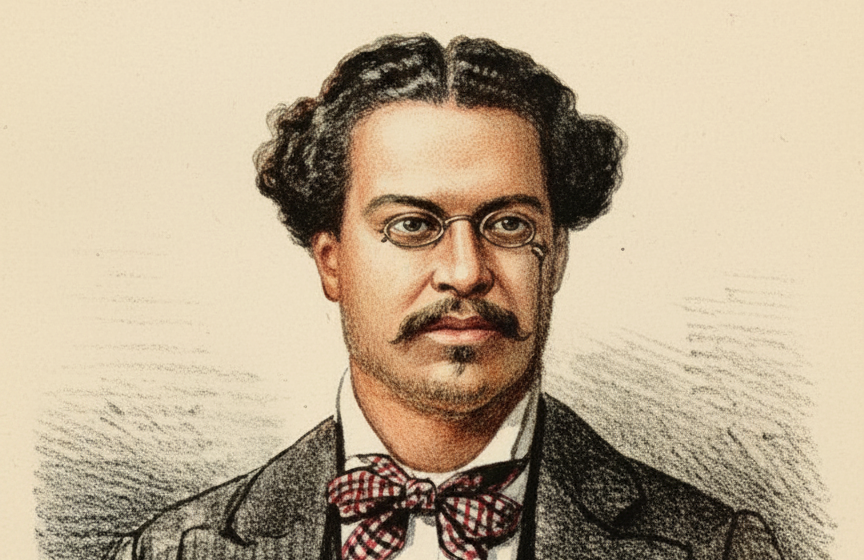
Joaquim Antonio da Silva Callado (Rio de Janeiro, June 11, 1848 – Rio de Janeiro, March 20, 1880) was a Brazilian flautist, composer, and teacher, recognized as one of the founders of choro. In just over three decades of life, Callado made a decisive contribution to the formation of the genre: he organized and led one of the first ensembles systematically dedicated to the repertoire that would come to be called choro, establishing an instrumental formation and a style of playing that would influence the entire following generation.
His importance to the choro tradition goes beyond his compositions. Callado was the first great organizer of choro as an organized collective practice — bringing musicians together, defining repertoire, and creating the ensemble model that would be refined by Chiquinha Gonzaga, Ernesto Nazareth, and later by Chiquinho do Acordeon, Jacob do Bandolim, and many others. He died at the age of 31, leaving behind a brief yet historically invaluable body of work.
Education and Musical Context
Born in Rio de Janeiro, Callado showed early musical talent and received solid training in the institutional environment of the imperial capital. He studied at the Conservatory of Music of Rio de Janeiro — now the School of Music of UFRJ — where he would later become a flute teacher, achieving a virtuosic level recognized by his contemporaries.
Mid-19th century Rio de Janeiro was a complex musical city. The imperial court supported a European-style operatic and concert life, with predominant Italian influences. At the same time, in the streets, parties, and gatherings of the popular classes and the emerging urban middle class, polkas, mazurkas, lundus, and habaneras circulated — imported genres that, when filtered through Afro-Brazilian musicality, gained new rhythmic and expressive forms. Callado grew up and trained precisely at this crossroads: an institutionally trained musician who immersed himself in the informal environment of popular carioca festivities.
It was in this context that Callado formed his ensemble, the Choro Carioca — also referred to as Callado's choro — gathering instruments that would become canonical in the tradition: flute, guitar, cavaquinho, and later, the pandeiro. This formation, while interpreting the dance genres of the time with the characteristic syncopated flavor, was the seed of what the 20th century would call choro.
Musical Style
Joaquim Callado's style reflects the creative tension of his time: formally trained as a musician, he operated within the forms and genres of European salon music, but his daily practice in choros and popular parties imprinted a rhythmic groove and expressive freedom on this music that transcended the original model.
Melodic language: Above all, Callado was a virtuoso flautist, and his melodic writing reflects this mastery of the instrument. The lines are fluid, ornamented, with frequent use of passing chromatics — characteristics that would be inherited by the flautistic tradition of choro, from Patápio Silva to Altamiro Carrilho.
Harmonic language: Callado's harmony is rooted in the European tonality of the period — predominantly diatonic, with direct modulations to the relative and dominant. While it lacks the harmonic sophistication of Nazareth, it has functional clarity and effectiveness in supporting the dances he composed.
Rhythm and syncopation: The rhythmic element is central to his work. Callado was one of the first composers to systematize in writing the syncopated pattern that carioca popular musicians applied intuitively to European genres — especially the polka. This syncopation, characteristic of the lundu and Afro-Brazilian music, would be the rhythmic germ of choro.
Instrumentation and formation: His compositions were designed for the choro ensemble he led himself: solo flute over a harmonic-rhythmic support of guitar and cavaquinho. This texture — melody in a wind or high-string instrument, over guitar accompaniment — would define the sound of choro for over a century.
Typical forms: Callado primarily composed polkas and lundus, along with a few waltzes and pieces of various character. The forms are binary, with repeated sections and a trio in the relative or subdominant key — the same mold inherited by subsequent generations of choro.
Innovations and distinctive aspects: Callado's greatest innovation was not harmonic or melodic, but organizational and social: he was the first to systematically gather musicians around a syncopated repertoire and present them as a cohesive ensemble, giving choro an identity as a collective musical practice that remains to this day.
Important Works
Callado's production is relatively reduced in volume — a reflection of his short life — but several of his pieces circulated widely during his time and left a mark on the tradition:
| Title | Genre | Notes |
|---|---|---|
| Querida por Todos | Polka | One of the pieces most associated with his name; exemplifies the syncopated style defining his ensemble. |
| Flor Amorosa | Polka | Became one of the best-known pieces in the choro repertoire of the 19th century; frequently performed to this day. |
| Bom Cabelo | Lundu | Example of his production in the Afro-Brazilian genre, with a more popular and rhythmic character. |
| Inexplicável | Polka | Festive piece, representative of his style more in line with the environment of gatherings. |
Musical Example
"Flor Amorosa" is Callado's composition with the most presence in the modern choro repertoire and offers a good window into his style. When listening to it, one should observe how the melody of the flute — or of any instrument taking the solo role — describes fluid, ornamented lines over a constant rhythmic accompaniment. The syncopation appears naturally, unforced, as if it were inherent to the music — exactly how carioca popular musicians transformed European genres into something genuinely Brazilian. The simple binary form, with repetitions and trio, serves as the structural skeleton that subsequent choro would inherit almost unchanged.
Influences and Relationships
Influences on Callado:
- European flautistic tradition — Training at the Conservatory exposed Callado to 19th-century European flute repertoire, a technical base for his instrumental writing.
- Polka and salon music — The popular dance genres of Europe at the time were the raw material he worked with.
- Afro-Brazilian music and the lundu — The lundu and the rhythmic practices of African origin provided the syncopated element that differentiated the playing of chorões from simple European playing.
- Environment of carioca gatherings — Daily interactions with popular musicians, many of African or mixed heritage, were crucial in shaping his musical language.
Musicians and traditions influenced by Callado:
- Chiquinha Gonzaga — Participated in Callado's ensemble and directly absorbed his way of organizing and playing choro, continuing this tradition with her own creative autonomy.
- Ernesto Nazareth — Although a pianist with distinct training, Nazareth drew from the musical environment that Callado helped create, especially regarding the systematization of syncopation.
- Flautistic tradition of choro — The centrality of the flute in choro owes much to the model established by Callado; flautists like Patápio Silva and later Benedito Lacerda and Altamiro Carrilho are direct heirs of this lineage.
- Instrumental formation of choro — The ensemble that Callado organized — flute, guitar, cavaquinho — established the basic model of choro instrumentation that has persisted with variations to the present.
Circulation context:
- Callado primarily performed in gatherings, domestic parties, and social events of the elite and the carioca middle class, environments where emerging choro found its first regular audience.
- As a teacher at the Conservatory of Music, he also moved within the institutional environment of classical music, occupying a unique position between the two worlds.
Legacy
The legacy of Joaquim Callado is, paradoxically, both immense and invisible. Immense because without him — without the ensemble he organized, without the repertoire he gathered, without the model of collective performance he established — choro as a genre and musical practice might not have taken the form it has. Invisible because his premature death at 31 years prevented his work from growing in volume and from his name becoming as established as contemporaries like Chiquinha Gonzaga or successors like Ernesto Nazareth.
In the historiography of Brazilian music, Callado is recognized as one of the founding figures of choro — alongside Chiquinha Gonzaga, Joaquim Benedito Calado, and other musicians of his generation. Researchers such as José Ramos Tinhorão and Ary Vasconcelos have documented his importance in the formation of the genre, placing him in the role of organizer and catalyst of a musical practice that was being born.
In the modern choro repertoire, "Flor Amorosa" remains his most performed piece, a constant presence in choro circles and recordings. It serves as a living bridge between the choro of its origins and that of today — a sound legacy that has survived the brevity of its creator's life.
Sources
The following sources are relevant for studying Joaquim Antonio Callado and the musical context in which he operated:
- TINHORÃO, José Ramos. História Social da Música Popular Brasileira. Editora 34, 1998. — Fundamental reference for the historical and social context of emerging choro and Callado's role in its formation.
- TINHORÃO, José Ramos. Música Popular: Um Tema em Debate. Editora 34, 1997. — Critical analysis of urban popular music in Brazil in the 19th century.
- VASCONCELOS, Ary. Raízes da Música Popular Brasileira. Rio de Janeiro: Rio Fundo Ed., 1991. — Study on the origins of choro and its first protagonists, with references to Callado.
- CAZES, Henrique. Choro: do Quintal ao Municipal. São Paulo: Editora 34, 1998. — Indispensable reference work detailing the evolution of choro from its origins, extensively addressing Joaquim Callado's role in consolidating the "terno de pau-e-corda" and the choro circle.
- TABORDA, Marcia E. "As Abordagens Estilísticas no Choro Brasileiro (1902–1950)". Historia Actual Online, 2010. — Provides valuable analysis of the historiography of choro and the impact of the "Choro Carioca" formation led by Callado in the late 19th century.
- Encyclopedia of Brazilian Music (Art Editora / Publifolha) — Biographical and historical entries on the composer and the context of 19th-century choro.
- National Library of Brazil Archive (Rio de Janeiro) — Sheet music and documentation from the imperial period, including Callado's works.
Note: Callado's output is partially preserved in 19th-century sheet music collections. For primary research, it is recommended to consult the National Library of Brazil's archive and the records of the School of Music of UFRJ, the institution that inherited the Conservatory where Callado taught.
Suggested course
Move from editorial context into guided study with synchronized score and structured steps.
All courses
Browse the public course catalog connected to the content hubs.