Choropedia
João Lyra: Brazilian Guitarist and Composer
Discover João Lyra, a key figure in the renewal of choro and a prolific Brazilian guitarist and composer.
Introduction
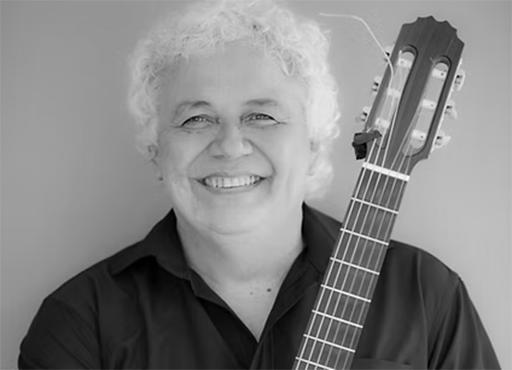
João Pinheiro de Andrade Lyra Filho, known as João Lyra (São José da Laje, Alagoas, April 26, 1949), is a Brazilian guitarist, composer, arranger, and music producer. His trajectory unfolds between the Northeastern instrumental tradition, Rio's choro (the traditional Brazilian instrumental genre that emerged in late 19th-century Rio de Janeiro), and the professional activity of the studios of Brazilian popular music, with decisive stages in Maceió, Recife, and Rio de Janeiro.
His importance to choro is tied to three complementary dimensions. The first is his activity as instrumentalist and arranger in groups fundamental to the renewal of the genre, such as the Camerata Carioca, the Orquestra de Cordas Dedilhadas de Pernambuco, and the duo with the pianist Cristovão Bastos. The second is an extensive compositional output, recorded by artists and groups such as Sivuca, Spok Frevo Orquestra, João Camarero, Nicolas Krassik, and Gabriel Grossi, with works that cross choro, frevo (a fast Pernambuco carnival dance genre), forró (a Northeastern Brazilian dance music genre), and song. The third is his conception of the Brazilian guitar as a matrix open to dialogue with Northeastern music — a conception that widens the history of choro beyond the Rio axis and helps acknowledge the contribution of Recife, Maceió, and other cities to the renewal of the genre.
Training and Musical Context
João Lyra's musical apprenticeship began at home. His mother played cavaquinho (a small four-string instrument akin to the ukulele), and his older brother was the one who introduced him to the guitar, the instrument that would become the center of his professional life. In Maceió, he took part in popular music ensembles, keeping close mainly to choro and bossa nova, and also played in rock groups — an experience that widened his contact with repertoires, sonorities, and forms of musical organization quite different from one another. From the beginning, his formation crossed the music transmitted in the family environment, the urban groups of Maceió, the radio repertoire, and the instrumental languages that were reaching the Northeast. Choro was one of his foundations, but never worked as a closed border.
He later moved to Recife, where he studied music at the Universidade Federal de Pernambuco and classical guitar with the professor José Carrion. The contact with formal study provided a technical structure that came to coexist with the practical experience accumulated in popular groups. He became a teacher at the Conservatório Pernambucano de Música, an institution in which he worked for nine years, and joined the Orquestra de Cordas Dedilhadas de Pernambuco (the Pernambuco Plucked-String Orchestra) as instrumentalist, arranger, and composer. Created in an environment of intense valuing of the plucked-string instruments, the orchestra gathered musicians tied to choro, frevo, forró, and concert music, and recorded compositions of his such as Pedra Terra, Adeus Dedilhadas, Mas Sim, Aí..., Arruado, Pauleando, and Triunfando. During the Recife period, he also took part in more than a thousand recordings by local artists — a studio activity decisive for his formation, which demanded quick reading, adaptation to different repertoires, mastery of accompaniment, and the ability to understand the function of the guitar within each arrangement.
While still living in Recife, he was invited by Maurício Carrilho to join the Camerata Carioca, one of the most important chapters in the renewal of Brazilian choro from the end of the 1970s. Alongside musicians such as Joel Nascimento, Maurício Carrilho, Luís Otávio Braga, Henrique Cazes, Paulo Sérgio Santos, and Beto Cazes, he took part in performances in Rio de Janeiro and in the United States. The Camerata worked the choro repertoire with special attention to arrangements, to writing for string ensembles, and to the integration between popular tradition and musical formation — and, for João Lyra, established a direct bridge between the instrumental scene of Pernambuco and the musicians who were reorganizing choro in Rio de Janeiro. In that period, he made international trips and took part in performances in Japan with artists and ensembles such as Elizeth Cardoso, Zimbo Trio, and Choro Carioca, and recorded in the United States with Joel Nascimento and the Sexteto Brasileiro.
For about six years, he also played in the band of Sivuca, touring Europe and taking part in two of his albums. The affinity between the two musicians was not limited to their shared regional origin: both treated forró, frevo, baião (a rhythm and dance form from Northeastern Brazil), and choro as languages open to arrangement, improvisation, and dialogue with other traditions. In 1993, João Lyra settled in Rio de Janeiro. In the city, he joined Nana Caymmi's band, widened his activity as a studio instrumentalist, arranger, and accompanist, and took part in recordings by artists such as Gal Costa, Gilberto Gil, Caetano Veloso, Chico Buarque, Djavan, Ivan Lins, Elba Ramalho, Zé Ramalho, Alceu Valença, Fagner, Maria Bethânia, João Bosco, Martinho da Vila, Zeca Pagodinho, Ney Matogrosso, Milton Nascimento, Dominguinhos, and Altamiro Carrilho, among many others. He also collaborated on different volumes of the songbooks of the Lumiar label, projects that demanded stylistic precision and deep harmonic knowledge.
Musical Style
João Lyra's style is defined by the intersection of the study of the classical guitar, the experience of the studio, the vocabulary of instrumental choro, and the vast rhythmic field of Northeastern music. Some of his most characteristic traits are:
The Northeast as structure: This is the central mark of João Lyra's language. In his compositions and arrangements, the Northeast does not appear only as theme, accent, or ornament — it lies in the rhythmic structure, in the melodic contours, in the choice of instruments, and in the way of organizing accompaniment. A choro may carry the accents of frevo; a Northeastern piece may present a harmonic motion associated with the regional (the traditional choro ensemble); a baião may open space for counter-melodic lines inherited from chamber writing.
Melodic language: The melodies work with the singable design typical of instrumental choro, widened by inflections from baião, xote (a Northeastern Brazilian dance form derived from the schottisch), forró, frevo, maracatu (an Afro-Brazilian ceremonial music tradition from Pernambuco), caboclinho (a Pernambuco carnival tradition with indigenous roots), and other forms. There is a taste for the long line, for idiomatic guitar passages, and for the dialogue between melody and ornamentation. Even the seemingly simple pieces are usually sustained by modulations and inner motion carefully planned.
Harmonic language: The harmony is clear, functional, and treated with the precision of an arranger. Substitutions, chromaticism, modulations, and reharmonizations appear without ostentation, always in service of the musical motion. The experience with the Lumiar songbooks and with studio work widened his vocabulary and his capacity to organize harmonic paths in any context.
Rhythm and syncopation: The pulse characteristic of choro combines with the rhythmic richness of Northeastern music — syncopations, displaced accents, characteristic cells of baião and frevo, dialogue between tension and resolution. This multiple rhythmic fluency is one of his most immediately recognizable marks.
The guitar as collective instrument: Even when it takes the solo position, João Lyra's playing keeps a clear awareness of the other voices. There is room for the bass, for the melodic response, for the percussion, and for silence. It is a music built less on the isolated display of the instrumentalist and more on the conversation among the participants — a trait that makes him a guitarist especially valued in accompaniment and in the studio.
Instrumentation: His output moves between solo guitar, the duo (with piano, with other guitars), the small ensemble, the plucked-string orchestra, and the formations of Brazilian song. He also plays viola (the Brazilian folk guitar, distinct from the European viola) and bass, widening the sonic possibilities in his own works.
Typical forms: The catalog articulates choros, frevos, baiões, xotes, forrós, songs, sambas, and the recently coined genre of the varandão — a kind of slow, contemplative choro, marked by the valuing of melody and developed in the duo with Cristovão Bastos.
Innovations and distinctive aspects: João Lyra's most singular contribution lies in the way he affirms the Brazilian guitar as a matrix open to dialogue with Northeastern music. His work shows that the history of choro is not organized only by closed geographical axes, and that the genre is renewed precisely when it opens itself to conversation with other traditions — provided that conversation happens in structure, not in ornament.
Important Works
Below is a selection of compositions representative of João Lyra's catalog, spanning choros, tributes, and partnerships:
| Title | Partnership or reference | Notes |
|---|---|---|
| Seu Rafa | Tribute to Raphael Rabello | Piece included on the album Tocador (2014). |
| Coringuinha | Tribute to Canhoto da Paraíba | Dedicated to the guitarist from Paraíba. |
| Dom Bastos de Marechal | Tribute to Cristovão Bastos | A portrait-piece of the pianist partner. |
| Tem Animal na Varanda | Dedicated to Maurício Carrilho | Records the long friendship and musical partnership. |
| Do João pra Pernambuco | Tribute to João Pernambuco | Dialogue between the heritage of the Brazilian guitar and the Northeastern matrix. |
| Pedra Terra | With Nilton Rangel | Recorded by the Orquestra de Cordas Dedilhadas de Pernambuco. |
| Mas Sim, Aí... | With Marco César | Recorded by the Orquestra de Cordas Dedilhadas de Pernambuco. |
| Triunfando | With Marco César | Recorded by the Orquestra de Cordas Dedilhadas de Pernambuco. |
| Riacho Seco | With Maurício Carrilho | Included on Sivuca's album Pau Doido (1992). |
| Caçuá | With Maurício Carrilho | One of the composer's substantial partnerships. |
| Alumiando | With Maurício Carrilho | A recurring compositional partnership. |
| Passo de Anjo | With Spok | Dialogue with the language of frevo. |
| Três Histórias | With Ivanildo Maciel | Narrative piece. |
| Pau Doido | Own composition | Title track of Sivuca's 1992 album. |
| Forró na Penha | With Adelmo Arcoverde | Also included on Pau Doido. |
| No Quintal do Matuto | Own composition | Part of the contemporary Brazilian instrumental repertoire. |
| Varandão 1–10 | With Cristovão Bastos | Cycle of ten pieces that gives title and form to the album Varandão (2022). |
Musical Example
Seu Rafa is the most useful piece for introducing the listener to João Lyra as a composer and to his tie to the tradition of Brazilian choro. A tribute to Raphael Rabello, it is part of the album Tocador (2014) — a solo work in which masters, partners, family members, and companions appear transformed into melodies. Attentive listening reveals central traits of his language: the singable melodic construction, the clear harmonic motion, and the rhythmic swing anchored in choro, with points of contact with the Northeastern matrix that runs through all his work.
To hear João Lyra in his most developed duo, the path is the album Varandão (2022), with Cristovão Bastos. The ten pieces of the cycle define, through practice, the genre-concept of the varandão — a kind of slow, contemplative choro, marked by the valuing of melody and by the patient conversation between piano and guitar. To hear João in his most explicitly Northeastern side, Xoteando (2025) gathers forró, xote, and song, with the composer also taking on the voice.
Selected Discography
- Orquestra de Cordas Dedilhadas de Pernambuco, 1984. — Participation as musician and composer.
- Ao Capitão Furtado: Marvada Viola, 1986. — With Roberto Corrêa and Adelmo Arcoverde.
- Joel Nascimento and the Brazilian Sextet, Live!, 1990. — Recording made in the United States.
- Pau Doido, 1992. — Sivuca's album, with participation and three compositions by João Lyra: Pau Doido, Riacho Seco (with Maurício Carrilho), and Forró na Penha (with Adelmo Arcoverde).
- Tocador, 2014/2015. — First major solo work, initially released in Japan. Gathers ten original compositions with Luciana Rabello, João Camarero, Cristovão Bastos, Rui Alvim, Zé Canuto, Adelson Viana, Zé Leal, and Celsinho Silva.
- Varandão, with Cristovão Bastos, 2022. — Duo formed by ten pieces (Varandão 1 to Varandão 10) that define the genre-concept of the varandão.
- Xoteando, 2025. — EP dedicated to forró and Northeastern song, with João Lyra also as singer and violeiro (a player of the Brazilian viola).
Over the course of his career, he has taken part in more than a thousand recordings in Brazil and abroad, both as accompanist and as arranger and composer.
Sources
The following sources are relevant to the study of João Lyra and the musical context in which he works:
- Instituto Casa do Choro. Biographical entry, musical formation, professional activity, Camerata Carioca, work with Sivuca, and career in Rio de Janeiro. — Central documentation on his life, work, and trajectory.
- Cravo Albin Dictionary of Brazilian Popular Music. Entry "João Lyra." — Biographical entry with date of birth, formation, and first recordings.
- Discografia Brasileira (Discos do Brasil). Compositions, partnerships, and phonographic records.
- Instituto Moreira Salles / Rádio Batuta. Record of João Lyra's appearance on the program dedicated to João Camarero. — Reference for his presence in the contemporary choro scene.
- Revista Prosa, Verso e Arte. Information on the albums Varandão (2022) and Xoteando (2025). — Reference for the most recent works.
Suggested course
Move from editorial context into guided study with synchronized score and structured steps.
All courses
Browse the public course catalog connected to the content hubs.