Choropedia
Garoto: Pioneer of Brazilian Guitar
Discover Garoto, a key figure in 20th-century Brazilian music known for his innovative guitar techniques.
Introduction
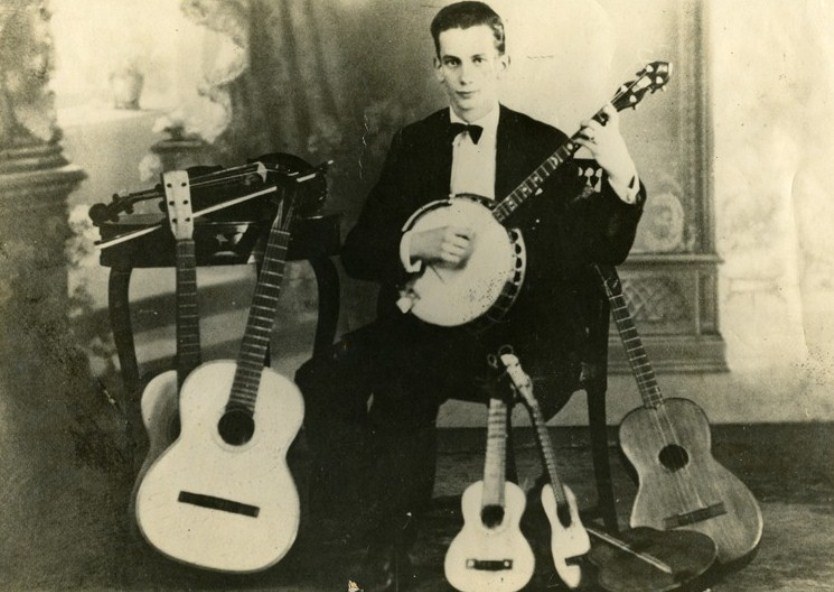
Aníbal Augusto Sardinha, known as Garoto (São Paulo, 28 June 1915 – Rio de Janeiro, 3 May 1955), was one of the most original musicians in twentieth-century Brazilian music. A guitarist, mandolinist, cavaquinho player, banjoist, arranger, and composer, he moved with rare ease between choro, popular song, jazz, radio music, and the most sophisticated instrumental writing. His work occupies a singular point in the history of Brazilian music: it is rooted in the choro tradition, yet points clearly towards the harmonic modernization of the Brazilian guitar (violão).
Few musicians combined so many fields of activity with such coherence. Garoto was a virtuoso on several string instruments, participated intensively in the musical life of radio, recorded as both soloist and accompanist, worked with Radamés Gnattali, was a member of the Trio Surdina, and left compositions that became reference points for subsequent generations. Regarded by many as the creator of the modern Brazilian guitar, he is described as one of the most versatile instrumentalists in the country's history.
His importance is not reducible to virtuosity. Garoto helped shift the expressive centre of the Brazilian guitar, expanding its harmonic vocabulary, its timbral reach, and its role as an instrument of invention. For that reason, his presence in the history of choro is double: he belongs to the tradition of the genre's great instrumentalists and, at the same time, functions as a bridge towards musical languages that would only become fully familiar years later.
Training and Musical Context
Garoto was born in São Paulo into a family of strong musical culture. The son of Portuguese immigrants, he was the first of the siblings to be born in Brazil. His father played the Portuguese guitar (guitarra portuguesa) and the violão, and the brothers were also drawn to string instruments. As a young boy he began working to help support the household, and soon approached the world of instruments — first out of practical curiosity, and then as a precocious musician. His first important instrument was the banjo, given to him by a brother, and by the age of eleven he was already performing with the Regional Irmãos Armani, earning the nickname Moleque do Banjo (the Banjo Kid).
His musical formation combined early practical experience with more systematic study. At eighteen he began formal classical guitar studies with Atílio Bernardini, and in 1937 he enrolled at the Conservatório Dramático e Musical de São Paulo to study harmony and composition. He also studied with João Sepe — which helps to explain why his writing and his touch reveal, from an early stage, a musician of broad musical awareness and above-average technique.
His professionalization intensified from 1931 onward, when he joined Rádio Educadora Paulista and shortly afterwards Rádio Cosmos. During the 1930s he also performed in duos, in regional ensembles, and alongside musicians such as Aimoré and Laurindo Almeida. The decisive turning point came in 1939, with the invitation to join the Bando da Lua for Carmen Miranda's season in the United States. This experience brought him into direct contact with the golden age of big bands, the electric guitar, and the first steps of bebop. Back in Brazil in 1940, he formed Garoto e seus Garotos, recorded discs, and integrated fully into the musical life of Rádio Nacional.
This trajectory makes Garoto a musician deeply connected to the Radio Era, but by no means confined by it. His career unfolds precisely at the moment when radio was reorganizing the professional work of instrumentalists, broadening the circulation of choro and popular song, and demanding musicians capable of playing fluently across diverse repertoires. Garoto did not merely respond to that environment: he raised its level of demand.
Musical Style
Garoto's style is distinguished by the combination of instrumental fluency, harmonic invention, and mobility across genres. He commanded acoustic guitar, electric guitar, tenor guitar, mandolin, cavaquinho, banjo, Hawaiian guitar, Portuguese guitar, and other instruments, always with remarkable technical assurance. But his singularity lies not only in this versatility — it lies in the way he reorganized the language of plucked strings, bringing choro closer to new harmonic and timbral solutions.
Harmonic openness: on coming into contact with big bands, the electric guitar, and new jazz sonorities during the 1939 trip, Garoto incorporated into his language elements that did not destroy the choro tradition but displaced it to a new level. His music is described as an association of choro's language, elements of jazz, and features of the French Impressionist school — a fitting characterization, because Garoto does not abandon the choro tradition but makes it more porous, more chromatic, and more modern. His harmonic vocabulary is identified as pioneering in introducing a new language that would later become widely familiar through bossa nova.
Dialogue with tradition: his relationship to the repertoire of others is equally revealing. Garoto recorded works by Ernesto Nazareth — including Ameno Resedá, Famoso, and Perigoso — which places him in direct dialogue with the urban pianistic tradition that feeds an important part of choro. Rather than denying the preceding lineage, he absorbs and reconfigures it.
Key Works
| Title | Notes |
|---|---|
| Desvairada | Recorded in 1950, on the same disc as Arranca Toco; Garoto in full command of choro recorded on 78 rpm. |
| Lamentos do Morro | One of the works most closely associated with his name; continually revisited by subsequent guitarists. |
| Gente Humilde | A central piece of his legacy; reappropriated in other forms and recorded by musicians of different generations. |
| Gracioso | An emblematic work of his melodic and harmonic writing; recurrently included in recordings dedicated to the composer. |
| Enigmático | Among the most remembered pieces in his catalogue; present in later tribute albums. |
| Duas Contas | Recorded prominently by the Trio Surdina in 1953; one of the rare compositions by Garoto with lyrics. |
A Listening Guide
Lamentos do Morro is perhaps the most eloquent entry point into Garoto's musical world. The piece helps to illuminate something central in his writing: the coexistence of song, harmonic sophistication, and a sense of internal movement that goes beyond traditional accompaniment. This is not a guitar that merely supports — it is a guitar that thinks melodically, that colours the harmony, and that reveals a composer already oriented towards solutions that would later acquire new resonance in Brazilian music.
A second essential listening experience is his relationship to the works of Ernesto Nazareth. The fact that Garoto recorded Famoso, Ameno Resedá, and Perigoso shows that his modernity is not built on gratuitous rupture, but on the reelaboration of tradition. Rather than denying the preceding lineage, he absorbs and reconfigures it.
Influences and Relationships
Influences on Garoto:
- Family environment and early practice on string instruments — His formation begins at home and continues in the ensembles of his youth, which accounts for the naturalness with which he moved between instruments.
- São Paulo and Rio de Janeiro radio — Experience at stations such as Rádio Educadora Paulista, Rádio Cosmos, and later Rádio Nacional consolidated his professional flexibility and his ensemble experience.
- Bando da Lua and the trip to the United States — Contact with big bands, the electric guitar, and jazz decisively broadened his sonic horizons.
- Radamés Gnattali — A relationship of study and musical companionship. Garoto played in Gnattali's ensembles and received from him the dedication of the Concertino no. 2 for Guitar and Chamber Orchestra.
Musicians and traditions influenced by Garoto:
- The modern Brazilian guitar — Regarded by many as the creator of the vocabulary that would become structural for the instrument in Brazil.
- Baden Powell, João Gilberto, Raphael Rabello, and Turíbio Santos — Artists who recorded and reinterpreted his work.
- Guinga and Yamandú Costa — Guitarists of subsequent generations who acknowledge his influence.
- Paulo Bellinati — Central to the preservation and dissemination of his work.
- Trio Surdina — With Chiquinho do Acordeom and Fafá Lemos, his participation helped redefine chamber instrumental music on radio and disc.
Legacy
The legacy of Garoto is broad because it operates in several directions simultaneously. As an instrumentalist, he expanded the technical and sonic horizons of plucked strings in Brazil. As a composer, he left pieces that have come to form part of the noble repertoire of the guitar and of choro. As an arranger and radio musician, he helped raise the standard of sophistication of urban popular music at a decisive moment in its formation.
His influence is especially strong in the guitar. Called by some the "father of the modern Brazilian guitar," the subsequent reach of his work among performers of very different generations confirms that Garoto was not merely a great instrumentalist of his time, but a structural reference point for the evolution of the instrument in the country.
There is also an important symbolic dimension. Garoto died young, at thirty-nine, but left a body of work that continues to seem ahead of its time. His legacy is defined not only by technical excellence or the beauty of individual pieces, but by this capacity to have made the choro tradition speak to a future that was still taking shape. Perhaps that is why his name keeps reappearing whenever one tries to understand how the Brazilian guitar became what it is.
Sources
- Dicionário Cravo Albin da Música Popular Brasileira — Primary basis for dates, professional trajectory, discography, radio activity, recordings of his own and others' repertoire, and participation in the Trio Surdina.
- Instituto Casa do Choro — Essential source for formation, studies, the trip with Carmen Miranda, contact with jazz and the electric guitar, the relationship with Radamés, and the general assessment of his historical importance.
- Instituto Moreira Salles / Rádio Batuta — Sources for the reading of his legacy, his centrality as a multi-instrumentalist, and his influence on subsequent generations.
- Choro Patrimônio / UFPel — Basis for the characterization of his harmonic language, his relationship to jazz and Impressionism, and his projection as a precursor of solutions later associated with bossa nova.
- Discografia Brasileira / Choro Patrimônio Discografia — Support for the specific recording data for Arranca Toco and Desvairada in 1950.
- Radamés Gnattali / Discografia Brasileira — Support for the record of the album Tributo a Garoto (1982), with Radamés Gnattali and Raphael Rabello.
Suggested course
Move from editorial context into guided study with synchronized score and structured steps.
All courses
Browse the public course catalog connected to the content hubs.