Choropedia
Dino 7 Cordas - Brazilian Music Icon
Discover Dino 7 Cordas, the virtuoso guitarist who shaped the role of the seven-string guitar in choro and samba.
Introduction
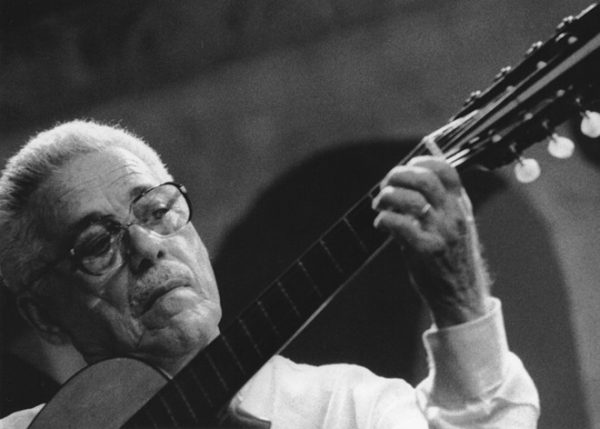
Horondino José da Silva, known as Dino 7 Cordas or Dino Sete Cordas, was born on May 5, 1918, in Rio de Janeiro. He became one of the central figures of Brazilian popular music and the person most responsible for consolidating the modern language of the violão de sete cordas (seven-string guitar) in choro and samba. If Tute was one of the great pioneers of the instrument in the regionais (small ensemble formations), Dino was the one who established its musical function: transforming the bass lines into counterpoint, commentary, response and internal movement within the song.
Childhood, Ear and Musical Formation
Dino was born on Rua Orestes, in the carioca neighborhood of Santo Cristo. Son of Caetano José da Silva, an amateur guitarist, he grew up in a house where music was part of everyday life. As a child, he began plucking the bandolim (Brazilian mandolin), but soon traded it for his father's violão. His formation was shaped less by formal schooling and more by listening: radio, records, family gatherings, saraus and direct contact with popular musicians.
This education by ear would prove decisive. Dino learned repertoires of toadas, valsas, sambas and choros by observing how guitarists accompanied singers and soloists. Later, already a professional, he would study music theory, but his foundation remained tied to the practice of the regionais and the intuitive intelligence of accompaniment.
The Regional de Benedito Lacerda
His entry into professional life came while still young, accompanying the singer Augusto Calheiros, known as Patativa do Norte, in circuses and theaters. But the great turning point came in 1937, when he joined the Regional de Benedito Lacerda, one of the most important ensembles of the era. There, Dino worked alongside fundamental figures such as Meira on violão and Canhoto on cavaquinho.
The Dino, Meira and Canhoto formation would become one of the most important accompaniment foundations in Brazilian music. The trio accompanied singers, soloists and recording sessions that spanned decades, establishing a standard of precision, elegance and swing for choro and samba. The Casa do Choro records that Dino and Meira became a kind of "brand name" in Brazilian accompaniment, such was the quantity and importance of the recordings in which they participated.
Pixinguinha, the Tenor Sax and the Invention of a Language
One of the most decisive encounters for Dino's language was with Pixinguinha. From 1946 onward, Pixinguinha began performing with Benedito Lacerda, playing tenor saxophone and creating low-register countermelodies that dialogued with the main melody. Dino absorbed deeply this way of building secondary lines: phrases that not only sustained the harmony but commented on the melody, responded to the soloist and created another musical layer within the arrangement.
This gesture is essential to understanding Dino. The violão de sete cordas, in his hands, was not merely a bass instrument. It was a voice. His baixaria (bass-line counterpoint) could walk, anticipate, respond, provoke tension and resolve with naturalness. What in Pixinguinha appeared on the tenor sax, Dino translated to the violão: a singable, rhythmic and contrapuntal low voice, perfectly integrated into the regional tradition.
The Arrival of the Seven-String
Although the violão de sete cordas existed before Dino and had in Tute a pioneering reference, it was Dino who consolidated its language in the professional environment of choro and samba. According to the Dicionário Cravo Albin, he had his first violão de sete cordas custom-built in 1954, thereafter becoming known as Dino Sete Cordas.
Dino's great contribution was not merely adopting an extra bass string. It was understanding what that string could do within Brazilian music. The seventh string expanded the low register, but it also demanded a new organization of accompaniment: more space for countermelodies, greater independence between bass and harmony, and a more dynamic relationship with the cavaquinho, the six-string violões, the pandeiro and the soloist.
The Época de Ouro and the Resistance of Choro
In the 1960s, at a time when choro was losing ground in the media to bossa nova, iê-iê-iê and other urban languages, Dino joined one of the most important ensembles in the history of the genre: the Época de Ouro, created by Jacob do Bandolim. In its first lineup, the group brought together Dino on the sete cordas, César Faria and Carlos Leite on violões, Jonas Silva on cavaquinho, Gilberto d'Ávila on pandeiro and Jorginho on rhythm.
With the Época de Ouro, Dino experienced one of the high points of his career. The group represented an almost chamber-music vision of choro: elaborate arrangements, collective listening, rhythmic precision and deep respect for tradition. The album Vibrações, by Jacob do Bandolim with the Época de Ouro, became a landmark for musicians and scholars of the genre.
After Jacob's death in 1969, choro went through a period of diminished visibility. But the revival of the 1970s, driven by artists such as Paulinho da Viola, brought regional musicians back to the center of the scene. Dino participated in this rebirth, keeping alive a language that seemed outdated to the market but remained technically sophisticated and musically indispensable.
Dino and Cartola
Beyond his importance in choro, Dino played a decisive role in samba. One of the best-known examples is his participation in the first albums by Cartola, released in the 1970s. The Casa do Choro notes that Dino arranged the first Cartola albums, consolidating a second strong phase in his artistic trajectory. The Dicionário Cravo Albin also records his work as arranger and guitarist on celebrated albums, including the composer's first records.
In those recordings, his violão does not appear as ornament. It organizes the harmonic ground, draws bass lines, guides breathing and creates a kind of living frame for Cartola's voice. It is a lesson in how to accompany without covering, comment without competing, sophisticate without stiffening.
Musical Style
Dino's style can be understood through three main elements:
Baixaria: The bass line that moves between chords. In Dino, it is rarely a mere mechanical connection. It has melodic direction, phrasing, syncopation and intention. Often, his bass lines seem to sing beneath the main melody, creating a second musical discourse.
Contraponto: This comes directly from listening to wind instruments, especially Pixinguinha. Dino did not fill gaps: he conversed with the music. His art lay in knowing when to enter, when to remain silent, when to play a short phrase, when to prepare the arrival of a chord and when to let the melody breathe.
Rhythmic function: This appears both in the traditional accompaniment patterns and in techniques such as the so-called violão tamborim, associated with pizzicato execution and a percussive sonority on the instrument. This technique reinforces the rhythmic character of the violão, bringing it closer to the batucada and expanding its function within the regional.
The Dino School
Dino created a school without ever needing to write a method book. His primary pedagogy lives in the recordings. Seven-string guitarists study his albums the way one consults a map: there lie the bass paths, the responses to the soloist, the melodic clichés, the chromaticisms, the syncopated patterns and the balance between freedom and function.
His best-known disciple was Raphael Rabello, who recognized in Dino a profound influence. The Dicionário Cravo Albin records Raphael's statement that he spent many years studying everything Dino did, to the point of considering his own work deeply shaped by the master's "accent."
In 1991, the two recorded together the album Raphael Rabello & Dino 7 Cordas, a symbolic encounter between the tradition of accompaniment and the solistic expansion of the instrument. The Casa do Choro observes that this was Dino's only album as a protagonist, despite his presence running through countless recordings of Brazilian music.
Composer and Behind-the-Scenes Musician
Dino also composed, although his fame is far more closely tied to accompaniment. The Dicionário Cravo Albin registers a body of 35 pieces, both vocal and instrumental, with recordings by artists such as Almirante, Castro Barbosa, Orlando Silva, Isaura Garcia, Ciro Monteiro, Carlos Galhardo, Ângela Maria and Linda Batista. Among his most remembered works is "Aperto de Mão", a partnership with Meira with lyrics by Augusto Mesquita.
But his greatest work may not be found in a list of compositions. It lies in a way of playing. Dino elevated the accompaniment musician to a central creative category. He showed that to accompany is not to stay behind, but to sustain the invisible architecture of the music. His violão is discreet only to those who do not know how to listen to the low end.
Notable Recordings
To understand his language, a few recordings are especially important:
| Title | Notes |
|---|---|
| Vibrações | Jacob do Bandolim with Época de Ouro. A landmark of chamber choro. |
| Choros Imortais | With Altamiro Carrilho and Regional do Canhoto. |
| Cartola's first albums | 1970s. Dino signed the arrangements. |
| Raphael Rabello & Dino 7 Cordas | 1991. Dino's only album as a protagonist. |
| Dino 50 Anos | Conjunto Época de Ouro, 1987. A tribute to his career. |
Legacy
Dino 7 Cordas died in May 2006, in Rio de Janeiro, after a career spanning more than six decades of Brazilian music. His importance is not limited to the instrument he played, but extends to the function he redefined. Before him, the sete cordas already existed. After him, it had a grammar, an ethic and a voice.
His legacy endures in every guitarist who studies a baixaria, in every regional that balances tradition and invention, in every accompaniment that understands that the low register can also sing. Dino taught that the violão de sete cordas is not merely the ground of the music. It is root, path and commentary. It is the memory of choro walking within the sound.
Sources
- Dicionário Cravo Albin da Música Popular Brasileira — Biographical entry on Horondino José da Silva, with chronology, compositions and discography. Available at: dicionariompb.com.br
- Instituto Casa do Choro — Entry on Dino Sete Cordas, highlighting his work in the regionais and the arrangements for Cartola's albums. Available at: casadochoro.com.br
- Instituto Moreira Salles / Rádio Batuta — Feature "Dino 7 Cordas, o violão fundamental." Available at: ims.com.br
- TABORDA, Márcia Ermelindo. Dino Sete Cordas e o acompanhamento de violão na música popular brasileira. Master's dissertation. — Academic reference for the study of the violão de sete cordas language and Dino's contribution.
Suggested course
Move from editorial context into guided study with synchronized score and structured steps.
All courses
Browse the public course catalog connected to the content hubs.