Choropedia
Canhoto da Paraíba - Brazilian Guitarist
Canhoto da Paraíba was a Brazilian guitarist and composer, known for his unique style in choro and instrumental music.
Introduction
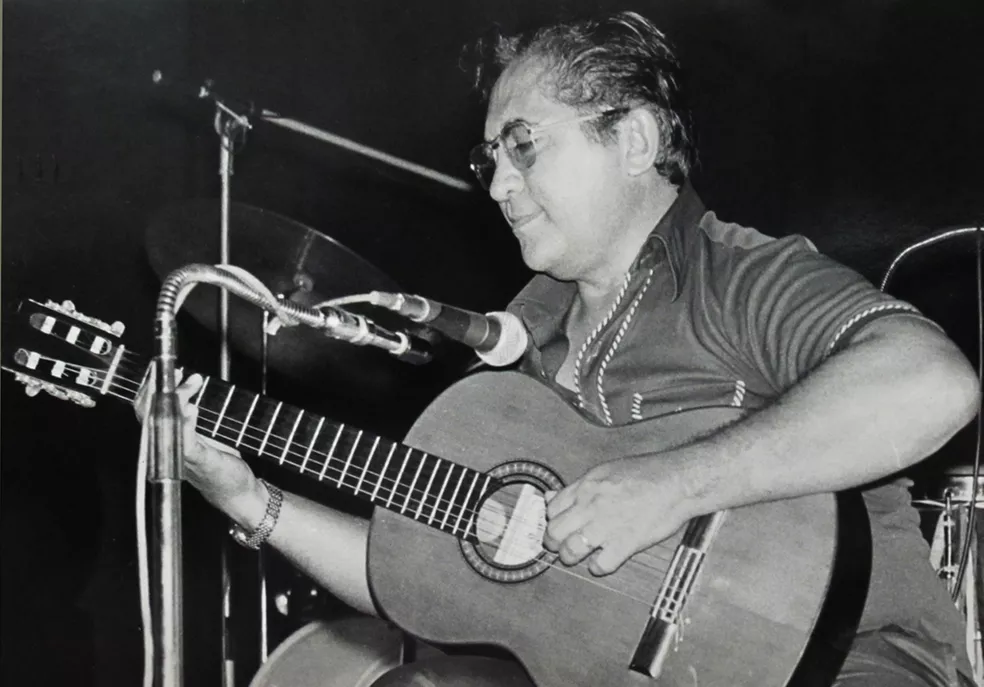
Francisco Soares de Araújo, known as Canhoto da Paraíba ("the Left-Hander from Paraíba") or Chico Soares, was a Brazilian guitarist and composer associated with choro (Brazil's oldest urban instrumental genre) and with the instrumental music of the Northeast.
Born in Princesa Isabel, in the sertão (semi-arid backlands) of Paraíba, and based for most of his life in Pernambuco, he became a singular figure in Brazilian guitar. Canhoto played the instrument upside down without reversing the order of the strings, turning that unusual approach into a musical language of his own.
Formation and early years
Canhoto grew up in a family of musicians. His grandfather, Joaquim Soares, was a clarinetist, and his father, Antônio Soares, played guitar. Saraus (informal musical salons), serestas (evening serenades) and musical gatherings were part of daily life at home and served as his first school.
Among the musicians who belonged to that circle were the accordionist Zé Costa, the saxophonist Manuel Marrocos, the guitarists Zé Micas and Luís Dantas, and the bandmaster Joaquim Leandro, conductor of the town band of Princesa Isabel.
As a young man he worked as a sacristan and rang the church bells. One of the best-known stories about his childhood recounts that he managed to play the frevo (fast, syncopated Pernambuco carnival music) Vassourinhas on the bells — a sign of a musicality that, from early on, went beyond the limits of conventional instruments.
The guitar turned inside out
His way of playing became Canhoto's defining trait.
Being left-handed and having to share the guitar with right-handed relatives, he learned to hold it inverted while keeping the strings in their original arrangement. As a result, the bass strings ended up on the bottom and the treble strings on top.
By the time he got his own guitar, at sixteen, the technique was already formed. Rather than relearning the instrument, Canhoto refined the solution he had invented on his own.
The inversion changed chord shapes, fingerings and the movement of both hands. The result was a highly personal touch, in which melodies, bass lines and accompaniment each found their own paths. The phrase "the guitar played inside out" would eventually become the title of one of his best-known records.
Radio and professional life
Canhoto's professional career gained momentum through radio.
In 1953 he moved to João Pessoa and signed with Rádio Tabajara, where he stayed for about five years. He formed his first regional (the small string-and-percussion ensemble that accompanies choro), backed local musicians and played with artists touring through the Northeast.
In 1958 he moved on to Recife and began working at Rádio Jornal do Comércio, appearing frequently on the program Quando os violões se encontram ("When the Guitars Meet").
Like many musicians of his generation, Canhoto did not live from music alone. He also worked as a social worker at Sesi in Pernambuco, balancing the job with rodas de choro (informal choro jam sessions), radio programs, performances and recordings.
Meeting Jacob, Pixinguinha and Radamés
In 1959, encouraged by the mandolinist Rossini Ferreira, Canhoto traveled to Rio de Janeiro. For about two weeks he stayed at the home of Jacob do Bandolim, coming into contact with some of the leading names in Brazilian instrumental music.
During that period he spent time with musicians such as Pixinguinha, Radamés Gnattali, Dilermando Reis, Tia Amélia and a young Paulinho da Viola.
One celebrated story involves Radamés Gnattali. Struck by hearing Canhoto play, the composer is said to have thrown a glass into the air, leaving a mark on the ceiling of Jacob's house. True in every detail or embellished over the years, the story endured as a portrait of the impact that guitar had on other musicians.
The stay in Rio helped make Canhoto known outside the Northeast and consolidated his standing among the great chorões (choro players) of his generation.
Canhoto's choro
Canhoto da Paraíba's music has a strong melodic presence and consists mainly of choros, waltzes and other instrumental pieces.
Though deeply tied to choro, his repertoire also carries the musical world of the Northeast in which he was formed. Baião, xote, xaxado and frevo — Northeastern dance genres — appear at various points in his work, blended naturally into the vocabulary of the choro guitar.
His playing combined highly singable melodies, striking bass lines and a particular way of building chords and phrases, itself a consequence of the instrument's inverted position.
Among his best-known compositions are Com Mais de Mil, Tua Imagem, Visitando o Recife, Lembrança que Ficou, Pisando em Brasa, Tá Quentinho, Reencontro com Paulinho, Valsa a Tozinho, 19 de Março and Choro na Madrugada.
Paulinho da Viola
His friendship with Paulinho da Viola spanned much of Canhoto's career.
In 1971 Paulinho composed the choro Abraçando Chico Soares in his honor. In the years that followed, he also helped widen the circulation of Canhoto's work and was instrumental in bringing him to the Marcus Pereira label.
In 1977 O Violão Brasileiro Tocado pelo Avesso was released, also known as Com Mais de Mil. The album gave Canhoto a national visibility that had been slow to arrive, despite the respect he already enjoyed among musicians such as Jacob do Bandolim and Pixinguinha.
Canhoto also took part in performances of the Projeto Pixinguinha, an initiative central to the renewed interest in choro during the 1970s.
Years later, Paulinho would appear again in his discography on the album Pisando em Brasa, alongside another major name of the Brazilian guitar, Raphael Rabello.
Notable works
Among his compositions are:
- Com Mais de Mil
- Tua Imagem
- Visitando o Recife
- Lembrança que Ficou
- Pisando em Brasa
- Tá Quentinho
- Reencontro com Paulinho
- Valsa a Tozinho
- 19 de Março
- Choro na Madrugada
- Lourdinha
- Glória do Relâmpago
- Ilha de Santo Aleixo
- Memórias de Sebastião Malta
Selected discography
- Único Amor — 1968, with Henrique Annes
- Um Violão Direito nas Mãos do Canhoto — 1974
- O Violão Brasileiro Tocado pelo Avesso — 1977
- Fantasia Nordestina: Violão Brasileiro Tocado pelo Avesso — 1990
- Pisando em Brasa — 1993
- Instrumental no CCBB: Canhoto da Paraíba e Zimbo Trio — 1993
Later years
In 1998 Canhoto suffered a cerebral ischemia that impaired his movement and left him unable to keep playing the guitar.
In the years that followed he received numerous honors. In 2005 he was recognized as a Living Heritage of Pernambuco (Patrimônio Vivo de Pernambuco).
His name was also chosen for the Lei Canhoto da Paraíba – REMA, a law created in Paraíba to recognize and protect masters of the state's traditional cultures.
Canhoto da Paraíba died on April 24, 2008, in the metropolitan region of Recife.
His career occupies a particular place in the history of the Brazilian guitar: a musician formed between the Paraíba backlands and Recife, tied to the rodas and regionais of the Northeast, and admired by figures such as Jacob do Bandolim, Pixinguinha, Radamés Gnattali and Paulinho da Viola.
With a guitar held literally the wrong way round, Canhoto found an entirely personal way of playing. What began as a practical solution ended up becoming his musical signature.
Sources
- Instituto Casa do Choro — archive and biographical entry on Canhoto da Paraíba.
- Instituto Moreira Salles — documentation on Brazilian choro and its revival in the 1970s.
- Dicionário Cravo Albin da Música Popular Brasileira — biography, career, works and discography.
- Fundação Joaquim Nabuco — biographical trajectory, discography and institutional recognition.
- A União — article Avesso do avesso, published March 19, 2026.
Suggested course
Move from editorial context into guided study with synchronized score and structured steps.
All courses
Browse the public course catalog connected to the content hubs.