Choropedia
Benedito Lacerda - Key Figure in Choro
Benedito Lacerda was a flutist and composer pivotal to Brazilian music.
Introduction
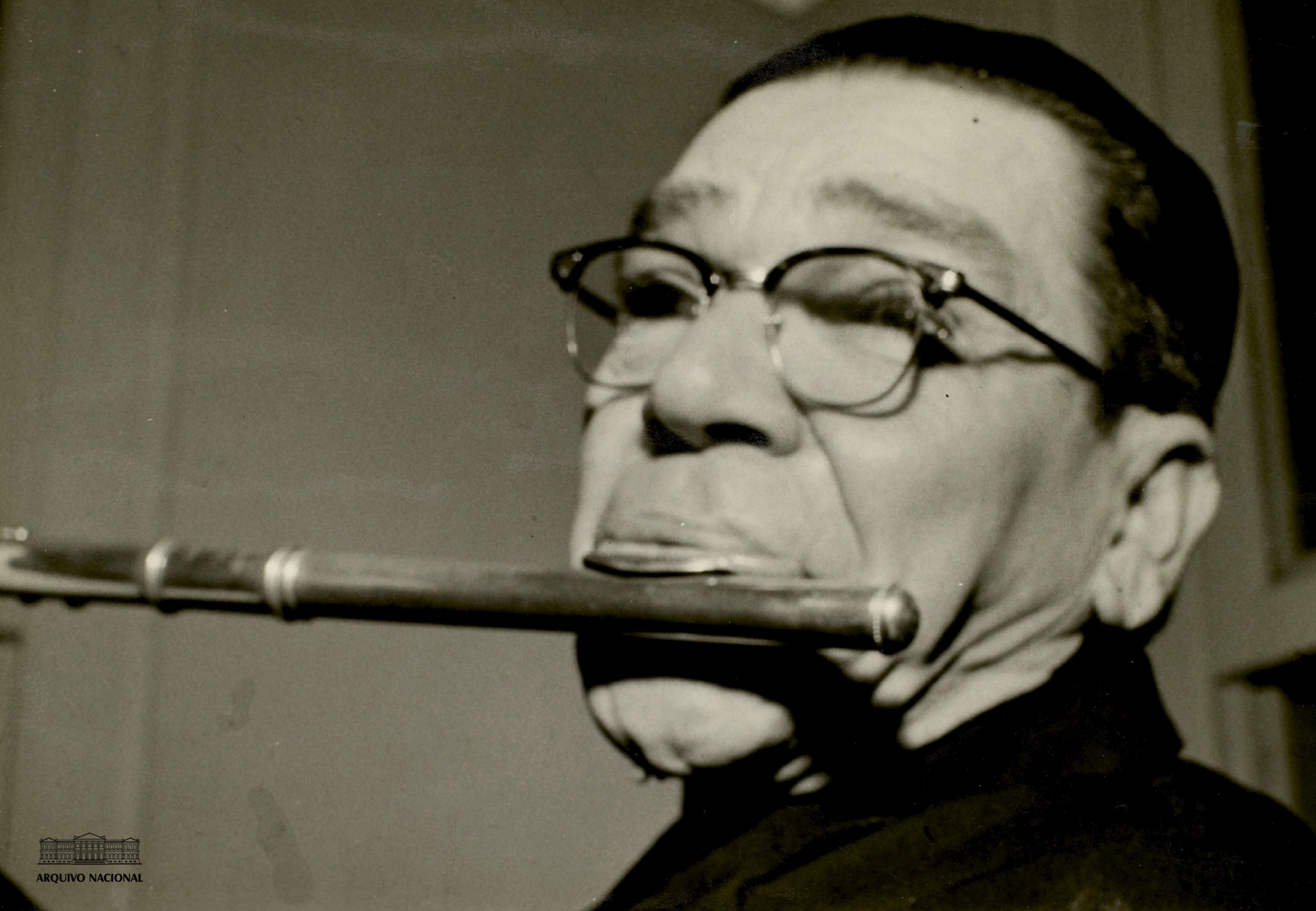
Benedito Lacerda (Macaé, 14 March 1903 – Rio de Janeiro, 16 February 1958) was a flautist, conductor, composer, singer, and ensemble leader — a central figure in the history of choro, samba, and Brazilian urban popular music. His importance is not reducible to instrumental virtuosity or to his role as regional director: he was also the author of an extensive body of work — around 700 pieces across choros, sambas, marches, waltzes, and songs — and helped consolidate an ensemble sound that would prove decisive for the Radio Era.
In the choro tradition, his name occupies a singular place. On one side, he belongs to the lineage of great flautists that succeeds the generation of Callado and precedes names such as Altamiro Carrilho. On the other, he was a musical organizer of the first order: his regional became a reference point for accompaniment, rhythmic precision, swing, and collective invention, leaving a model that endured for decades. At the same time, his authorial output reveals a musician who moved naturally between instrumental repertoire and popular song, between the roda and the radio, between choro and carnival.
Training and Musical Context
Benedito Lacerda began playing the flute by ear as a young child at the Sociedade Musical Nova Aurora in Macaé. In Rio de Janeiro, where he went to live in the Estácio neighbourhood, he studied with Belarmino de Sousa and graduated in flute and composition from the Instituto Nacional de Música. His contact with the samba players, percussionists, and chorões of the Estácio was decisive: though formally trained, Benedito never distanced himself from popular practice — and it is from that tension between rigour and lived experience that the musical idiom of his work was born.
In 1930 he organized the Gente do Morro, a vocal and instrumental ensemble that served as a laboratory for a language in which flute, cavaquinho, guitars, and percussion interacted in a new way, and in which Benedito began to establish himself as a composer and singer.
Benedito Lacerda and the *Regional*
From the mid-1930s onward, Benedito consolidated another of his great legacies: the Conjunto Regional de Benedito Lacerda. Between 1935 and 1938, his regional accompanied recordings by artists including Carmen Miranda, Sílvio Caldas, Noel Rosa, Marília Batista, and Francisco Alves. In 1937, the formation reached its emblematic stable line-up: Benedito on flute, Dino and Meira on guitars, and Canhoto on cavaquinho.
This ensemble became one of the most important accompaniment foundations of Brazilian popular music. More than merely "accompanying" singers, the regional helped to define the musical form of the recordings: introductions, responses, harmonic direction, fills, rhythmic swing, and instrumental identity. When Canhoto assumed the directorship in 1950, renaming the group the Regional do Canhoto, this only confirmed that Benedito had structured an enduring ensemble model — not merely a circumstantial formation.
Musical Style
Benedito Lacerda's style emerges from the encounter between solid musical training and intense immersion in the Estácio.
As a flautist, his playing stands out for melodic clarity, phrasing instinct, and direct communication with the listener.
As a composer, he shows great mobility across genres, with a writing style capable of functioning equally in the instrumental and the popular song domains. His work suggests a language shaped by three main forces: a communicative, clear, and singable melody with strong popular appeal; the rhythmic presence of carioca urban samba, especially from the Estácio environment; and structural efficiency, typical of someone who understood deeply how discs, radio, and the regional ensemble worked.
Also striking is the way Benedito moves between choro and song without losing his identity. Rather than confining himself to "pure" choro, he occupies a broader zone of urban popular music where march, samba, waltz, and choro are in continuous dialogue. This helps to explain why his work achieved wide public circulation and why his name appears with such force in both the historiography of choro and the history of carnival and radio.
Key Works
| Title | Notes |
|---|---|
| A Jardineira (with Humberto Porto) | His greatest popular success; originally recorded by Orlando Silva. |
| Pretensioso | An instrumental choro of independent value within the genre's repertoire. |
| Gorgulho | A representative instrumental from his output as a choro composer. |
| Dinorá | A piece that reveals Benedito as composer in his own right, beyond the Pixinguinha collaborations. |
| Doidinho | One of the most remembered instrumentals in his authorial catalogue. |
| Seresteiro | A lyrical choro, present in recordings dedicated to the composer. |
| Canhoto | A tribute to the cavaquinho player who would succeed him as regional director. |
| Flauta e Pandeiro | A piece that reflects the instrumental make-up of Benedito's own ensemble. |
| Minha Flauta de Prata | One of the titles most associated with his name as flautist-composer. |
| Naquele Tempo (with Pixinguinha) | One of the most recorded choros of the twentieth century; central to the history of the genre. |
| 1×0 (with Pixinguinha) | An euphoric choro, among the most popular pieces from the partnership. |
| Ingênuo (with Pixinguinha) | Delicate in melody; a recurrent presence in rodas and recordings. |
| Vou Vivendo (with Pixinguinha) | Another classic of the duo, active in the living choro repertoire. |
| Proezas de Solon (with Pixinguinha) | A piece of virtuosity and humour, characteristic of the two musicians' shared language. |
The Partnership with Pixinguinha: Musical Greatness and a Critical Question
The relationship between Benedito Lacerda and Pixinguinha must be handled with precision. Musically, the duo's recordings are historic: Benedito on flute and Pixinguinha on tenor saxophone produced some of the most important phonograms in twentieth-century choro.
Historiographically, however, the co-authorship of part of that repertoire is a matter of debate. There is documented evidence that Benedito became Pixinguinha's partner at a time when the composer was experiencing financial difficulties, and that a number of these pieces were, in their origin, by Pixinguinha alone. The subject calls for contextual reading, not moralistic simplification.
For the purposes of this entry, the most accurate approach is to acknowledge this double dimension: Benedito was a genuine composer, with a broad and well-documented body of his own work, but the portion of his catalogue co-signed with Pixinguinha warrants a critical distinction between artistic partnership, publishing arrangement, and primary musical authorship. This observation does not diminish his importance — on the contrary, it helps to place him with greater historical precision.
A Listening Guide
Doidinho and Seresteiro are good entry points into Benedito Lacerda as a choro composer: instrumental pieces with their own identity, which reveal a musician who knew how to write for the ensemble and for the flute — not only for song.
For the Benedito-and-Pixinguinha duo at their finest, Naquele Tempo and Ingênuo are the natural choices. In these recordings from the 1940s, Benedito's flute and Pixinguinha's saxophone speak to each other with the precision and naturalness of two musicians who knew each other from the inside. This is recorded choro at its highest level.
Influences and Relationships
Influences on Benedito:
- Belarmino de Sousa and the Instituto Nacional de Música — The technical foundation in flute and composition.
- Sociedade Musical Nova Aurora — His first musical environment, in Macaé, in childhood.
- The Estácio and carioca urban samba — Contact with samba players, percussionists, and chorões at a decisive moment of rhythmic transformation in carioca samba; a fundamental influence on his musical idiom.
Key musical relationships:
- Pixinguinha — Partner in the recordings of the 1940s, one of the most important instrumental duos in the history of choro; a relationship that warrants critical reading with regard to the co-authorships.
- Dino, Meira, and Canhoto — Musicians who, alongside Benedito, formed the regional that became the reference point for Brazilian popular music between 1937 and 1950.
- Carmen Miranda, Sílvio Caldas, Noel Rosa, Francisco Alves — Major singers of the Radio Era accompanied by his regional between 1935 and 1938.
- Humberto Porto — Co-composer of A Jardineira, his greatest success outside the instrumental choro repertoire.
Legacy
The legacy of Benedito Lacerda can be read on three levels.
The first is that of the flautist and ensemble director: a decisive figure in the consolidation of the regional as the sonic foundation of Brazilian popular music, and a model of instrumental organization that endured for decades — including after Canhoto took over the group.
The second is that of the composer: author of a broad and widely circulated repertoire, with a presence spanning both choro and popular song. Around 700 compositions document an author of real stature, not merely an occasional partner of more celebrated names.
The third is that of the historical mediator: particularly in the phonographic revival of Pixinguinha in the 1940s, Benedito was the musician who brought the greatest living choro composer back into the recording studio — regardless of the complexities that partnership carries.
In the history of choro, Benedito Lacerda remains a name that demands broad reading. He was not merely a virtuoso, nor merely an ensemble director, nor merely a celebrated partner of Pixinguinha. He was a musician of rare connective ability, capable of composing, playing, organizing, and projecting a Brazilian musical language with enormous effectiveness. His name belongs, with full merit, to the core of the great builders of Brazilian popular music in the twentieth century.
Sources
- Instituto Casa do Choro — Biographical entry and works catalogue for Benedito Lacerda. Primary source for the number of compositions and for the assessment of his profile as composer and regional director.
- Dicionário Cravo Albin da Música Popular Brasileira — Entries for Benedito Lacerda and the Grupo Gente do Morro. Source for biographical data and professional trajectory.
- Discografia Brasileira / IMS — Article "Um mestre na flauta, no samba, no choro e no carnaval: os 120 anos de Benedito Lacerda" [A Master of Flute, Samba, Choro and Carnival: The 120 Years of Benedito Lacerda] and database of compositions and phonograms. Reference for the 314 catalogued compositions and discographic data.
- Rádio Batuta / Instituto Moreira Salles — Programmes on Benedito Lacerda and his relationship with Pixinguinha. Source for the historical contextualisation of the partnership and the 1940s recordings.
Suggested course
Move from editorial context into guided study with synchronized score and structured steps.
All courses
Browse the public course catalog connected to the content hubs.