Choropedia
Altamiro Carrilho - Brazilian Choro Flutist
Altamiro Carrilho was a renowned Brazilian choro flutist known for his virtuosity and compositions.
Introduction
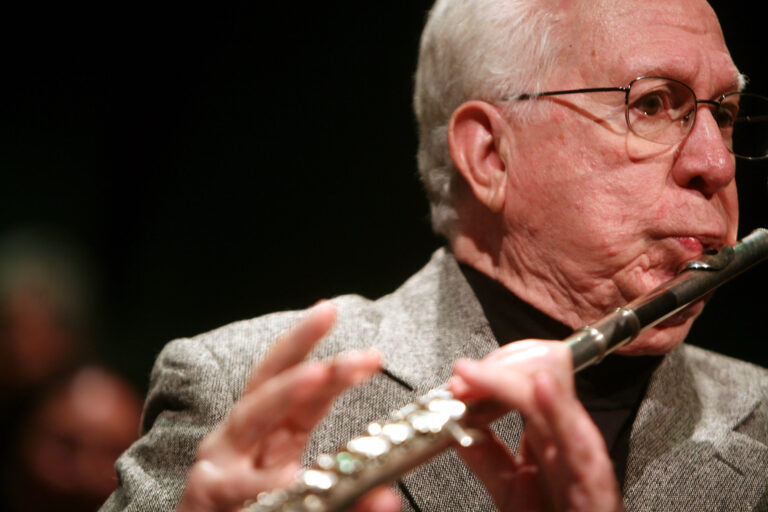
Altamiro Aquino Carrilho was one of the central names of the Brazilian flute in the twentieth century. A flautist, composer, arranger and one of the great popularizers of choro in Brazil and abroad, he became a reference not only for the extent of his discography, but for the way he turned the flute into an instrument of popular virtuosity, improvisation, lyricism and direct communication with the audience.
Childhood and Formation
Born in Santo Antônio de Pádua, in the interior of Rio de Janeiro, on December 21, 1924, Altamiro grew up in a family deeply tied to music. As a child, he had contact with bands, bandstands and wind instruments. The image of the boy playing a small tin flute is almost symbolic: before becoming one of the great soloists of Brazilian music, Altamiro already revealed a spontaneous relationship with the instrument, as if the flute were a natural extension of speech.
At fifteen, he moved with his family to the Rio de Janeiro metropolitan area, passing through São Gonçalo and then Bonsucesso. He worked as a pharmacist and studied music at night, until he managed to buy a secondhand flute. This combination of ordinary work, persistent study and everyday musical practice is important to understanding his trajectory: Altamiro does not emerge merely as a prodigy, but as a musician formed at the meeting point of popular tradition, radio, dance repertoire, choro and instrumental discipline.
Professional Beginnings
Altamiro appeared very young on amateur-talent programs, even winning Ary Barroso's show. In 1943, he took part in his first recording, on an album by Moreira da Silva. A few years later, he began performing in radio orchestras — a decisive setting for the formation of many Brazilian musicians of the first half of the twentieth century.
Radio demanded sight-reading, a good ear, quick adaptation, command of repertoire and the ability to play in different contexts. This laboratory helped form a versatile musician, able to move between choro, samba, maxixe (an early Brazilian urban dance), baião (a Northeastern Brazilian genre), dance music, adapted concert repertoire and popular instrumental music.
In 1951, Altamiro joined the Regional do Canhoto, replacing Benedito Lacerda. This passage is fundamental. The regional (the typical choro ensemble) was one of the most important formations in Brazilian music: cavaquinho, guitars, pandeiro and soloist, with a language based on flexible accompaniment, contrapuntal bass lines and a constant dialogue between melody and rhythm. By entering this world, Altamiro placed himself directly in the lineage of the great choro flautists, following names such as Joaquim Callado, Patápio Silva, Pixinguinha, Benedito Lacerda and Dante Santoro.
The Bandinha de Altamiro Carrilho
In 1955, Altamiro formed the Bandinha de Altamiro Carrilho, a group that would become one of the hallmarks of his career. The Bandinha drew on the imagery of brass bands, bandstands, dobrados (military marches), maxixes and Brazilian popular festivities. It was a formation of popular appeal, but not simplistic. Behind its communicative character lay well-built arrangements, varied repertoire and a flute capable of sounding bright, virtuosic and danceable.
The great commercial landmark of this period was "Rio Antigo," a maxixe of his own. The recording achieved enormous success and established Altamiro as a national figure. His program "Em tempo de música," on TV Tupi, also drew large audiences, further widening the circulation of his image and his sound.
The Bandinha is an important point for understanding Altamiro without reducing him merely to the figure of the "virtuoso chorão." He was also a mass-communication artist, someone who understood radio, television, records and the audience's affective memory. His music wandered among the choro roda (the informal circle where choro is played), the ballroom, the bandstand and the stage.
Virtuosity, Improvisation and Language
Altamiro had extraordinary technical command of the transverse flute. But his virtuosity was not merely speed or brilliance. What makes him so important for choro is the way he articulated technique, improvisation, ornamentation and popular phrasing.
In his interpretations, it is common to find melodic variations, mordents, appoggiaturas, small rhythmic anticipations, accent displacements, chromatic passages and improvised responses that renew the melody without erasing it. He respected the theme, but did not leave it motionless. The melody, in Altamiro, breathes, ornaments, plays, runs, suspends and returns to the ground.
This is one of the reasons his recordings became study material for flautists interested in choro. More than playing the right notes, Altamiro teaches a way of saying the phrase. His interpretation shows that, in choro, the score is a starting point, but the language lives in the details: in the attack, the swing, the inflection, the variation and the dialogue with the accompaniment.
Composer of Many Brazils
Altamiro composed around two hundred pieces in varied genres. Although he is remembered mainly for choro, his catalog includes maxixes, sambas, baiões, waltzes, polkas, frevos and other forms tied to Brazilian popular music.
Among his most remembered compositions are "Rio Antigo," "Aeroporto do Galeão," "Deixa o Breque pra Mim," "Oriental," "Bem Brasil," "Canarinho Teimoso," "Enigmático," "Flauteando na Chacrinha," "Samba de Morro" and "Vivaldino."
This diversity of genres reveals a composer deeply tied to the musical Brazil of the twentieth century. Altamiro did not treat choro as an isolated island. His work shows choro in contact with maxixe, the waltz, samba, baião, band music and the instrumental repertoire of the ballroom.
The Relationship with the Flute Tradition
Altamiro saw himself as a disciple of Patápio Silva, one of the great references of the Brazilian flute. He also counted Benedito Lacerda and Dante Santoro as important names in his aesthetic formation. This genealogy helps situate his importance: he does not invent the Brazilian flute from nothing, but carries forward a tradition already consolidated since the nineteenth and early twentieth centuries.
At the same time, Altamiro modernizes that tradition through records, radio, television and international tours. His flute preserves traits of the old choro, but gains public projection on a much larger scale. He is, in this sense, a bridge between the tradition of the bandstands, regionais and choro rodas and the modern recording industry.
Discography and International Presence
Altamiro recorded dozens of albums over his career and took part in hundreds of recordings. His discography crosses different phases of Brazilian music: the 78-rpm records, the LPs of choro and dance music, the anthologies, the encounters with other instrumentalists and the CD reissues.
Among important albums of his career are Rio Antigo, Choros Imortais, Antologia do Chorinho, Pixinguinha de Novo (alongside Carlos Poyares), Clássicos em Choro, Altamiro Revive Patápio e Interpreta Clássicos, Bem Brasil and Flauta Maravilhosa.
His international activity was also significant. He performed in several countries in Europe and South America, in the United States, in Japan and on other circuits, carrying choro and the Brazilian flute beyond Brazil. In 1958, he received the Microfone de Ouro as best radio instrumentalist. In 1997, he won the Prêmio Sharp in the category of best instrumental album with Flauta Maravilhosa.
Why Altamiro Carrilho Matters for Choro
Altamiro matters because he synthesizes several dimensions of choro in a single figure.
He was a virtuoso, but not academic in the narrow sense. He was popular, but not superficial. He was a composer, performer, improviser, arranger and communicator. He played in regionais, bands, radio, television programs, commercial records, historical projects and international stages.
His importance lies in showing that choro is, at the same time, a sophisticated language and music of popular circulation. In Altamiro, the flute sings with rhythmic mischief, melodic elegance and an almost narrative clarity. Each phrase seems to tell a small story: sometimes laughing, sometimes nostalgic, sometimes showing off, but always musically aware.
For those who study choro, Altamiro is a school. Not just a school of flute, but a school of phrasing, swing, articulation and melodic imagination.
Death and Legacy
Altamiro Carrilho died in Rio de Janeiro on August 15, 2012, at the age of 87. He left behind an extensive body of work, a fundamental discography and an interpretive model that continues to influence flautists and chorões.
His legacy lies not only in his compositions or records, but in the way he consolidated an idea of the Brazilian flute: agile, expressive, popular, technically refined and deeply tied to the tradition of choro.
Altamiro Carrilho is one of those musicians who do not fit into biography alone. He remains as sound, accent and path. To understand the flute in choro, one must pass through him.
Sources
- Casa do Choro — Composer archive and catalog of scores by Altamiro Carrilho. Available at: casadochoro.com.br
- Instituto Moreira Salles (IMS) — Iconographic archive of Altamiro Carrilho.
- Dicionário Cravo Albin da Música Popular Brasileira — Entry "Altamiro Carrilho." Available at: dicionariompb.com.br
- Discografia Brasileira / Discos do Brasil — Recordings featuring Altamiro Carrilho.
- Musica Brasilis — Entry "Altamiro Carrilho."
- Pereira, Marcelo das Dôres. Procedimentos rítmico-melódicos na performance de Altamiro Carrilho: um estudo de caso aplicado ao ensino do choro. Master's dissertation, UFMG, 2016.
- Modesto, Marcio; Berg, Silvia Maria Pires Cabrera. "A múltipla produção artística do flautista Altamiro Carrilho entre 1948 e 1960." Anais da ANPPOM, 2020.
Suggested course
Move from editorial context into guided study with synchronized score and structured steps.
All courses
Browse the public course catalog connected to the content hubs.