Blog
Pixinguinha and Dino Sete Cordas' Guitar
Explore how Pixinguinha influenced Dino Sete Cordas' guitar language.
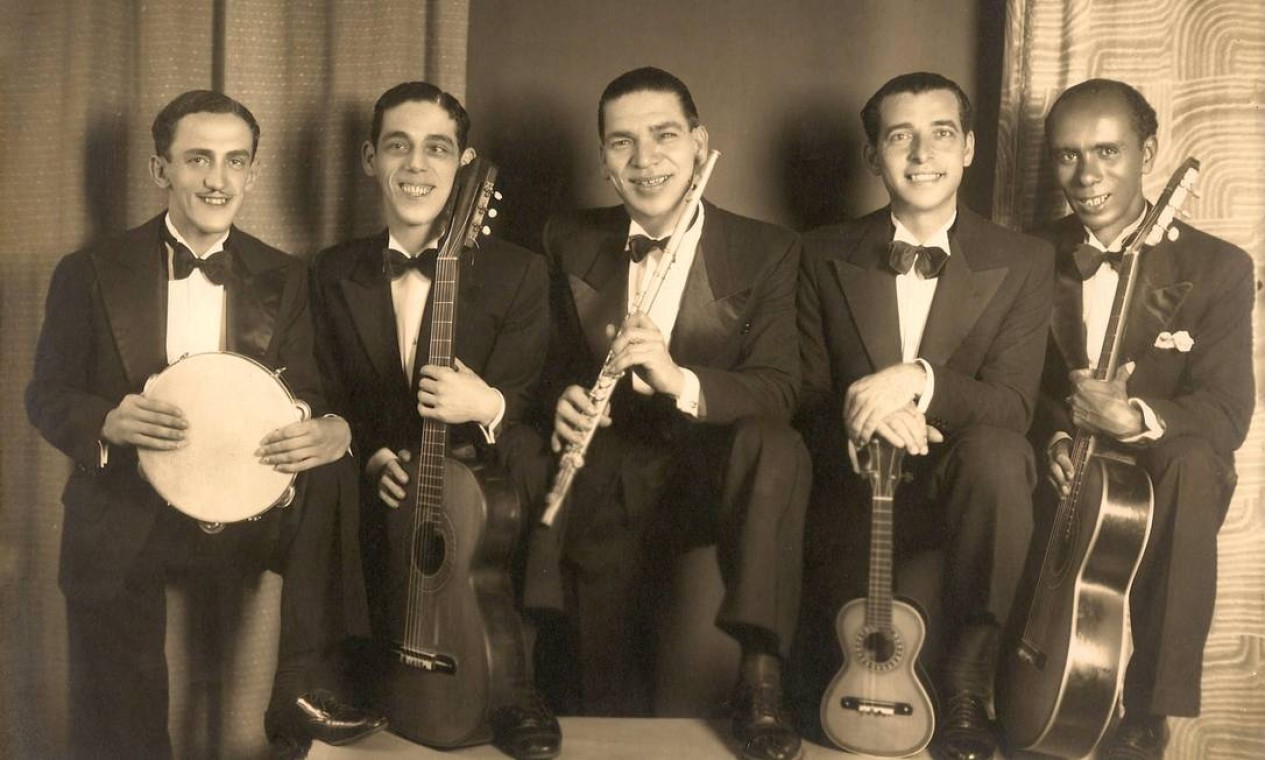
Living alongside Pixinguinha’s saxophone helped Dino turn bass lines into a second voice within the regional ensemble
When we listen to Dino Sete Cordas accompanying a choro, the guitar seems to do much more than support the harmony.
It guides the bass line, anticipates chord changes, answers the soloist, creates short melodies, and fills empty spaces without disturbing the main theme. At times, it feels as though two pieces of music are unfolding at once: the soloist’s melody and another line, built in the lower register of the guitar.
This way of playing did not arise from a single influence. Dino knew the tradition of earlier guitarists who played bass runs, worked alongside Meira for decades, and developed his own resources long before adopting the seven-string guitar.
One encounter, however, was especially important in shaping his style: his professional relationship with Pixinguinha in Benedito Lacerda’s Regional.
By listening closely to the countermelodies of Pixinguinha’s tenor saxophone, Dino found a model for turning the guitar into an increasingly active voice within the ensemble.
Dino before Pixinguinha
Horondino José da Silva, later known as Dino Sete Cordas, joined Benedito Lacerda’s Regional in 1937.
At the time, he still played a six-string guitar. Alongside Meira, he formed one of the most important guitar duos in Brazilian music.
Even before Pixinguinha arrived, Dino and Meira already displayed distinctive features in their playing. They worked with bass lines in thirds, chord inversions, syncopations, and different kinds of articulation.
Dino also developed a highly percussive style of accompaniment known as the “tamborim guitar.”
It would therefore be inaccurate to say that Dino’s style began with Pixinguinha. The guitarist already had experience, personality, and a highly developed ear.
His contact with Pixinguinha, however, opened up a new possibility: to think of accompaniment not only as a rhythmic and harmonic foundation, but also as a melodic line capable of conversing with the soloist.
The meeting in Benedito Lacerda’s Regional
In 1946, Pixinguinha began performing in Benedito Lacerda’s Regional as a tenor saxophonist.
The group brought together Benedito Lacerda on flute, Pixinguinha on saxophone, Canhoto on cavaquinho, Dino and Meira on guitars, as well as percussion.
At that time, Dino was still playing six-string guitar and closely observing the way Pixinguinha built his countermelodies.
While the flute stated the main melody, the saxophone did not merely play low notes or reinforce the chords. Pixinguinha created another melodic line, with movement of its own, responding to the theme and helping drive the music forward.
His saxophone entered during moments of rest in the flute part, took advantage of sustained notes, crossed harmonic changes, and created pathways between chords.
For Dino, that daily contact became a kind of continuous lesson.
What was different about Pixinguinha’s countermelodies?
Pixinguinha’s countermelodies were not random sequences of notes.
Even when they sounded spontaneous, they had direction. The phrases began on an important harmonic note and moved toward another, using scales, arpeggios, chromatic motion, and different kinds of approach notes.
Put simply, Pixinguinha knew exactly where he wanted to arrive.
Between one important note and the next, he built the path.
A phrase might, for example:
- approach a chord tone;
- move through part of the arpeggio;
- use chromatic or diatonic motion;
- arrive at a new important note in the following chord.
Analyses of his recordings often identify a logic that can be summarized as approach, arpeggio, and another approach.
This reasoning would become fundamental to Dino’s language. The guitar bass lines also began connecting important harmonic notes through phrases with a clear beginning, direction, and destination.
The saxophone disappears and leaves an empty space
In 1951, Dino, Meira, and Canhoto left Benedito Lacerda's Regional group to form Canhoto's Regional group, led by cavaquinho player Waldiro Frederico Tramontano.
Pixinguinha's departure caused a noticeable change in the group's sound. Without the tenor saxophone, the regional lost part of its low range and, mainly, that voice that constantly interacted with the melody.
Dino noticed that absence.
At the same time, guitarist Tute, one of the pioneers of the seven-string guitar in regional ensembles, was withdrawing from professional music. The instrument already existed in choro, so Dino did not invent the seven-string guitar. What he did was develop a new way of using it.
In the early 1950s, Dino switched to the seven-string guitar. His instrument, built by luthier Sylvestre, was made in 1953.
The additional string expanded the guitar’s lower register, but the major transformation was not simply a matter of range.
What mattered most was the language Dino brought to that extra string.
From saxophone to guitar
Dino began transferring to the guitar part of the logic he had absorbed from Pixinguinha.
This did not mean reproducing every saxophone phrase literally. The two instruments have very different characteristics.
The saxophone can sustain long notes, vary dynamics continuously, and breathe with the phrase. The guitar produces a more defined attack, and its sound begins to fade soon after the string is plucked.
Dino had to adapt that language to the possibilities of the instrument.
Long saxophone notes could become repeated notes, bass motion, or chords. The phrases also had to take into account tuning, open strings, left-hand positions, and the inversions available on the guitar neck.
It was precisely through this adaptation that something new emerged.
Dino did not copy Pixinguinha’s saxophone. He translated its logic to the guitar and created a language of his own.
The bass line as a second melody
With Dino, the bass line began serving several different functions.
It could connect two chords, announce the repetition of a section, guide a modulation, or perform an essential phrase from the composition.
But it could also act as a second melody.
When the soloist held a note, repeated a figure, or paused, Dino found space to respond. Rather than competing with the main melody, the guitar completed its meaning.
That dialogue requires listening and control.
It is not enough to know many phrases. The player must know when to play, how much to play, and when to remain in the background.
A good bass run is not necessarily the longest or most difficult one. It is the one that appears at the right moment and carries the music forward without interrupting its flow.
This is one of the great lessons shared by Pixinguinha and Dino: the strength of a countermelody depends as much on the notes chosen as on the space in which they are placed.
Harmony in motion
Another important feature of Dino’s style is the way harmony always seems to be moving.
Instead of jumping directly from the root of one chord to the root of the next, he creates paths between them.
These paths may include:
- stepwise motion;
- ascending or descending scales;
- chromatic approaches;
- arpeggios;
- chord inversions;
- anticipations;
- notes from the melody itself;
- short motifs that are repeated and transformed.
The result is a bass line with continuity. Even as the chords change, the listener perceives a phrase moving forward.
This feature was already present in Pixinguinha’s so-called “singing bass lines.” On Dino’s guitar, it gained a different articulation, a different rhythmic weight, and a direct relationship with the groove of the regional ensemble.
Rhythmic freedom
Pixinguinha and Dino also shared a flexible relationship with rhythm.
Their phrases did not always begin exactly on the first beat of the bar. They could start before a chord change, cross the bar line, and only reach their destination afterward.
This freedom prevents the accompaniment from sounding rigid or square.
On paper, some of these lines may appear displaced. In the recording, however, they fit naturally because they follow the musical breath of the phrase.
Dino learned how to work within the pulse without becoming trapped by strict subdivision. His bass lines can anticipate, delay, suspend, or push the music forward, while always maintaining a relationship with the melody and the other instruments.
Dino was not merely a follower
Recognizing Pixinguinha’s influence does not diminish Dino’s originality.
On the contrary, it helps us understand how a musical language changes over time.
Pixinguinha himself had absorbed procedures from earlier musicians, especially players of low-register band instruments such as the ophicleide, tuba, euphonium, and trombone. One particularly important figure in this process was Irineu de Almeida, an ophicleide player and one of Pixinguinha’s teachers.
We can imagine a long chain:
the low-register instruments of wind bands influenced Pixinguinha; Pixinguinha developed that language on tenor saxophone; Dino transferred part of that logic to the seven-string guitar; and later generations studied and transformed Dino’s style.
The choro tradition is not a frozen object. It is built through listening, shared experience, imitation, and reinvention.
The creation of a school
Dino’s style became one of the main references for the Brazilian seven-string guitar.
For many years, this language was transmitted mainly through practice. Musicians learned by listening to records, attending rodas de choro, accompanying more experienced players, and trying to reproduce phrases from recordings.
Gradually, these bass lines also began to be transcribed, analyzed, and organized in methods and academic studies.
What Dino had learned through close contact and listening became a true school of playing.
To this day, anyone beginning to study the seven-string guitar usually encounters principles consolidated by him:
- guiding the bass line clearly;
- knowing chord inversions;
- connecting harmony through melodic motion;
- making use of the spaces left by the soloist;
- mastering different articulations;
- building phrases with direction;
- listening to the ensemble before playing.
More than a collection of ready-made phrases, Dino’s legacy is a way of thinking about accompaniment.
How can we hear this influence?
A useful exercise is to compare Pixinguinha’s saxophone recordings with Dino’s later accompaniments.
In the recordings of Pixinguinha and Benedito Lacerda, it is worth listening to choros such as “Vou Vivendo,” “Ingênuo,” “Sofres Porque Queres,” “O Gato e o Canário,” and “Ainda Me Recordo.”
Instead of following only the flute melody, try focusing on the saxophone. Notice where Pixinguinha enters, how he connects the chords, and which spaces in the melody he chooses to fill.
Then listen to Dino with Canhoto’s Regional, especially in recordings collected on albums such as Choros Imortais.
Pay attention to the lowest guitar. Try to notice:
Where does the bass line begin? Which note seems to be its destination? Does it accompany the melody or answer it? What happens when the soloist pauses? Does the phrase end before or after the chord change?
A particularly interesting starting point is “Ainda Me Recordo,” by Pixinguinha and Benedito Lacerda, recorded by Canhoto’s Regional. In it, we can hear Pixinguinha’s composition filtered through the language Dino developed on the guitar.
A transformation greater than one extra string
The importance of Dino Sete Cordas lies not only in the fact that he adopted a guitar with one additional low string.
Other musicians had already used the instrument before him.
His major contribution was turning that added range into a space for melodic, harmonic, and rhythmic creation.
His years alongside Pixinguinha provided a powerful model. The saxophone showed Dino that the low register could sing, respond, guide, and surprise.
Dino brought this idea to the guitar, adapted it to the instrument’s characteristics, and added his own experience, articulation, and extraordinary sense of accompaniment.
The result was a language that changed the role of the guitar within the regional ensemble.
The instrument continued to support harmony and rhythm, but it also began to comment on the melody, connect sections, and guide the music from within.
When we hear one of Dino’s bass lines, then, we hear more than the sound of seven strings.
We hear the memory of old low-register wind instruments, Pixinguinha’s saxophone, and the deeply original response of a guitarist who transformed influence into language.
References
BRAGA, Luiz Otávio. O violão de sete cordas: teoria e prática. Rio de Janeiro: Lumiar, 2002.
CABRAL, Sérgio. Pixinguinha: vida e obra. Rio de Janeiro: Lumiar, 1997.
GEUS, José Reis de. Pixinguinha e Dino Sete Cordas: reflexões sobre a improvisação no choro. Master’s dissertation. Universidade Federal de Goiás, 2009.
MEIRE, Rafael. O sax de Pixinguinha e o violão de 7 cordas. Undergraduate thesis. Universidade Federal do Estado do Rio de Janeiro, 2006.
TABORDA, Márcia Ermelindo. Dino 7 Cordas e o acompanhamento de violão na música popular brasileira. Universidade Federal do Rio de Janeiro, 1995.
Suggested course
Move from editorial context into guided study with synchronized score and structured steps.
All courses
Browse the public course catalog connected to the content hubs.