Blog
Choro Roda as Informal Music School
Discover how the choro roda teaches musicians through practical experience.
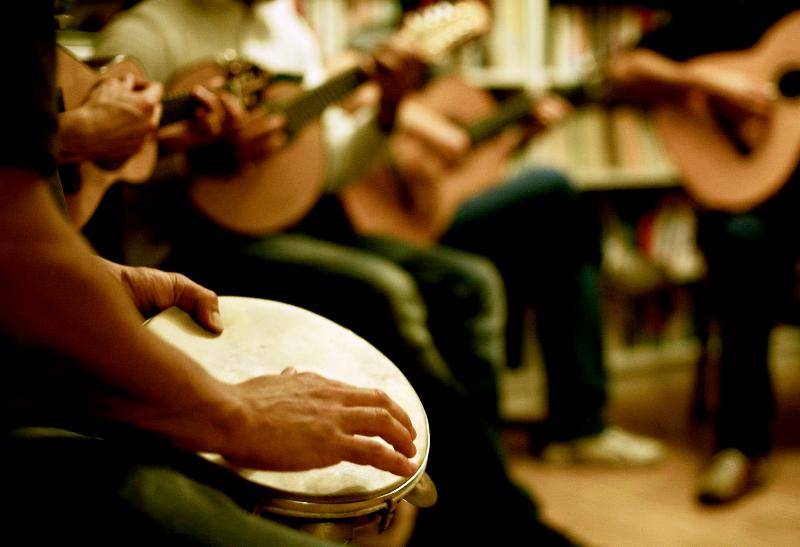
In an age of video lessons, play-alongs, digital scores, and online courses, one simple truth is worth remembering: the choro circle still remains the best school for anyone who truly wants to learn the language of the genre.
That does not mean studying alone is ineffective. It works, and it matters a great deal. But in choro there is a layer of music that only really appears in contact with other musicians. The circle teaches things no PDF can fully deliver: repertoire, listening, groove, accompaniment, entrances, responses, dynamics, respect for the space of others, and the ability to read the musical environment.
Anyone who attends choro circles knows this. Sometimes you spend the whole week studying a piece, think you have it ready, and then discover in the circle that you were still missing the real tempo, the atmosphere, the groove, the articulation, the way musicians breathe together. The circle has that power. It reveals what individual practice has built and what still needs to mature.
The circle is not just social gathering
Many people look at the choro circle as a relaxed, almost folkloric space: friends gathered together, instruments in hand, music flowing freely. That is certainly part of its beauty. But the circle has never been only a social gathering. It has always also been a place of formation.
It is in the circle that beginners learn to listen before playing. They learn that playing well does not mean playing loudly, nor showing everything they know at every moment. They learn how to sustain the pulse, how to accompany without getting in the way, how to recognize themes, how to understand the form of the pieces, and how to enter the real repertoire of the tradition.
And perhaps this is one of the most beautiful aspects of choro: the circle is demanding, but also deeply democratic. It brings together experienced musicians, amateurs, students, curious newcomers, professionals, and passionate lovers of the music. Not everyone is at the same level, of course, but everyone can learn something there. The circle organizes coexistence through music.
This is where repertoire enters the body
There are repertoires you can learn from a list. But the choro repertoire truly enters the body through repetition, listening, and coexistence. You hear the same piece a few times, then try to accompany it, then risk playing it, then make mistakes, then understand the form more clearly, then notice a modulation that had gone by unnoticed, then begin to recognize the piece from its very first measures.
This process is much more organic than schooling in the conventional sense. And that is exactly why it works so well.
In the circle, repertoire stops being an abstract collection of titles and becomes a living language. You do not just learn that a certain piece exists. You learn how it circulates, how it is usually played, what kind of groove it asks for, what spirit the piece carries, where the tricky spots usually are, and how musicians orient themselves inside it.
The language of choro is not fully contained in the score
This point is decisive. The score is extremely important. Technical study matters too. Harmony, analysis, listening to recordings, all of that matters. But the language of choro does not fit entirely on the page.
Some things are written. Some things are recorded. And some things only emerge in collective practice.
The right groove, the weight of subdivision, the subtle cunning of accompaniment, the way one responds to the soloist, the way one drives the music without becoming stiff, the moment to hold back and the moment to move forward: all of this is absorbed in practice. The circle is where language stops being a concept and becomes musical behavior.
That is why so many musicians who “play the notes” still do not sound idiomatic. They lack time in the circle. They lack lived repertoire. They lack shared listening.
The circle is still current
It may sound like something from a romanticized past, but it is not. It remains completely current.
Today we have more access to information than ever before. That is excellent. It allows for deep study, comparison of versions, slowing down recordings, analyzing harmony, reviewing difficult passages, and organizing repertoire. All of that greatly strengthens musical training.
But precisely because of that, the circle has become even more valuable. Because it offers what an excess of information cannot offer: presence, real listening, collective time, immediate response, and concrete musical experience.
In practice, the circle remains the best place to test what you have studied. It is where repertoire gains context. It is where you find out whether your groove holds up. It is where you learn to play together. It is where you encounter new pieces, new musicians, new ways of phrasing, and even new paths within the tradition.
The best school for any chorão
Perhaps the best way to sum all of this up is very simple: the circle remains the best school for any chorão.
It is the liveliest way to learn repertoire. It is the most natural way to learn the language. It is the most honest way to practice listening and ensemble playing. And despite all the changes of time, it remains one of the most democratic spaces in Brazilian music.
Those who study alone improve. Those who take lessons improve. Those who read, analyze, and research improve. But those who combine all of that with real experience in the circle go much deeper into the language of choro.
Because in the end, choro is not just a set of pieces. It is a way of making music together. And that, the circle teaches like nothing else.
Suggested course
Move from editorial context into guided study with synchronized score and structured steps.
All courses
Browse the public course catalog connected to the content hubs.