Choropedia
Paulo Aragão - Brazilian Musician
Learn about Paulo Aragão, a Brazilian guitarist, composer, and researcher known for his contributions to choro music.
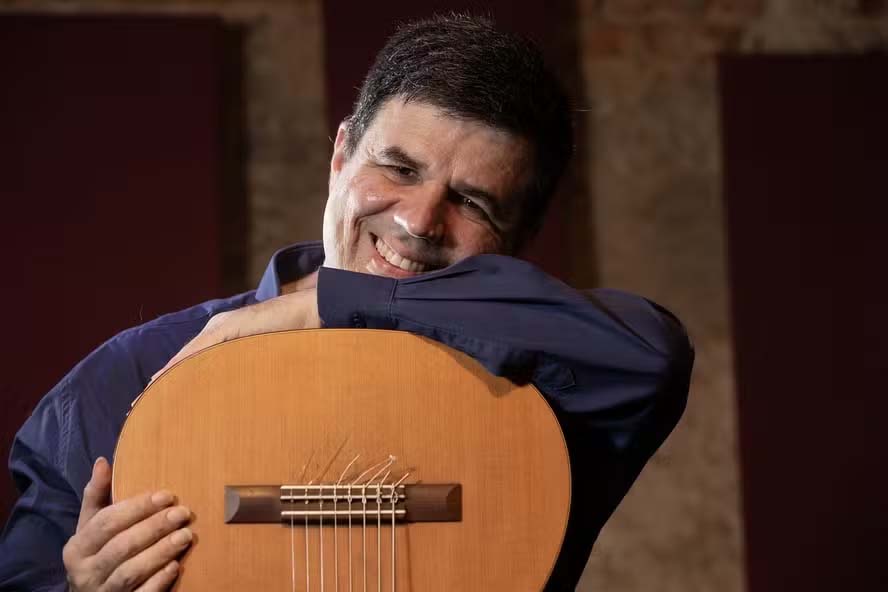 Foto: Ana Branco
Introduction
Paulo Aragão (Rio de Janeiro, 5 March 1976) is a guitarist, composer, arranger, teacher, and researcher of Brazilian music. His career brings together the practice of choro (an instrumental genre born in nineteenth-century Rio de Janeiro), writing for guitar ensembles, work with orchestras, and research into the history of popular arranging.
Founder of Quarteto Maogani, he has built an extensive body of work as an arranger and has collaborated with artists of different generations. He has also developed important work in the teaching and preservation of choro, particularly through the Escola Portátil de Música, the Casa do Choro, and projects dedicated to the work of Pixinguinha.
Quarteto Maogani
In 1994, Paulo Aragão founded Quarteto Maogani alongside Carlos Chaves, Marcos Alves, and Sergio Valdeos. The group emerged from the meeting of the four musicians in the guitar course at the School of Music of the Federal University of Rio de Janeiro.
Using different types of guitar, Maogani developed a sonority based on the distribution of melodies, bass lines, chords, and countermelodies among its members. Their first album, Maogani, was released in 1997. In the works that followed, the quartet took on pieces by composers such as Tom Jobim, Guinga, Pixinguinha, Moacir Santos, and Ernesto Nazareth, while also building a repertoire of original compositions.
Since 2024, the group has consisted of Carlos Chaves on violão requinto (a small guitar tuned a fourth higher), Diogo Sili on violão de sete cordas (seven-string guitar), Lucas Gralato on six-string guitar, and Paulo Aragão on violão de oito cordas (eight-string guitar). The new lineup made its recording debut with Maogani Autoral, the quartet's first album devoted entirely to compositions by its own members.
Over the course of its career, Maogani has received numerous accolades, including three awards for Best Instrumental Group at the Prêmio da Música Brasileira. Its discography has consolidated a language of its own, built from the Brazilian guitar tradition and open to choro, samba, song, and chamber music.
Work as an arranger
Paulo Aragão became one of the most sought-after arrangers of his generation. He has worked on projects by Guinga, Francis Hime, Dori Caymmi, Edu Lobo, Mauricio Carrilho, Nailor Proveta, and Monica Salmaso, as well as collaborating with instrumentalists such as Sergio Assad, Yamandu Costa, and Hamilton de Holanda.
His arrangements have been performed by Brazilian and foreign ensembles, among them the Brazilian Symphony Orchestra, the Petrobras Symphony Orchestra, the Jazz Sinfônica Orchestra, the Los Angeles Philharmonic, the Orchestre National de France, the Gewandhausorchester Leipzig, and the Metropole Orkest.
His writing distributes musical material across different voices, creates countermelodies, and draws on the sonic characteristics of each ensemble.
Teaching and research
Since 2002, Paulo Aragão has taught at the Escola Portátil de Música, a project dedicated to transmitting the language of choro. He is also part of the leadership of the Instituto Casa do Choro, taking part in the preparation of teaching materials, concerts, recordings, and arrangements for the Bandão (the large ensemble of the Escola Portátil de Música).
Between 2009 and 2017, he served as consultant to the music collection of the Instituto Moreira Salles. During this period, he took part in research, publications, and projects aimed at recovering the work of Pixinguinha.
He was among those responsible for organizing editions such as Pixinguinha na Pauta, Pixinguinha: Inéditas e Redescobertas, and O Carnaval de Pixinguinha. These works made accessible scores that had remained unpublished, out of print, or held in archives, while also contributing to the study of the composer's orchestral writing.
He has likewise written scripts for the Casa do Choro series on Rádio Batuta and has taught courses on the origins of choro, the formation of urban popular music, and the history of Brazilian arranging.
Musical style
Paulo Aragão's music develops at the meeting point between the choro tradition and chamber writing. His compositions preserve the melodic movement and the pulse of popular ensembles, with attention to the distribution of voices, to the different combinations among instruments, and to the construction of musical forms.
As a composer, he moves between fast and slow choros, valsas (waltzes), polcas (polkas), schottisches, maxixes (an early urban dance genre), and tangos brasileiros. His writing combines singable melodies, elaborate harmony, and an instrumental treatment that brings the roda de choro (informal choro circle) closer to chamber music.
Notable works
Contemplativo A slow choro that exemplifies his melodic writing; it was taken into the repertoire of the Furiosa Portátil.
Choro sentimental Composed in 2020 and dedicated to Cristovão Bastos, it opens the album Choros Líricos e Sentimentais.
A casa da música A lively choro built from the dialogue between melody, countermelodies, and accompaniment.
Choro no fim do mundo A collaboration with Roberto Didio, recorded with the participation of Monica Salmaso.
Tarde em Paquetá A schottisch that revisits a genre important to the historical formation of choro.
Nazareth e Milhaud A tango brasileiro whose title draws Ernesto Nazareth close to the French composer Darius Milhaud.
Choro lírico A slow-tempo piece that closes the album marking his fiftieth birthday.
Choros Líricos e Sentimentais
In 2026, Paulo Aragão released Choros Líricos e Sentimentais, an album devoted to his output as a composer. The work gathers pieces written at different moments in his career, in formations ranging from solo guitar to ensembles with winds, strings, piano, and instruments characteristic of choro.
The repertoire features thirteen tracks, among them Choro sentimental, Gafieira, Choro de outono, Choro bordado, 45 do primeiro tempo, Valsa seresteira nº 2, and Coreto de Itaipu.
The record features musicians such as Cristovão Bastos, Monica Salmaso, Toninho Carrasqueira, Nailor Proveta, Luciana Rabello, Mauricio Carrilho, Pedro Aragão, Jayme Vignoli, and members of Quarteto Maogani. Beyond documenting his original work, the album brings together the main strands of his career: the guitar, the arrangement, choro, and writing for larger ensembles.
Selected discography
Maogani, with Quarteto Maogani, 1997.
Cordas Cruzadas, with Quarteto Maogani, 2001.
Água de Beber, with Quarteto Maogani, 2004.
Maogani Autoral, with Quarteto Maogani, 2024.
Impressão de Choro, with Quarteto Maogani, 2008.
Pairando, with Quarteto Maogani, 2014.
Canela, with Renato Braz and Quarteto Maogani, 2015.
Álbum da Califórnia, with Quarteto Maogani, 2019.
Choros Líricos e Sentimentais, 2026.
Importance for choro
Paulo Aragão's contribution goes beyond his work as an instrumentalist. As an arranger, he expanded the possibilities of the guitar and of the regional (the traditional choro accompanying ensemble) within chamber and orchestral formations. As a teacher, he takes a direct part in training new generations of musicians. As a researcher, he helped recover and disseminate an important portion of Pixinguinha's repertoire and of the history of Brazilian arranging.
His work shows that tradition and renewal are not opposing paths. In his arrangements and compositions, the historical language of choro remains recognizable even as it finds new instrumentations, textures, and possibilities of writing.
Sources
The following sources are relevant to the study of Paulo Aragão and his work in Brazilian music:
Instituto Casa do Choro. Entry "Paulo Aragão," score catalogue and materials of the Escola Portátil de Música. Central source for biographical data, activity as an arranger, Quarteto Maogani, teaching, and participation in the institution's projects.
Instituto Moreira Salles. Publications, courses, and materials relating to Pixinguinha. Reference for his work as consultant to the music collection and his participation in research and score editions.
Rádio Batuta, Instituto Moreira Salles. The series Casa do Choro and Pixinguinha na Pauta, and courses on the origins of Brazilian popular music. Documentation of his activity as researcher, teacher, and scriptwriter.
Discografia Brasileira, Discos do Brasil. Records of his work as an arranger on albums by artists, instrumental ensembles, and orchestras.
Quarteto Maogani. History, lineup, and discography of the group.
Paulo Aragão's official website. Artistic career, work as guitarist, composer, and arranger, as well as his participation in the founding and development of Quarteto Maogani.
Revista Prosa, Verso e Arte. Information and technical credits for the album Choros Líricos e Sentimentais, released in 2026.
Suggested course
Move from editorial context into guided study with synchronized score and structured steps.
All courses
Browse the public course catalog connected to the content hubs.