Choropedia
Maurício Carrilho - Choro Musician
Maurício Carrilho is a prominent figure in contemporary choro music.
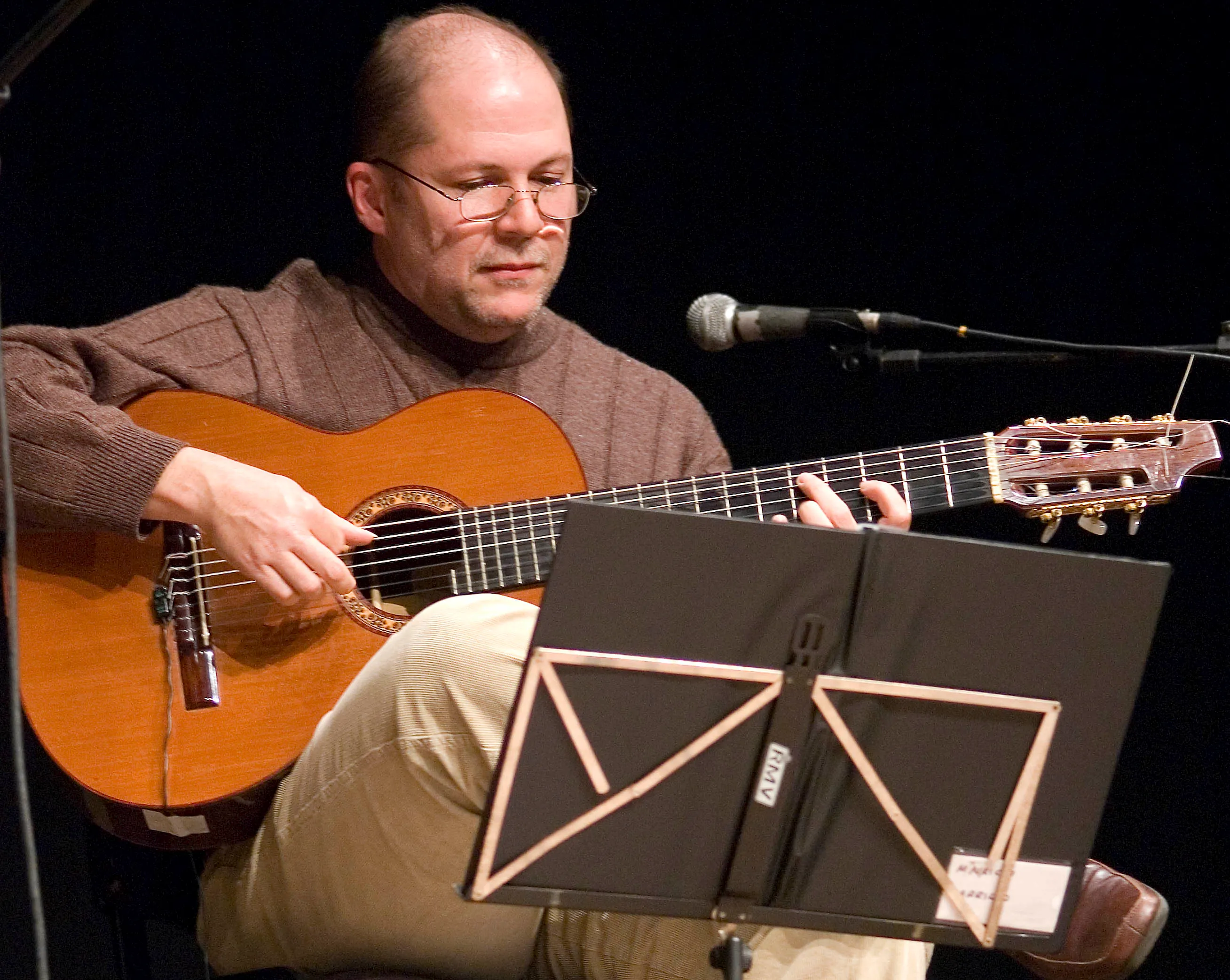
Introduction
Maurício Carrilho is a guitarist, composer, arranger, producer, researcher, and educator. Born in Rio de Janeiro on April 26, 1957, he has become one of the central figures of contemporary choro (a Brazilian instrumental music genre rooted in late-19th-century Rio de Janeiro), both for his artistic work and for his role in the transmission, systematization, and renewal of the genre. He comes from a family deeply connected to music.
His trajectory combines three fundamental dimensions: direct connection with masters of the tradition, such as Dino Sete Cordas, Meira, and Radamés Gnattali; professional work as a guitarist and arranger alongside major names of Brazilian music; and the creation of institutions and projects devoted to preserving, teaching, and circulating the choro repertoire, such as the Escola Portátil de Música, Acari Records, and the Casa do Choro.
Musical Training and Family
Maurício Carrilho was born into a family of musicians. His father, Álvaro Carrilho, was a flutist, and his uncle Altamiro Carrilho became one of the great names of the Brazilian flute. From childhood, he was surrounded by musicians such as Canhoto da Paraíba, Paulo Moura, Radamés Gnattali, Lindolfo Gaya, Elizeth Cardoso, and Nara Leão, who frequented the home where he lived.
At five years old, he received a guitar from Altamiro Carrilho. Although he began his musical studies on piano, he turned to the guitar in 1966. He studied with Dino Sete Cordas and Jayme Florence, known as Meira, and also studied classical guitar with João Pedro Borges.
The relationship with Meira was decisive. At twelve years old, Maurício began studying with Meira in long lessons that combined reading, technique, written repertoire, and ear training. For him, Meira not only taught the guitar but also gave him the confidence to pursue music as a profession.
This formation helps explain a constant mark of his trajectory: the refusal to fully separate oral tradition from formal study. Choro, for Maurício, is neither solely written repertoire nor solely intuitive practice. It is a language transmitted through fellowship, listening, accompaniment, memory, reading, and collective performance.
Dino, Meira, and the Brazilian Guitar Tradition
Maurício Carrilho's training passes through two central names of the Brazilian guitar: Dino Sete Cordas and Meira. Dino was a fundamental reference for the violão de sete cordas (the Brazilian seven-string guitar) and for the consolidation of baixarias (the characteristic descending bass lines of the seven-string guitar) in the accompaniment of choro and samba. Meira, in turn, became a decisive figure as a teacher and trainer of guitarists.
From these masters, Maurício inherited a deep understanding of the accompanying guitar. In his view, the guitar in choro should not be understood merely as a harmonic base. It organizes rhythm, drives bass lines, creates countermelodies, sustains the collective phrasing, and dialogues with the melody. It is an architectural instrument: it builds the house while the music is happening.
Meira was his great master of the guitar. His lessons combined theory, reading, and direct practice, in which the student had to immediately accompany melodies of different genres, with nothing written down. This experience would become one of the foundations of his later pedagogical work. The Meira lesson, with score in one hand and ear in the other, reappears transformed in the methodology of the Escola Portátil de Música.
Os Carioquinhas and the Choro Revival
In 1977, Maurício joined the ensemble Os Carioquinhas, alongside Luciana Rabello on cavaquinho (a small four-string Brazilian guitar), Rafael Rabello on seven-string guitar, and Celsinho Silva on pandeiro (Brazilian frame drum). The group recorded the LP Os Carioquinhas no choro and marked an important stage in the choro revival by a new generation of musicians.
This period is important because it connects Maurício to a generation that still had direct contact with old masters but also sought new forms of presentation, study, and recording. The 1970s were a fertile period in which young musicians played with figures such as Meira, Canhoto, Abel Ferreira, Waldir Azevedo, Dino, and Copinha.
Os Carioquinhas thus represent more than a youth group. They symbolize the passing of the baton. The tradition of the regional (a small ensemble built around guitars, cavaquinho, and a melodic lead instrument), the rodas (informal gatherings where choro musicians play together), and the living masters was beginning to find a new generation that was technically prepared and interested in researching, recording, teaching, and expanding the repertoire.
Camerata Carioca and Radamés Gnattali
After Os Carioquinhas disbanded, Maurício joined the Camerata Carioca, a group linked to Radamés Gnattali and Joel Nascimento. With the Camerata he recorded four LPs. In 1979, while a member of the group, he worked on shows with Elizeth Cardoso, the singer he would accompany for nearly twenty years on national and international tours.
The Camerata Carioca was decisive in modernizing the chamber language of choro. Under Radamés's influence, the group sought to unite the spontaneity of popular tradition with the balance, written notation, and precision of chamber music. This experience was tied to an aesthetic proposal that shaped Maurício's career as performer and arranger.
This synthesis between tradition and elaboration is one of the keys to understanding his work. Maurício does not treat choro as a museum piece, but neither does he dilute it in superficial modernization. His music seeks to preserve the accent, the swing, and the inner logic of the genre while expanding its formations, textures, and compositional possibilities.
O Trio
In 1993, Maurício formed O Trio alongside Paulo Sérgio Santos on clarinet and soprano saxophone, and Pedro Amorim on bandolim (Brazilian mandolin) and tenor guitar. The group brought together musicians connected to samba and choro, all with prior experience. Their first CD was recorded in Paris and nominated for the Prêmio Sharp in the instrumental music category.
O Trio continued the exploration of chamber sonorities in choro. Without abandoning traditional vocabulary, the group explored more elaborate arrangements, interaction between instruments, and a repertoire that crosses the borders between choro, samba, and Brazilian instrumental music.
The importance of this group lies precisely in its economy of means. With few instruments, the music has to breathe with clarity. Every line shows. Every countermelody must serve a purpose. Maurício's guitar, in this context, is not mere accompaniment: it is floor, wall, window, and wind.
Composer and Work
Maurício Carrilho has an extensive output as a composer. There are 796 works attributed to him, including choros, polkas, maxixes (a Brazilian urban dance form), waltzes, schottisches, frevos (a fast rhythm from Pernambuco), sambas, and other genres close to the universe of choro. Among the titles are "Biju", "Boêmia", "Bolado", "Bons tempos", "Borboleta", "Bordado de prata", "Bozó no frevo", and "Brasileiro bandolim".
Other works include "Alumiando", in partnership with João Lyra; "Choro cubano"; "Dino"; "Meira"; "O turbante do Joel"; "Proveta na madrugada"; "Serenata pro Pilger"; "Suíte para violão de sete cordas e orquestra"; "Trinta e três"; and "Um choro pra Anna".
Some of these works explicitly reveal his relationship with the tradition. Titles such as "Dino", "Meira", and "Canhoto Tramontano" function as tributes to masters and historical references. Others explore less common formal paths, such as the album Choro ímpar, released in 2007, on which he presented compositions in ternary and quintuple meters.
As a composer, Maurício works within a living tradition. His work does not imitate the past, but converses with it. Rather than treating older choro as a fixed frame, he uses its structural elements: modulations, baixarias, countermelodies, syncopations, sectional forms, swing, and melodic vocabulary. Tradition appears as a tool, not as a cage.
Acari Records and Phonographic Research
In 2000, Maurício Carrilho and Luciana Rabello created Acari Records, the first Brazilian record label specialized in choro. The label released important albums and collections, including the series Princípios do Choro, with 15 CDs, and a box set dedicated to the work of Joaquim Callado.
In 2001, the label released the series Princípios do Choro, gathering on 15 discs precious works by chorões (composers and performers of choro) from the early 20th century.
This phonographic work has historical importance. In a genre whose transmission has always depended heavily on the roda, on listening, and on memory, recording functions as a sonic archive, didactic material, and a gesture of preservation. Acari Records helped bring back into circulation little-known repertoires, unpublished works, and fundamental authors in the history of choro.
In 2007, Maurício and Luciana Rabello released the box set Choro carioca: Música do Brasil, with nine CDs dedicated to the work of 74 chorões from various regions of the country. The project arose from the Inventário do Repertório do Choro research, conducted by Maurício Carrilho and Anna Paes, which uncovered more than eight thousand works by composers of the genre between 1870 and 1920, many of them unpublished.
Escola Portátil de Música and Casa do Choro
Maurício Carrilho is one of the central names of the Escola Portátil de Música. The EPM was founded in 2000 in partnership with Pedro Aragão and Luciana Rabello, bringing together masters of choro and fostering new groups and instrumentalists.
In 2000, Maurício founded the Oficina de Choro alongside Luciana Rabello, Celsinho Silva, Álvaro Carrilho, and Pedro Amorim. This experience is directly tied to the formation of the EPM and to the consolidation of a model for collective choro teaching.
Maurício is also one of the directors of the Instituto Casa do Choro. The Escola Portátil de Música is specialized in the teaching of choro and related genres, founded in 2000 and based in Rio de Janeiro, with continuous activity in classes, workshops, and festivals.
The importance of the EPM lies in transforming oral tradition into pedagogical practice without emptying it. The goal is not to replace the roda with the classroom, but to build bridges between listening, reading, ensemble practice, perception, repertoire, and improvisation. It is a school with the smell of an archive and the sound of a roda: score on the stand, ears alert, the pandeiro calling.
Orality, Score, and Transmission
One of Maurício Carrilho's most important contributions is his reflection on the transmission of choro. Many subtleties of popular music are not in the score and are impossible to write down. This view does not reject musical notation; on the contrary, it places the score in its proper position: as a guide, not as a substitute for musical experience.
In the practice of the EPM and the Casa do Choro, scores with melody and chord symbols serve as a basis from which musicians build arrangements, countermelodies, harmonic paths, and collective solutions in real time. The score organizes the encounter, but the music happens in the way each instrumentalist transforms that material into living sound.
This position is central to the study of choro. The genre depends on reading, but is not born of reading alone. It depends on technique, but is not reduced to technique. It depends on tradition, but does not survive without invention. Maurício works precisely at this fold: between the memory of the masters and the training of new generations.
Choro as a Broader Language
Maurício Carrilho defends a broad understanding of choro. Choro is a language present in much of Brazilian music, even when it is not explicitly named as choro. For him, composers such as Tom Jobim, Edu Lobo, Caetano Veloso, and Chico Buarque also use this language at different moments in their works.
This view shifts choro away from a definition limited to a specific instrumental formation. Choro would not be only flute, bandolim, cavaquinho, seven-string guitar, and pandeiro. It is also a way of organizing melody, rhythm, harmony, counterpoint, and swing. It is a Brazilian grammar that crosses genres, periods, and formations.
For this reason, in his work and in his pedagogical practice, Maurício treats choro as a matrix. Not an old relic, but a musical language capable of continuing to produce meaning.
Archive and Preservation
Maurício Carrilho's work is also tied to the documentary preservation of choro. The Instituto Casa do Choro is one of the largest archives in Brazil dedicated exclusively to the genre, with collections such as the Inventário do Repertório do Choro, the Coleção Escola Portátil de Música, the Coleção Maurício Carrilho, and the Coleção Instituto Jacob do Bandolim.
At the Biblioteca Nacional, around 1,930 titles of choros and related genres were located among the 6,000 titles surveyed by Maurício Carrilho and Anna Paes in the Inventário do Repertório do Choro no Século XIX research.
The Coleção Maurício Carrilho contains part of the guitarist's personal LP collection, with about a thousand records, incorporated into the Casa do Choro in early 2016.
This work shows a decisive facet of Maurício: that of the musician-researcher. He does not only play the repertoire; he searches its sources, reorganizes scores, records forgotten works, trains students, and creates institutional structures so that knowledge does not depend solely on individual memory.
Legacy
Maurício Carrilho occupies a singular place in contemporary choro. He is a direct heir to masters such as Dino, Meira, and Radamés Gnattali, but also an organizer of institutions, repertoires, methods, and archives. His trajectory shows that to preserve choro does not mean to freeze it, and to renew choro does not mean to erase its tradition.
As a guitarist, he deepened the language of accompaniment and of the seven-string guitar. As a composer, he expanded the contemporary repertoire of the genre. As an arranger, he worked the sound of choro in chamber formations and in dialogue with Brazilian popular music. As an educator, he helped transform oral transmission into organized pedagogical practice. As a researcher, he contributed to revealing thousands of works and strengthening the documentary memory of the genre.
His importance lies precisely in this rare combination: Maurício Carrilho is a musician of the roda, a musician of the stage, a musician of the archive, and a musician of the school. An artist who understands that choro lives not only in the past, but also in the method, in the listening, in the new repertoire, in the student learning to accompany, and in the archive that keeps a music from disappearing.
On the map of Brazilian choro, Maurício is a bridge: from Dino to Rafael Rabello, from Meira to the Escola Portátil, from Radamés to the Casa do Choro, from oral tradition to digital archive. A bridge of strings, wood, paper, and ear.
Featured Works
Alumiando: choro in partnership with João Lyra. The piece appears as an example of his output tied to the contemporary instrumental repertoire of choro.
Dino: composition dedicated to Dino Sete Cordas, included in the repertoire of Choro ímpar. The work makes evident Maurício's relationship with the seven-string guitar tradition and with the masters who shaped his language.
Meira: composition dedicated to Jayme Florence, known as Meira, his great master of the guitar. The title reinforces the presence of affective and pedagogical memory in his compositional work.
O turbante do Joel: composition by Maurício Carrilho registered in his discography, present among the tracks of his solo CD released by Acari Records.
Suíte para violão de sete cordas e orquestra: work that expands the space of the seven-string guitar beyond the traditional regional formation, placing the instrument in dialogue with orchestral writing. It was performed by Maurício in Paris and also by Yamandú Costa with the Orquestra Sinfônica Brasileira.
Sources
- Dicionário Cravo Albin da Música Popular Brasileira — Entry "Maurício Carrilho," with biographical data, catalog of works, partnerships, recordings, and institutional activity. Available at: dicionariompb.com.br
- Instituto Casa do Choro — Composers' archive and score catalog of Maurício Carrilho, including records of groups, work in the Oficina de Choro, and reference to the holdings of the Coleção Maurício Carrilho. Available at: casadochoro.com.br
- ROSA, Luciana. "O músico e o professor: Entrevista com Mauricio Carrilho, professor na Escola Portátil de Música." MusiMid, 2022. — Maurício's reflections on teaching, orality, score, and the transmission of choro.
- IPHAN. Dossiê Técnico do Choro. — Cultural heritage document on Brazilian choro, with inventory of archives, repertoire, and institutions, including the work of the Casa do Choro and the Inventário do Repertório do Choro research.
- Teoria e Debate. "Choro: continuidade e renovação." Interview with Maurício Carrilho, 1998. — Conversation on tradition, the choro revival of the 1970s, and the relationship with Meira, Radamés Gnattali, and the Camerata Carioca.
- MuseusBr Registry — Record of the Coleção Maurício Carrilho at the Casa do Choro, with about a thousand records incorporated into the holdings in 2016.
For complementary consultation, we recommend cross-referencing the sources above with the Choropedia entries dedicated to Dino Sete Cordas, Meira, Radamés Gnattali, Rafael Rabello, and the history of the Escola Portátil de Música.
Suggested course
Move from editorial context into guided study with synchronized score and structured steps.
All courses
Browse the public course catalog connected to the content hubs.