Choropedia
Luperce Miranda: Brazilian Bandolinist
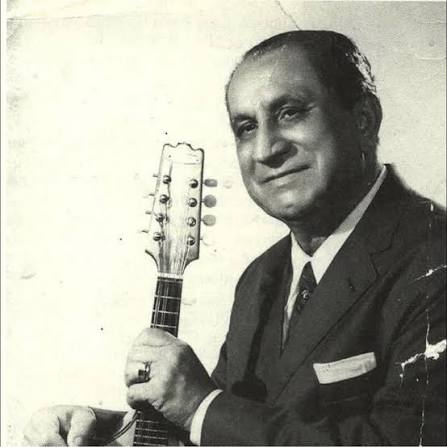
Luperce Miranda was a Pernambuco-born bandolinist, known for his contributions to choro music.
Introduction
Luperce Bezerra Pessoa de Miranda (Recife, Pernambuco, July 28, 1904 – Rio de Janeiro, April 5, 1977) was a Brazilian bandolim player, composer and multi-instrumentalist. He is regarded as one of the main figures responsible for establishing the bandolim as a solo instrument in choro. He stood out for his virtuosity, his speed of execution and the expressiveness of his playing.
His career followed the expansion of Brazilian popular music in the 20th century, from the regional ensembles of Pernambuco to the major radio stations and record labels of Rio de Janeiro. The author of hundreds of compositions, he recorded with some of the leading artists of his time and helped develop the Brazilian language of the bandolim.
Childhood and musical training
Luperce was born in the Afogados neighborhood of Recife, into a family deeply involved in music. His mother played piano, and his father played piano, guitar and bandolim. Luperce had ten siblings, and the family kept a small household orchestra.
His first contact with an instrument was one of his brothers' violin. Around the age of 12, he took up the bandolim as his main instrument. He also played cavaquinho, violão (Brazilian acoustic guitar), viola, Portuguese guitar, tenor guitar and piano.
As a teenager, he worked as a musician in cafés and cinemas in Recife. At 14, he performed as the pianist of the Jazz Band Leão do Norte. Around that time, Pixinguinha, passing through the city with the Oito Batutas, invited him to tour with the group. Luperce declined because he was helping to support his family.
In his youth, he drew close to Recife's regional music ensembles, at a time when cocos, emboladas, frevos and other northeastern genres were widely played.
The northeastern ensembles and the move to Rio de Janeiro
Luperce was among the founders of the Turunas da Mauricéia, a Pernambuco ensemble that achieved great success in Rio de Janeiro from 1927 onward. He did not travel with the group, however: his brothers João and Romualdo Miranda went to Rio while he stayed in Recife.
With singer Augusto Calheiros, the Turunas recorded the embolada Pinião in 1927, and it became one of the biggest hits of the 1928 carnival. The song is credited to Luperce and Calheiros, but its authorship is disputed: researchers point to a likely folk origin, and the sheet music of the time credited it to the Turunas themselves.
Luperce arrived in Rio de Janeiro in early 1928 with the Voz do Sertão, an ensemble he had founded in Recife in 1927. Besides Luperce on bandolim, the group included Robson Florence, also on bandolim, Jaime Florence, later known as Meira, on guitar, José Ferreira on cavaquinho, and embolada singer Minona Carneiro.
Between August 1928 and March 1929, the Voz do Sertão released 16 78-rpm discs on Odeon, with two songs per disc, featuring Luperce compositions such as the choro Pra frente é que se anda, the waltz Lucinete and the fox-charleston Buliçoso. In the same period, he recorded as a soloist for Parlophon and was hired by Rádio Clube do Brasil, the first station of his long radio career.
The bandolim on record and on the radio
In the early 1930s, Luperce became a sought-after instrumentalist for the country's leading record labels. His bandolim can be heard on the first recordings of the sambas Com que roupa?, by Noel Rosa, and Se você jurar, by Ismael Silva, Nilton Bastos and Francisco Alves, and shortly afterward on No tabuleiro da baiana, by Ary Barroso.
His regional ensemble accompanied artists such as Carmen Miranda, Francisco Alves, Mário Reis and Noel Rosa, at a time when small instrumental groups played a central role in recordings and radio broadcasts.
In 1931, he toured South America with Carmen Miranda, Francisco Alves and Mário Reis, performing in Argentina, Chile and Paraguay. In Buenos Aires, he played on Radio El Mundo and at the Cine Teatro Broadway, cementing his reputation as a virtuoso.
After Rádio Clube do Brasil, he worked at Rádio Mayrink Veiga, where he was a featured act on the Programa Casé, and at Rádio Nacional. In the 1940s, he formed the Quarteto Brasil, with the guitars of Romualdo Miranda and José Menezes and with Tute, recording for Continental.
His constant presence on the radio helped spread the bandolim as both a solo and accompanying instrument, bringing his repertoire to an audience far wider than that of the rodas de choro.
Working with Pixinguinha
The musical relationship between Luperce Miranda and Pixinguinha, a longtime admirer of the bandolim player, produced important recordings in the history of choro.
In 1934, Luperce recorded an instrumental version of Carinhoso for Victor, years before the piece received João de Barro's lyrics. It was one of the earliest recordings of the work, which Pixinguinha had already recorded in 1928, and the disc was released under a misprinted title: Carinhos.
At the same session, he recorded Pixinguinha's Naquele tempo, released on disc that same year. It is the earliest known recording of this classic.
Shortly afterward, Luperce recorded two more Pixinguinha compositions, the choro Recordando and the waltz Iolanda, alongside the composer himself on flute and Arthur de Souza Nascimento, known as Tute, on the seven-string guitar.
The lineup brought together three instruments that are fundamental to the language of choro: the flute carrying the melody, the bandolim with its characteristic articulation, and the seven-string guitar building the accompaniment and bass counterpoint. These recordings document a decisive phase of Brazilian instrumental music.
Luperce Miranda's style
Luperce developed a bandolim technique marked by agility, precision and clear articulation. His playing explored fast passages, scales, arpeggios and ornaments, combined with elaborate melodic phrases.
Speed became one of his best-known traits, but his style also stood out for its expressive treatment of waltzes and slow melodies. His rich phrasing, inventive harmonic solutions and command of the instrument's possibilities helped establish a distinctive Brazilian bandolim language.
Alongside Jacob do Bandolim, fourteen years his junior, Luperce became a fundamental reference for choro bandolim players in the 20th century.
The two had distinct musical personalities and a relationship of mutual admiration, though not without friction. In a 1967 testimony to the Museu da Imagem e do Som, Luperce stated that he had been Jacob's teacher. A few days later, at the same museum, Jacob replied that he had never been his student, while praising the Pernambuco musician's technique and agility.
The return to Pernambuco
In 1946, Luperce left the Rio record labels and radio stations and returned to Recife, where he stayed until 1955.
In the Pernambuco capital, he worked at Rádio Jornal do Commercio. He performed leading the station's Grande Orquestra, then conducted by César Guerra-Peixe, with the Trio Miranda, formed with his brothers Nelson and Romualdo, and with his regional ensemble, which included the young pandeiro player Jackson do Pandeiro.
Through the station, he toured northeastern cities from Salvador to Fortaleza. The period strengthened choro in the Northeast and coincided with the rise of Jacob do Bandolim in Rio de Janeiro.
Back in Rio de Janeiro and teaching
In May 1955, Luperce went to Rio for a concert at the Associação Brasileira de Imprensa and was soon hired by Rádio Nacional, where he stayed until his retirement in 1973. He also began recording for the Sinter label.
In 1956, he founded the Academia Luperce Miranda, dedicated to teaching string instruments. The school formalized a teaching activity he had already been pursuing informally for years.
Among his students was Evandro do Bandolim, from Paraíba, who would stand out in the next generation.
In 1970, he became the first recipient of the title of Bachelor of Brazilian Popular Music, awarded by the Museu da Imagem e do Som of Rio de Janeiro. He kept teaching until the end of his life, alongside a career built on stage, in the studio and on the radio.
Major works
Luperce Miranda's output is estimated at around 500 compositions, including choros, waltzes, frevos, emboladas and other popular genres.
Among his best-known works are:
- Segura o dedo: a choro recorded by the composer in 1934 for Victor with a regional ensemble, known for its technical demands.
- Reboliço: a choro first recorded in 1945 by the Quarteto Brasil, one of his most widely played works.
- Picadinho à baiana: a choro recorded in the 1950s, now part of the traditional bandolim repertoire.
- Frevo pernambucano: co-written with Osvaldo Santiago and released by Francisco Alves for the 1931 carnival; it is considered the first recording with the word "frevo" in its title.
- Fala, coração: a waltz recorded by the composer in 1934 that showcases his melodic writing.
- Tezinha: a waltz released on his first Sinter record, after his return to Rio.
- Pinião: an embolada credited to Luperce and Augusto Calheiros, of disputed authorship.
The diversity of his work reflects his constant contact with different Brazilian musical traditions and his activity both as a soloist and as an accompanist.
Selected discography
Luperce took part in around 700 recordings over his career. Most were released on 78-rpm discs, before the LP took hold in Brazil.
- Ritmos Brasileiros – Vol. 2: Choros e Valsas — 1950s, Sinter
- De Ontem e Sempre — 1968, Museu da Imagem e do Som
- O Bandolim e o Mestre — 1970, Prodígio
- Luperce Miranda — 1971, Som/Copacabana
- História de um Bandolim — 1977, Discos Marcus Pereira
- Luperce Miranda Interpreta Luperce Miranda — 1978, posthumous release
In 1995, bandolim player Pedro Amorim released Pedro Amorim Toca Luperce Miranda, his first solo album, devoted entirely to the Pernambuco composer's work.
Final years and legacy in choro
In the 1970s, Luperce was filmed in the short documentary Chorinhos e chorões (1973) and, in 1976, at a recital at the Copacabana Palace captured by the newsreel Brasil Hoje. He died in Rio de Janeiro on April 5, 1977, aged 72, after a heart attack, following more than five decades of musical activity.
His contribution went beyond virtuosity. He took part in the expansion of choro in the recording industry, helped establish the bandolim as the solo voice of regional ensembles and left a repertoire still played by musicians of the genre.
As a performer, composer and teacher, Luperce is a link between the tradition of the chorões of the early 20th century and the generations that went on to develop the language of the Brazilian bandolim.
Sources
- Instituto Moreira Salles. Discografia Brasileira: Turuna, chorão e "máquina de tocar bandolim": memórias de Luperce Miranda nos 120 anos de seu nascimento.
- Instituto Moreira Salles. Rádio Batuta: Luperce de ontem e sempre.
- Instituto Moreira Salles. José Ramos Tinhorão Collection: Luperce Miranda, Luiz Barbosa e Pixinguinha.
- Instituto Casa do Choro. Archive and biographical entry on Luperce Miranda.
- Instituto Memória Musical Brasileira (IMMuB). Discography and records of Luperce Miranda.
- Dicionário Cravo Albin da Música Popular Brasileira. Entry Luperce Miranda.
- Discography of American Historical Recordings (UCSB). Victor 33825 and Victor 33795.
- BARBOZA, Marília Trindade. Luperce Miranda, o Paganini do bandolim. Rio de Janeiro: Editora da Fonseca, 2004.
Suggested course
Move from editorial context into guided study with synchronized score and structured steps.
All courses
Browse the public course catalog connected to the content hubs.