Choropedia
Louro: Brazilian Musician and Band Leader
Learn about Louro, a prominent clarinetist and band leader in Brazilian music.
Introduction
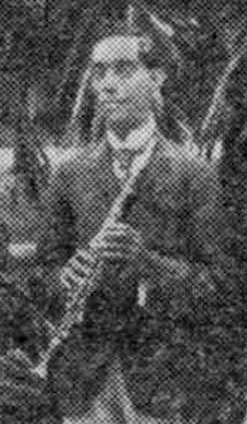
Lourival Inácio de Carvalho (Niterói, Rio de Janeiro, April 22, 1894 – June 17, 1956), known as Louro, was a Brazilian clarinetist, saxophonist, composer and bandmaster. His career unfolded in the first decades of the twentieth century, a period in which choro was taking shape as a genre and the recording industry was expanding in Brazil.
He began in the town bands of Rio de Janeiro state. He then moved on to the instrumental ensembles that played at dances, popular festivals, theaters and cinemas. Leading his own group, he recorded dozens of records, playing his own pieces and those of composers of his generation.
His most successful recordings were Urubu Malandro and Moleque Vagabundo.
Musical Training and Early Years
Born in Niterói, Louro began studying music in the band of the Companhia Manufatora Fluminense, the textile factory where he also worked. There he gained experience in ensemble playing, music reading and the band repertoire of the time.
His talent was noticed early. At little more than 16 years old, he was invited to organize and conduct the town band of Rio Bonito, in the interior of Rio de Janeiro state.
He later became bandmaster of the Grupo Vinte e Um de Abril in Capivari. Capivari was a municipality neighboring Rio Bonito, and it was renamed Silva Jardim in 1943. During this period he created his adaptation of Urubu Malandro, the popular tune that would become linked to his name.
The Grupo do Louro
After leaving his post as bandmaster, Louro formed the Grupo do Louro. The group played at festivals, dances, theaters and cinemas in Rio de Janeiro and Niterói.
One of its members was João da Baiana (João Machado Guedes, 1887–1974), a composer, singer and percussionist. He played the pandeiro (Brazilian frame drum with jingles) and the prato-e-faca (a plate scraped with a knife, used as percussion). He also played in the Grupo da Guarda Velha and the Diabos do Céu ensemble.
The group's repertoire included choros, sambas, polkas, mazurkas, schottisches and maxixes (an urban Brazilian dance of the late nineteenth century). This range was typical of the chorões (choro musicians) of the time, who moved freely between European-derived dances and Brazilian rhythms.
Besides Louro's own compositions, the group performed works by Anacleto de Medeiros, Ernesto Nazareth, Azevedo Lemos, José Belisário, Otávio Dutra, Donga and Benedito Montes, among others.
The Recordings
Starting in 1913, the Grupo do Louro made dozens of recordings for Casa Edison, the company that laid the foundations of the Brazilian recording industry.
These recordings belong to the acoustic era. Musicians played in front of large horns that captured sound mechanically, before electric microphones were introduced. The records document the sound of small Brazilian instrumental ensembles before the rise of the regionais (the standard choro ensembles of the radio era).
The recordings of Urubu Malandro and Moleque Vagabundo were the group's greatest successes.
Louro kept recording into the electric era. In December 1930, he recorded two choros of his own for Victor in Rio de Janeiro, as a saxophone soloist: Em Alta Madrugada and Osvaldina.
Urubu Malandro
Urubu Malandro is the work most closely associated with Louro. According to the Casa do Choro, its origin lies in a popular tune that circulated in the interior of Rio de Janeiro state. Louro gave the tune an adaptation of his own while serving as bandmaster in Capivari.
Separating the traditional melody from Louro's contributions is essential to understanding the piece's history. Although the work is catalogued under his name, his biography describes it as an adaptation of an earlier tune.
Over the years, Urubu Malandro entered the repertoire of successive generations of chorões. It became especially associated with the practice of melodic variation, in which the soloist develops new phrases over a well-known theme.
The Grupo do Louro at the Festa da Penha
In the 1920s, the Grupo do Louro was a regular presence at the Festa da Penha, one of Rio de Janeiro's most important popular celebrations. It appeared alongside the groups of Caninha, Pixinguinha, Donga and Sinhô.
Beyond its religious dimension, the festival was a meeting place for professional and amateur musicians and a showcase for new compositions.
The group's regular participation shows how firmly it belonged to the Rio de Janeiro music scene of the period.
Compositions
Louro left works in several genres of urban popular music. The Casa do Choro archive holds 16 of his compositions:
- A Origem da Dor
- Catinga de Mulato
- Céu Moreno
- Coração que Chora
- Édila
- Então Não Sei!
- Jardineiro
- Juvenal Brandão
- Mágoas do Louro
- Não É Exato
- O Namoro do Avelino
- Oculta
- Parafuso do Inferno
- Quando Ela Gosta
- Rogério no Choro
- Urubu Malandro
His 1930 Victor records add two more choros of his own:
- Em Alta Madrugada
- Osvaldina
Louro and the History of Choro
Louro's career brings together practices that were central to the development of choro in the early twentieth century. He trained in town bands, organized his own ensemble and took part in the first decades of the recording industry.
His repertoire also documents the coexistence of genres that shaped the chorões' repertoire, such as the polka, the maxixe, the schottische and the samba.
Louro died on June 17, 1956, at the age of 62. His records and scores remain important documents for the study of Brazilian instrumental music in the first decades of the twentieth century.
Sources
- Instituto Casa do Choro. Louro (Lourival Inácio de Carvalho). Enciclopédia Ilustrada do Choro no Século XIX. Main reference for biographical data and professional career.
- Instituto Casa do Choro. Catálogo de obras de Louro. Record of 16 compositions held in the archive.
- Instituto Moreira Salles. João da Baiana tocando prato-e-faca. Photograph, c. 1968, Pixinguinha Collection. The biographical caption records João da Baiana's membership in the Grupo do Louro.
- Discography of American Historical Recordings (UC Santa Barbara Library). Louro. Record of the December 1930 Victor sessions: Em Alta Madrugada (matrix 65081, Victor 33433) and Osvaldina (matrix 65082, Victor 33443), both saxophone solos.
- IBGE. Silva Jardim: histórico do município. Record of the renaming of Capivari as Silva Jardim (State Decree-Law No. 1,056, December 31, 1943).
Works cited in the Casa do Choro entry:
- Enciclopédia da Música Brasileira: Popular, Erudita e Folclórica. São Paulo: Art Editora/Publifolha, 1998.
- Pinto, Alexandre Gonçalves. O Choro: Reminiscências dos Chorões Antigos. 2nd ed. Rio de Janeiro: Funarte, 1978 [1936]. pp. 40–41.
- Aquarone, F. História da Música Brasileira. Rio de Janeiro: Francisco Alves, 1946.
- Franceschi, Humberto. A Casa Edison e seu Tempo. Rio de Janeiro: Sarapuí, 2002.
Suggested course
Move from editorial context into guided study with synchronized score and structured steps.
All courses
Browse the public course catalog connected to the content hubs.