Choropedia
José Rielli: A Key Figure in Brazilian Choro
Discover the life of José Rielli, a pivotal Italian accordionist and composer in São Paulo's choro scene.
Introduction
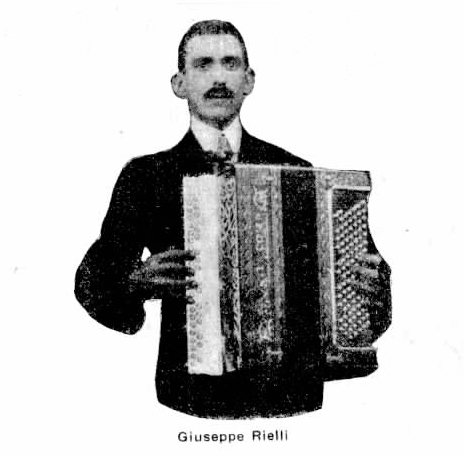
José Rielli, the name by which Giuseppe Rielli became known (Pontedera, Pisa, Italy, November 19, 1885 – São Paulo, March 22, 1947), was a composer and accordionist, an important figure in São Paulo's instrumental music during the first half of the 20th century.
An Italian immigrant raised in the interior of São Paulo state, he took part in the first phonographic recordings of the accordion in Brazil and performed with ensembles that were fundamental to the consolidation of São Paulo choro, such as the Sexteto Piratininga and the Orquestra Colbaz.
His career spans a decisive period in Brazilian music: from the first mechanical recordings of the 1910s to the expansion of record labels, sound film, radio, and the large instrumental ensembles of the following decades.
From Italy to São Paulo
Rielli arrived in Brazil in 1891, still a child, accompanied by his father, who settled in Itu, in the interior of São Paulo state. At around ten years old, he began learning music with the organist of the town's main church, who noticed his musical aptitude.
He became a carpenter and, alongside this trade, continued studying piano and harmonica. He also developed skills in repairing and tuning pianos and harmonicas, work that brought him into direct contact with a variety of keyboard and bellows mechanisms.
He later moved to the Brás neighborhood in the state capital, where he would become one of the most active instrumentalists on the São Paulo scene. His training took place in a musical environment that predated the consolidation of the Brazilian recording market. When he began recording, the accordion still occupied a very different place from the one it would later hold in popular music.
A Pioneer of the Accordion on Record
In 1914, Rielli began recording for Odeon/Casa Edison, on records where he also appears under his birth name, Giuseppe Rielli. He would later record for Columbia and for the São Paulo label Arte-Fone.
These records are among the earliest phonographic documents of the accordion in Brazilian popular music. His repertoire included waltzes, mazurkas, tangos, salon pieces, and adaptations of well-known works, reflecting the wide circulation of these genres in the early 20th century.
Among his compositions from this period are the mazurkas Às Margens do Tietê and Saudades da Lapa.
Rielli's presence in the early years of the recording industry is particularly significant because it predates the great popularization of the accordion in Brazil. Decades before sanfona players and accordionists became central figures of radio and popular music, the instrument was already appearing in recording studios through musicians like him.
The Sexteto Piratininga
Starting in 1927, Rielli joined the Sexteto Piratininga, the first ensemble he was part of and one of the most important groups in São Paulo choro of the period.
The group was associated with violinist and composer Alberto Marino. With him, Rielli recorded Rapaziada do Brás and Luar de São Paulo in 1932, two waltzes by Marino associated with the musical landscape of São Paulo at the time.
At the same time, he continued to record his own compositions, including Arminda, Saudosa Araraquara, and Stella.
The Sexteto Piratininga reveals an important characteristic of São Paulo choro in the early decades of the 20th century. Alongside string instruments and the violin, the accordion helped create a sound distinct from that associated with the Rio de Janeiro regional ensembles of flute, cavaquinho, and guitars.
The Orquestra Colbaz
Another fundamental chapter in Rielli's career was his participation in the Orquestra Colbaz, founded in the early 1930s and led by pianist and conductor Gaó, Odmar Amaral Gurgel.
The orchestra's name came from the telegraphic address of Columbia in Brazil, whose studios were located in São Paulo. The lineup brought together some of the leading instrumentalists of the São Paulo scene: Gaó on piano, Atílio Grany on flute, Jonas Aragão on clarinet, José do Patrocínio Oliveira, known as Zezinho and later as Zé Carioca, on violin, Hudson Gaya, known as Petit, on guitar, and Rielli on accordion.
With this lineup, Rielli took part in important recordings of the works of Zequinha de Abreu, including Tico-Tico no Fubá, Os Pintinhos no Terreiro, Nossa Padroeira, Amando sobre o Mar, and Branca.
These recordings hold a special place in the history of choro. The Colbaz recording of Tico-Tico no Fubá, released by Columbia in 1931 on disc 22029, was the first recording of the composition that would, years later, become internationally known. In 1932, the orchestra also made the first recording of Os Pintinhos no Terreiro, another future classic of the genre.
The presence of Rielli's accordion within the orchestra also shows the instrumental variety of São Paulo choro at the time, when ensembles close to salon orchestras coexisted with small regional groups.
Composer and Soloist
Rielli simultaneously maintained his own output as a composer and soloist.
His repertoire moved through genres very present in the recording market of the time, especially waltzes and mazurkas. In 1932 he recorded for Columbia the waltz Alma Dolorosa and the mazurka Olga, both his own compositions. In 1939 he recorded, among others, the mazurka Sombras do Império and the polka Saltitante. His recordings also include titles such as Alegrias de Primavera, Rapaziada de São Caetano, and Joly.
The Discografia Brasileira lists more than a hundred recordings related to Rielli as a performer over the course of his career, in addition to various compositions of his own.
This body of recordings reveals a musician who was not restricted to a single genre. The same career that placed him within the history of choro also passes through urban waltzes, mazurkas, polkas, rancheiras, and other forms that circulated among dance halls, radio stations, records, and popular ensembles.
In 1931, Rielli also appeared in Coisas Nossas, by Wallace Downey, the first Brazilian film in the form of a musical revue.
Between Choro and Sertanejo Music
In the following decades, the accordion would gain an ever larger space in Brazilian popular music. Rielli took a direct part in this transformation.
His work also extended into the world of rural and sertanejo music produced in São Paulo. One of his best-known compositions in this repertoire is Feijão Queimado, co-written with Raul Torres and later recorded by Raul Torres and Florêncio.
During the last five years of his life, Rielli hosted the program Os Três Batutas do Sertão on Rádio Bandeirantes, which stayed on the air until his death in 1947.
This connection shows how permeable the boundaries between choro, salon music, and the sertanejo repertoire were in São Paulo in the 1930s and 1940s. Instrumentalists moved between radio stations, studios, orchestras, and accompanying ensembles, carrying techniques and repertoires from one setting to another.
The accordion was at the center of this circulation.
A Family of Musicians
Music also carried on within the Rielli family.
Of Rielli's four children, Emílio Rielli and Oswaldo Rielli, known professionally as Rielinho, pursued musical careers. Emílio worked as a composer and conductor; Oswaldo became an accordionist, composer, and radio and recording artist.
In 1941, José Rielli himself organized the Orquestra Típica Rielli, an ensemble devoted to the repertoire of the orquestras típicas and the world of tango, which came to be directed by Emílio.
Rielinho would continue recording for decades and even recorded compositions by his father, keeping part of that repertoire in circulation after José Rielli's death.
José Rielli and São Paulo Choro
José Rielli's career helps broaden our understanding of the history of choro beyond the more thoroughly documented Rio de Janeiro axis.
In the early decades of the 20th century, São Paulo developed its own instrumental scene, fueled by immigration, cafés, theaters, radio stations, record labels, and urban expansion. Musicians such as Gaó, Garoto, Alberto Marino, Armandinho Neves, and José Rielli were part of this environment.
Within this history, Rielli holds a particular position.
He was one of the first accordionists recorded by the Brazilian phonographic industry, took part in important ensembles of São Paulo instrumental music, and was present on the first recordings of works that would become fundamental documents of the choro repertoire.
His story also shows that the accordion was already part of Brazilian urban music long before its explosion in popularity from the 1940s and 1950s onward.
Notable Works
His compositions include:
- Às Margens do Tietê
- Saudades da Lapa
- Arminda
- Saudosa Araraquara
- Stella
- Alegrias de Primavera
- Alma Dolorosa
- Olga
- Sombras do Império
- Saltitante
- Rapaziada de São Caetano
- Joly
- Feijão Queimado, with Raul Torres
Selected Recordings
As an ensemble performer:
- Rapaziada do Brás, by Alberto Marino — Sexteto Piratininga
- Luar de São Paulo, by Alberto Marino — Sexteto Piratininga
- Tico-Tico no Fubá, by Zequinha de Abreu — Orquestra Colbaz, first recording, 1931
- Os Pintinhos no Terreiro, by Zequinha de Abreu — Orquestra Colbaz, first recording, 1932
- Nossa Padroeira, by Zequinha de Abreu — Orquestra Colbaz
- Amando sobre o Mar, by Zequinha de Abreu — Orquestra Colbaz
- Branca, by Zequinha de Abreu — Orquestra Colbaz
Sources
- Instituto Casa do Choro. Archive and documentation on José Rielli and São Paulo choro.
- Instituto Moreira Salles. Discografia Brasileira and phonographic records of José Rielli, Sexteto Piratininga, and Orquestra Colbaz.
- Dicionário Cravo Albin da Música Popular Brasileira. Entry "José Rielli".
- Dicionário Cravo Albin da Música Popular Brasileira. Entry "Orquestra Colbaz".
- PRANDO, Flávia Rejane. Research on the guitar and popular music in São Paulo. ECA-USP.
- José Rielli, chorão sanfoneiro de Itu. Catraca Livre.
Suggested course
Move from editorial context into guided study with synchronized score and structured steps.
All courses
Browse the public course catalog connected to the content hubs.