Choropedia
Joel Nascimento - Brazilian Choro Musician
Learn about Joel Nascimento, a pivotal figure in Brazilian choro since the 1970s.
Introduction
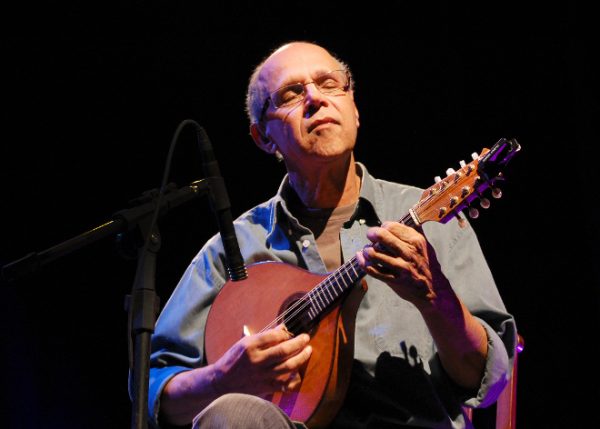
Joel Nascimento (Rio de Janeiro, October 13, 1937) is a bandolim player, composer, and multi-instrumentalist. He has been one of the central figures of Brazilian choro since the 1970s. He holds a unique place between the generation shaped under the direct influence of Jacob do Bandolim and the musicians who would renew the genre in the following decades.
Although he made his name on the eight-string bandolim (the Brazilian mandolin), his training included piano, cavaquinho, guitar, and accordion. This broad background shaped a way of playing that combines choro's characteristic articulation with a musical conception close to chamber writing.
Joel also played a decisive role in bringing the choro regional together with the work of Radamés Gnattali. The ensemble that would become the Camerata Carioca was first assembled to perform Retratos. It became a reference for a generation of instrumentalists and opened new possibilities of repertoire and writing for choro ensembles.
Early Years and Training
Born in Penha Circular, in the suburbs of Rio de Janeiro, Joel became interested in music as a child. He was playing cavaquinho by age ten, and at 14 he began studying piano. He later studied accordion at the Academia Mário Mascarenhas, and at 18 he entered the Conservatório Brasileiro de Música, where he studied classical piano with Max de Menezes Gil.
This training left a deep mark on the way he practiced and performed. Even after the bandolim became his main instrument, Joel kept an approach to practice built on the discipline of classical piano. He worked on articulation, dynamics, tone, and phrasing with great care.
While still young, he met Jacob do Bandolim, at a time when he played mainly cavaquinho and was studying piano. His contact with Jacob was important to his understanding of the instrument.
Return to Music and the Bandolim
At 22, Joel interrupted his musical path after completely losing the hearing in his right ear due to otosclerosis. He stepped away from his instruments and worked for the airline Panair do Brasil. He later trained as a radiology technician, a profession he practiced in public hospitals in Rio de Janeiro and at the Instituto Médico Legal (the city's forensic medicine institute).
His return began in 1968, through his brother Joyr Nascimento, a guitarist and one of the founders of the Sovaco de Cobra. Joyr brought Dr. Oraci, a lawyer and amateur musician, to Joel's home. Oraci asked Joel to play the cavaquinho. Impressed by what he heard, he invited him to join the choro rodas he hosted at his house, attended by musicians such as Dino Sete Cordas and César Faria.
In 1969, Dr. Oraci gave Joel a bandolim purchased at Ao Bandolim de Ouro, a traditional Rio store known for making and selling string instruments. The gift changed the course of his career for good. Already past 30, Joel devoted himself to the bandolim and began building the career that would make him one of the leading instrumentalists of his generation.
Jacob's influence remained, but Joel gradually developed his own language. His pianistic training and his interest in repertoire beyond the traditional boundaries of choro made the bandolim, in his hands, an instrument able to move between rodas, popular recordings, and more elaborate chamber works.
This openness to repertoire would become one of the defining features of his career.
The Sovaco de Cobra and the Choro Revival
Joel was connected to the Sovaco de Cobra, in Penha, one of the most important strongholds of Rio choro in the 1960s and 1970s.
The venue brought together musicians of different generations. It helped strengthen a practice that had never disappeared from Rio's rodas and neighborhoods, but that would regain wide public visibility during the 1970s.
During this period, concerts, festivals, and new records brought choro back to major concert halls and to the record market. Alongside musicians such as Déo Rian, Abel Ferreira, Altamiro Carrilho, Waldir Azevedo, and Paulo Moura, Joel became one of the instrumentalists associated with this revival.
His bandolim, however, also pointed in another direction. Beyond the traditional repertoire, Joel was drawn to concert music, to elaborate arrangements, and to composers who could bring written music and popular practice closer together.
In Radamés Gnattali he would find an essential partner in this pursuit.
*Chorando pelos dedos*
In 1976, Joel released his first solo album, Chorando pelos dedos ("Crying Through the Fingers").
The title came from a song by João Nogueira and Cláudio Jorge, written in his honor and recorded by João Nogueira the previous year.
The album introduced a bandolim player capable of traveling through different regions of Brazilian music without abandoning the language of choro. The tracks included Evocação de Jacob by Avena de Castro, Chorinho do Sovaco de Cobra by Abel Ferreira, and compositions by Joel himself.
Later works such as Meu sonho and O pássaro further expanded the repertoire he recorded.
Alongside his solo career, Joel became a regular presence in the studio. His bandolim can be heard on recordings by artists such as Chico Buarque, Clara Nunes, João Nogueira, Paulinho da Viola, Nara Leão, Dona Ivone Lara, Elizeth Cardoso, and Paulo Moura, among many others.
Joel Nascimento and Radamés Gnattali
His relationship with Radamés Gnattali holds a special place in Joel's career.
In the 1970s, Joel turned to Retratos, a work Radamés had originally written for bandolim and instrumental ensemble and that Jacob do Bandolim had recorded in 1964.
Joel studied the piece and began performing it with Radamés himself at the piano. Their musical affinity led to a collaboration that went beyond the relationship between performer and composer.
In 1979, Joel asked Radamés for a new instrumentation of Retratos, replacing the strings of the earlier version with an ensemble based on the choro regional.
To perform it, he gathered some of the most important young musicians of the time: Raphael Rabello, Maurício Carrilho, Luís Otávio Braga, Luciana Rabello, and Celsinho Silva.
This group would become the first lineup of the Camerata Carioca.
The new version of Retratos placed side by side two traditions that had long been treated separately: chamber writing and the instrumental format of choro.
The result was recorded on the album Tributo a Jacob do Bandolim ("Tribute to Jacob do Bandolim"), released in 1980.
The Camerata Carioca
The Camerata Carioca became one of the defining experiences of Brazilian instrumental music of that period.
Rather than using the regional merely as accompaniment for a soloist, the ensemble explored arrangements in which each instrument took on carefully written roles. Guitars, cavaquinho, percussion, and bandolim took part in a collective texture, with countermelodies, shifting roles, and constant dialogue between the voices.
Joel was at the melodic center of the group, but without reducing it to a mere backing band for the bandolim.
This conception is clearly heard in the work done with Radamés.
On Vivaldi & Pixinguinha, the ensemble placed seemingly distant repertoires side by side. Works by Antonio Vivaldi shared the program with compositions by Pixinguinha, showing that the regional could handle counterpoint and chamber writing as well as the swing and articulation typical of choro.
The experience had a strong impact on the next generation. The Camerata helped show that the choro tradition could be preserved not only by repeating established models, but also by expanding its instrumental possibilities.
Between Choro and Other Repertoires
Joel Nascimento's career goes beyond the traditional choro repertoire. Over the years, his bandolim moved through works by Pixinguinha, Jacob do Bandolim, Ernesto Nazareth, and Waldir Azevedo, but also through composers such as Vivaldi, Villa-Lobos, and Radamés Gnattali, in settings ranging from the regional to chamber ensembles and orchestras.
Joel also developed his own body of work as a composer, writing choros, instrumental pieces, and works for piano. His compositions include Ecos, O pássaro, Primavera, Contrastes, Cantilena, Caminhos, Congada do Sino, Silhueta, and Lamento.
Ecos gained prominence in the 1970s when it was included in the soundtrack of the telenovela À Sombra dos Laranjais. It was also recorded on his first album.
Part of his piano output received a new reading in 2023 on Maria Teresa Madeira interpreta Joel Nascimento – Obras para piano ("Maria Teresa Madeira Plays Joel Nascimento – Works for Piano"). The album revealed a compositional voice not confined to the possibilities of the bandolim.
The Sexteto Brasileiro and International Tours
Joel formed the Sexteto Brasileiro (Brazilian Sextet) with musicians from the same instrumental generation that had renewed choro.
Its lineups included names such as Paulo Sérgio Santos, Maurício Carrilho, Luís Otávio Braga, João Lyra, Henrique Cazes, and Beto Cazes.
With the group, Joel toured the United States in the late 1980s and performed at the Santa Fe Chamber Music Festival. He brought to the American chamber music circuit a repertoire spanning Pixinguinha, Jacob, Radamés, Villa-Lobos, Ernesto Nazareth, and traditional Brazilian themes.
Recordings of these performances were released as Joel Nascimento and the Brazilian Sextet – Live! and, later, Joel Nascimento & Sexteto Brasileiro.
The Relationship with Jacob
Although he followed his own path, Joel never let go of Jacob do Bandolim as a reference.
In 1998 he released Relendo Jacob do Bandolim ("Rereading Jacob do Bandolim"), devoted entirely to Jacob's work. The repertoire includes pieces such as Noites cariocas, Doce de coco, Vibrações, Bole-bole, Reminiscências, Remelexo, Dolente, and Alvorada.
Two decades later, he returned to this world with Fábio Peron on the album Jacob do Bandolim 100 Anos – Sentimento & Balanço, released in 2018.
These recordings reveal a relationship built not only on admiration but on the continuity of an instrumental school. Joel absorbed essential aspects of Jacob's technique and conception, while taking the bandolim into repertoires and ensembles different from those that had defined the previous generation.
Teaching and Transmission
Joel's work has also included training new musicians.
For many years he taught bandolim, ensemble practice, and choro workshops at Brazilian festivals and institutions, taking part repeatedly in the Oficina de Música de Curitiba and the Festival de Londrina.
In 2010 he was invited to give the inaugural lecture of the Bachelor's Degree in Bandolim at the UFRJ School of Music. This was a milestone in the instrument's institutionalization within Brazilian higher education.
His relationship with younger musicians also developed outside the classroom. Joel stayed in constant contact with different generations of bandolim, guitar, and cavaquinho players.
A symbolic encounter took place with Hamilton de Holanda, with whom he recorded De bandolim a bandolim ("From Bandolim to Bandolim"). The project brought face to face two conceptions of the instrument formed at different moments in the history of choro.
The Colorful Bandolim
The expression that became associated with Joel was born from his relationship with Radamés Gnattali.
On hearing him play Retratos, Radamés described his playing through the image of color. Other bandolims seemed to him to be in black and white, while Joel's was in color.
The phrase became a fitting summary of his career.
The color, in this case, is not only in the tone. It lies in the way Joel moved across repertoires, ensembles, and generations without drawing rigid lines between the chorão, the chamber musician, the studio player, and the composer.
His career helped build a bridge between the bandolim school established by Jacob and a generation that, from the 1970s and 1980s onward, would greatly expand choro's place in Brazilian instrumental music.
Selected Discography
- Chorando pelos dedos — 1976
- Meu sonho — 1978
- O pássaro — 1978
- Tributo a Jacob do Bandolim, with the Camerata Carioca and Radamés Gnattali — 1980
- Vivaldi & Pixinguinha, with Radamés Gnattali and the Camerata Carioca — 1982
- Tocar, with the Camerata Carioca — 1983
- Joel Nascimento and the Brazilian Sextet – Live! — 1989
- Chorando de verdade — 1995
- Relendo Jacob do Bandolim — 1998
- Joel Nascimento & Sexteto Brasileiro — 1998
- Valsas brasileiras, with Fernanda Canaud — 2008
- De bandolim a bandolim, with Hamilton de Holanda — 2009
- Joel Nascimento – Som, Estilo & Improviso – 80 Anos — 2017
- Jacob do Bandolim 100 Anos – Sentimento & Balanço, with Fábio Peron — 2018
Sources
- Instituto Casa do Choro: Memória do Choro archive. Entry on Joel Nascimento, biographical documentation, discography, and records related to the Camerata Carioca. Available at: https://acervo.casadochoro.com.br/
- Instituto Moreira Salles: IMS Archive and Rádio Batuta. Programs, recordings, and documentation on Joel Nascimento, Jacob do Bandolim, Radamés Gnattali, and the Camerata Carioca. Available at: https://ims.com.br/ and https://radiobatuta.ims.com.br/
- Dicionário Cravo Albin da Música Popular Brasileira: entry on Joel Nascimento. Available at: https://dicionariompb.com.br/
- O Globo: report and interview with Joel Nascimento on his 80th birthday, with information on his career, his otosclerosis, and his return to music.
- Folha de Londrina: interview with Joel Nascimento, including his accounts of his training, his time away from music, and his work as a radiology technician.
- TV Cultura: documentation on Joel Nascimento's career and the story of the bandolim given to him by Dr. Oraci, purchased at Ao Bandolim de Ouro.
Suggested course
Move from editorial context into guided study with synchronized score and structured steps.
All courses
Browse the public course catalog connected to the content hubs.