Choropedia
Irineu de Almeida: Key Figure in Choro Music
Irineu de Almeida was a crucial figure in Brazilian choro music, composer, and multi-instrumentalist.
Está quase pronto. Faltam três detalhes no português:
- Ponto duplicado. Depois de "1900" há um ". ." sobrando.
- Parâmetro no link [1]. A URL da Casa do Choro termina com
?utm_source=chatgpt.com, um parâmetro de rastreamento que vale remover. Na tradução abaixo já está limpo. - Repetição leve nos parágrafos de Qualquer Cousa ("conhecer diretamente" e logo depois "permitindo conhecer"). Não é erro, só estilo. Na tradução variei o verbo.
Introduction
Irineu Gomes de Almeida (Rio de Janeiro, November 23, 1862 – August 22, 1914), known as Irineu Batina, was a composer, teacher and multi-instrumentalist who played the ophicleide, trombone and euphonium. An important figure in Rio de Janeiro's musical life at the turn of the twentieth century, he performed with bands, opera companies, carnival ranchos (carnival procession groups), circus theatres and choro groups.
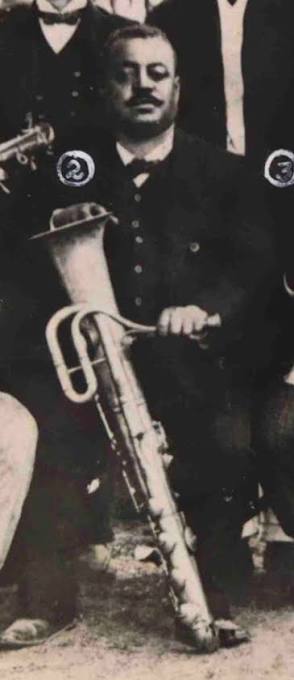
His name is especially associated with the ophicleide, a low-pitched wind instrument that held an important place in the ensembles of that period, and with the language of counterpoint, in which bass lines conversed with the main melody.
Irineu also played a decisive role in the musical training of Pixinguinha. He was his teacher, brought the young flutist to professional engagements and played alongside him on the first recordings of the Choro Carioca.
The short distance between the two musicians' generations helps explain a fundamental transformation in the language of choro: from the countermelodies played on the ophicleide in the early twentieth century to the lines Pixinguinha would develop decades later on the saxophone.
Musical training
Irineu studied harmony, counterpoint and fugue at the Imperial Conservatory of Music, training that would shape both his professional career and the way he built his instrumental lines.
He worked in a range of musical settings. In choro ensembles, his most characteristic instrument was the ophicleide. In the opera companies that performed in Rio de Janeiro, he played mainly trombone, while in the Fire Department Band (Banda do Corpo de Bombeiros) he played low brass instruments.
His entry into the band, then led by Anacleto de Medeiros, is documented in 1900. Besides performing, Irineu also composed for ensembles of this kind. His works include the march Arthur Azevedo, performed by the Fire Department Band in a program recorded in 1909.
Irineu Batina and the ophicleide
The nickname Irineu Batina came from his habit of wearing a long frock coat, a common item of men's clothing at the time, whose look resembled a batina (cassock).
Among carnival revelers he earned another nickname: Lorde Mamoeiro. Mamoeiro (papaya tree) was one of the names the chorões (choro musicians) used for the ophicleide.
Invented in France in the early nineteenth century, the ophicleide is a conical-bore brass instrument played with a mouthpiece but fitted with keys similar to those found on woodwinds. In Brazil it found a place in bands and in the earliest choro ensembles.
Its low register allowed it to hold down the bass, but players like Irineu went far beyond that role. On his recordings, the ophicleide develops its own lines, answers the melody, anticipates harmonic movements and creates countermelodies.
This way of playing reveals a stage that predates the development of the guitar baixarias (bass-register counter-lines) and the countermelodies that would later become a defining feature of the choro regionais (standard choro ensembles).
The *rodas* of Rio de Janeiro
Irineu moved among some of the leading figures of Rio's musical life in his time.
He frequented the traditional shop O Cavaquinho de Ouro, a meeting point where musicians played and talked about music. Among those who passed through were Quincas Laranjeiras, Luiz de Souza, Anacleto de Medeiros, Sátiro Bilhar and the young Heitor Villa-Lobos.
In 1903, Irineu took part in a large musical tribute to Santos Dumont, recently returned from Europe. The group brought together guitars, cavaquinhos (small four-string guitars), flutes, trumpet, bombardon, two ophicleides and even Villa-Lobos playing the ocarina.
Another historic photograph, taken on Paquetá Island in 1906, shows Irineu with his ophicleide alongside musicians such as João dos Santos, Luiz de Souza and Luiz Gonzaga da Hora. The image became one of the best-known visual documents of the early generations of choro.
Music for the circus
A lesser-known part of Irineu's career took place in the circo-teatro (circus theatre), an important venue for Brazilian popular music in the early twentieth century.
Irineu worked with Benjamin de Oliveira, a key artist in the development of circus theatre in Brazil, composing and arranging music for shows staged mainly at the Circo Spinelli in Rio de Janeiro.
Between 1905 and 1912, his music was associated with at least twelve productions. Together, they comprised more than two hundred musical numbers.
In Os Guaranys, Irineu adapted excerpts from Carlos Gomes's opera O Guarani. For O Colar Perdido he wrote dozens of numbers, and the farce A Princesa Cristal featured 33 pieces of his own, including waltzes, marches, polkas and schottisches.
This body of work shows a musician whose activity reached far beyond the choro rodas (informal choro gatherings), extending to bands, popular theatre and widely attended shows.
The Pensão Vianna and Pixinguinha
One of the most important encounters of his life took place in the home of Alfredo da Rocha Vianna, Pixinguinha's father.
The large house in Catumbi became known as the Pensão Vianna. More than a family residence, it was a gathering place for musicians. Chorões such as Candinho do Trombone, Quincas Laranjeiras, Bonfiglio de Oliveira and other figures of Rio's music scene passed through its rooms.
Irineu came to live there with his mother and his children.
In that setting, he became the teacher of young Alfredo da Rocha Vianna Filho, Pixinguinha. Quickly recognizing the boy's skill, he began taking him to dances and performances.
In 1911, when Pixinguinha was only 13, Irineu brought him into the orchestra of the carnival rancho Filhas da Jardineira, where Irineu served as diretor de harmonia (musical director).
The ensemble combined instruments from different traditions: flutes, guitars, mandolin and pandeiros (Brazilian frame drums) played alongside clarinet, trumpets, euphonium, double bass and Irineu's ophicleide.
There, the young Pixinguinha began to experience professionally the musical world he had known since childhood at home.
The Choro Carioca and the first recordings
Also in 1911, Irineu and Pixinguinha took part in the first recording sessions of the Choro Carioca ensemble for Casa Faulhaber, the Brazilian representative of the German label Favorite.
The group brought together musicians from the Vianna family and had Irineu as one of its central figures.
Titles recorded included Nininha, Dainéa, São João Debaixo d'Água, Albertina, Salve and Aí, Morcego!, as well as pieces by other composers.
These discs are precious documents from a time when choro was still consolidating many of the traits by which it would later be recognized.
On them, the flute often carries the main line while the ophicleide moves through the low register with independent phrases. Rather than simply marking chord roots, Irineu builds true parallel melodies.
An especially important recording is Qualquer Cousa, made in 1911, on which Irineu de Almeida himself appears as ophicleide soloist. It is one of the very few recordings of a solo on this instrument, an exceptional document that lets us hear his sound and playing style firsthand.
The original recording is preserved in the collection of the Instituto Moreira Salles and can still be heard today, revealing not only Irineu's composition but his own interpretation on the instrument.
Counterpoint and the language of choro
The relationship between Irineu and Pixinguinha went beyond lessons and early professional opportunities.
The writing and accompaniment style Irineu developed are part of the history of counterpoint in choro.
Decades later, when Pixinguinha took up the tenor saxophone alongside flutist Benedito Lacerda, his role was usually no longer to state the main melody. The saxophone began creating low lines that answered the flute, outlined the chords and established a second melodic layer.
This practice would become one of the most important references for the baixarias of the violão de sete cordas (seven-string guitar) and for Brazilian instrumental accompaniment.
Pixinguinha's experience alongside Irineu's ophicleide therefore belongs among the direct antecedents of this language.
Composer
Irineu left an extensive body of work spanning polkas, waltzes, schottisches, tangos brasileiros, maxixes, marches and choros.
His surviving works include:
- Aí, Morcego!
- Albertina
- Arthur Azevedo
- Bem Te Quero
- Boêmia Terra
- Dainéa
- Despedida
- Digitalis
- Jaci
- Mariana em Sarilho
- Nininha
- O Lico Sorrindo
- Qualquer Cousa
- Salve
- São João Debaixo d'Água
Some of these compositions kept circulating long after his death.
Jaci, for example, was arranged by Pixinguinha for the Orquestra do Pessoal da Velha Guarda. Mariana em Sarilho was later recorded by several choro ensembles, including the duo of Pixinguinha and Benedito Lacerda and the Conjunto Época de Ouro.
Some of his melodies also received lyrics by Catulo da Paixão Cearense, showing how these pieces moved between the instrumental world and song.
Final years
Irineu remained connected to the Pensão Vianna until the end of his life.
He died in Rio de Janeiro on August 22, 1914, at age 51, of pulmonary tuberculosis. He was buried in the São Francisco Xavier Cemetery.
His death roughly coincided with the gradual disappearance of the ophicleide from Brazilian ensembles. Other low instruments took its place in bands, while in choro the guitars, and later the saxophone, took over many of the bass and counterpoint functions the instrument had performed.
For this reason, for decades it became hard even to imagine the sound of the ensembles Irineu had played in.
The few surviving recordings opened a window onto that world.
The rediscovery of Irineu de Almeida
In the twenty-first century, his work underwent an extensive process of research and recovery.
Scores scattered across private collections and musicians' archives were gathered, while old recordings were used to reconstruct pieces that had survived only in incomplete form.
This work led to the project Irineu de Almeida e o Oficleide – 100 Anos Depois ("Irineu de Almeida and the Ophicleide – 100 Years Later"), developed by musicians including Everson Moraes, Aquiles Moraes and Leonardo Miranda, with the participation of players linked to the Escola Portátil de Música.
The album, released in 2016, brought the ophicleide back to the center of a choro ensemble and presented works by Irineu that had remained little known for about a century.
Research continued with the cataloging of scores, historical documents and sound recordings, making it possible to reconstruct a career far broader than previously known.
Irineu de Almeida thus reemerges not merely as the teacher of a young Pixinguinha, but as a composer, performer and teacher who took a direct part in shaping the language of choro in the first decades of its history.
Sources
- Instituto Casa do Choro: Enciclopédia Ilustrada do Choro no Século XIX; entry on Irineu de Almeida and score catalog, which currently holds 36 entries related to the composer. (Casa do Choro)
- Instituto Moreira Salles / Rádio Batuta: documentation on Irineu de Almeida, the Choro Carioca, the ophicleide and his relationship with Pixinguinha. (Rádio Batuta)
- Discografia Brasileira: discographic documentation on Irineu and research on the Casa Faulhaber recordings made from 1911 onward. (Discografia Brasileira)
- MORAES, Everson Neves de. Irineu de Almeida e o Oficleide: o resgate de um instrumento esquecido. Escola de Música da UFRJ, 2021. The study draws on civil records, periodicals, scores and the collections of the Casa do Choro and the IMS, and revises Irineu's biographical dates.
Suggested course
Move from editorial context into guided study with synchronized score and structured steps.
All courses
Browse the public course catalog connected to the content hubs.