Choropedia
Hermeto Pascoal - Brazilian Music Composer
Explore the life and works of Hermeto Pascoal, a pioneering Brazilian composer and multi-instrumentalist known for his Universal Music concept.
Introduction
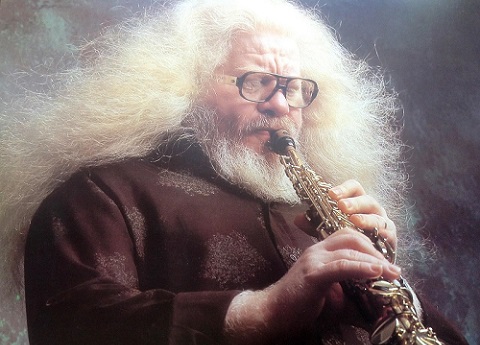
Hermeto Pascoal (Alagoas, June 22, 1936 – Rio de Janeiro, September 13, 2025) was a composer, arranger and multi-instrumentalist, responsible for one of the most singular musical languages ever to emerge in Brazilian music.
In his music, accordion, piano, flute, saxophone, guitar, percussion and keyboards coexisted with kettles, bottles, toys, water, animal sounds, everyday noises and human speech itself. For Hermeto, the division between what was and was not musical simply made no sense.
His work moved through baião (a Northeastern Brazilian song and dance rhythm), frevo (a fast carnival genre from Pernambuco), choro (the instrumental popular genre born in Rio de Janeiro), jazz, concert music, free improvisation and countless Brazilian folk traditions without ever settling permanently within any of them. Hermeto preferred to call what he did Música Universal ("Universal Music").
More than a blending of genres, the idea described a way of listening: any sound could become part of the music.
Before Instruments, Sound
Hermeto grew up in Lagoa da Canoa, then part of the municipality of Arapiraca, in Alagoas. Because he was albino and could not stay out in the sun for long periods, his childhood differed from that of other children who accompanied their families in farm work.
A considerable part of that time was devoted to observing the sounds around him.
He made small pífanos (rustic fifes) from castor-plant stalks and other materials found in the countryside, played for the birds, experimented with sounds in water, and used scraps of metal discarded from his blacksmith grandfather's workshop to build sound objects.
His father's sanfona de oito baixos (eight-bass button accordion) added another world to these discoveries. While still a child, Hermeto began playing it and started performing alongside his brother José Neto at parties, weddings and dances.
Many elements that decades later would be seen as radical experiments in his records and concerts were already present there in some form: metal, animals, water, improvisation, attention to noise, and the idea of responding musically to the sounds of nature.
From Northeastern Radio to Rio de Janeiro
In 1950, at age 14, Hermeto and José Neto began working at Rádio Tamandaré in Recife. Shortly afterward they moved on to Rádio Jornal do Commercio, one of the important institutions of Pernambuco's musical life at the time.
Hermeto also worked at Rádio Tabajara in João Pessoa, where he played accordion in the orchestra led by conductor Gomes. Although he had no conventional training in music reading at that point, he was able to keep up with the other musicians by ear.
In 1958, he moved to Rio de Janeiro. He played in the regional (the traditional small ensemble that accompanied choro and radio performers) of Pernambuco do Pandeiro and in groups associated with musicians such as Fafá Lemos and Copinha. At the same time, he deepened his study of the piano and steadily expanded the number of instruments he played.
The musician who had started on the Northeastern accordion now came into direct contact with regionais, nightclubs, orchestras, choro, samba and the intense professional life of the big cities.
São Paulo and Quarteto Novo
In 1961, Hermeto moved to São Paulo. He worked as a pianist in nightclubs and played in groups such as Som Quatro and Sambrasa Trio, the latter alongside Airto Moreira and Humberto Clayber.
In 1966 he joined a group formed by Heraldo do Monte, Theo de Barros and Airto Moreira. The former Trio Novo then became Quarteto Novo.
The group was short-lived, but it left a deep mark on Brazilian instrumental music.
Its only LP, Quarteto Novo, released in 1967, brought together improvisation, Northeastern rhythms, harmonic sophistication and a particular way of carrying elements of baião, modal music and other Brazilian traditions into a modern instrumental format.
It also featured O Ovo, one of Hermeto's first compositions to be recorded.
That same year, Quarteto Novo accompanied Edu Lobo and Marília Medalha in their performance of Ponteio, winner of the III Festival de Música Popular Brasileira on TV Record.
The group disbanded in 1969, but the experience had already revealed something essential in Hermeto's path: the search for a Brazilian music able to engage with improvisation without simply reproducing foreign models.
The Encounter with Miles Davis
In the early 1970s, at the invitation of Airto Moreira, Hermeto went to the United States to take part in recordings and arrangements.
It was in that setting that he met Miles Davis.
Hermeto took part in 1970 sessions that would later appear on Live-Evil, released by Miles in 1971. Among them were Hermeto's compositions Igrejinha, presented internationally as Little Church, and Nem um Talvez.
This contact placed the musician from Alagoas in direct touch with one of the most experimental jazz scenes of the time, but it did not turn Hermeto into a jazz musician.
His language had already been built from a different combination of experiences.
From then on, jazz would coexist with baião, frevo, choro, Northeastern bands, concert music, improvisation, the sounds of nature and everything else his ear considered musical.
Free Music
In 1973, Hermeto released A Música Livre de Hermeto Pascoal ("The Free Music of Hermeto Pascoal") in Brazil.
The title could not have been more fitting.
The repertoire placed his own compositions alongside Carinhoso, by Pixinguinha and Braguinha, and Asa Branca, by Luiz Gonzaga and Humberto Teixeira. Works deeply identified with different Brazilian traditions were transformed through arrangement, improvisation, changes of texture and new harmonic possibilities.
Hermeto did not treat traditional repertoire as a museum piece.
A tune could be recognized, taken apart, reharmonized, cut through with improvisation and rebuilt in a different way.
This freedom would become one of the permanent features of his work.
Música Universal
Hermeto rejected the idea of defining his work simply as jazz, Brazilian popular music, experimental music or any other genre.
He called it Música Universal.
The expression did not mean a music without roots. On the contrary: much of his vocabulary came from deeply Brazilian and Northeastern experiences.
Baiões, frevos, cocos (Northeastern call-and-response dance songs), maracatus (Afro-Brazilian processional rhythms from Pernambuco), choros, waltzes, sambas and other forms coexisted with harmonies associated with modern jazz, techniques from concert music, free improvisation, noise, natural sounds and structures invented by the composer himself.
The guiding principle was openness.
A piece could begin modally, pass through dense harmonies, change meter, turn into improvisation and end in another sonic world, without Hermeto seeing any contradiction in that.
Boundaries belonged to genres.
Music, for him, did not need them.
Everything Is Sound
Hermeto's public image became closely associated with the unlikely instruments he used.
But these experiments were not mere stage effects.
Bottles could form tuned ensembles. Pots, kettles and toys had specific pitches and timbres. Animal sounds could become part of a composition. Water could produce rhythm, resonance and pitch.
In Música da Lagoa, recorded in 1985 for the film Sinfonia do Alto Ribeira, Hermeto and members of his group literally step into a lagoon and make music using flutes, bottles, voices and the water itself.
The scene became one of the best-known images of his work because it sums up an idea he had cultivated since childhood.
The instrument did not have to end where the world began.
The world itself could be the instrument.
Som da Aura
One of the most original practices Hermeto developed was called Som da Aura ("Sound of the Aura").
Hermeto perceived human speech as melody.
Every sentence has pitches, intervals, rhythms and inflections, even when the speaker is not trying to sing. Building on that perception, he began to identify those pitches musically and accompany them with instruments.
Spoken voice then ceased to be mere text and revealed a melody hidden within language itself.
In the 1980s, Hermeto carried out experiments of this kind using, among other material, recordings of sports announcers.
The procedure once again broadened his definition of music.
If birds, water and objects held music, so did everyday speech.
One only had to listen.
Hermeto Pascoal e Grupo
A fundamental part of Hermeto's work cannot be understood by looking at the composer alone.
Between the late 1970s and the early 1990s, the ensemble Hermeto Pascoal e Grupo took shape, bringing together musicians such as Itiberê Zwarg, Jovino Santos Neto, Pernambuco, Carlos Malta and Márcio Bahia, among others.
At Hermeto's house in the Jabour neighborhood of Rio de Janeiro, a working routine developed that would become known among musicians and researchers as the Escola Jabour ("Jabour School").
For a long period, the group rehearsed daily for about six hours, in addition to the individual practice each musician did.
It was a true musical laboratory.
Hermeto wrote constantly, experimented with arrangements, altered structures, and worked on unusual meters, improvisation, interpretation and a range of Brazilian rhythms. The musicians had to develop a collective language capable of keeping pace with an almost continuous flow of compositions.
This period produced landmark albums such as Zabumbê-bum-á, Cérebro Magnético, Hermeto Pascoal & Grupo, Lagoa da Canoa, Município de Arapiraca, Brasil Universo, Só Não Toca Quem Não Quer and Festa dos Deuses.
The Escola Jabour also helped shape musicians who would go on to build important careers of their own, carrying different aspects of Hermeto's language to new generations.
Calendário do Som
Between June 23, 1996 and June 22, 1997, Hermeto undertook one of his most extraordinary projects.
He composed one piece a day for an entire year.
The result was the 366 compositions of Calendário do Som ("Calendar of Sound"), including a piece for February 29.
Hermeto wrote wherever he happened to be: at home, in hotels, while traveling, on airplanes.
The idea was that every person could find a composition corresponding to their own birthday.
The scores were later collected in the book Calendário do Som.
The project demonstrates a central trait of Hermeto's: composing, for him, was not an exceptional event dependent on rare inspiration. It was a daily activity.
Music was always happening.
Hermeto and Choro
Hermeto does not belong to choro in the same way as Pixinguinha, Jacob do Bandolim, Waldir Azevedo or the musicians formed directly within the tradition of the regionais.
His relationship with the genre followed a different path.
Choro was one of the many languages absorbed into his musical universe.
Hermeto spent time among musicians connected to the regionais from his early years in Rio de Janeiro, worked with Copinha and Pernambuco do Pandeiro, recorded Carinhoso on A Música Livre de Hermeto Pascoal, and wrote pieces directly related to the genre.
Among them is Chorinho Pra Ele, recorded on the 1977 album Slaves Mass, a composition that has become an important part of the Brazilian instrumental repertoire and presents the technical and harmonic demands characteristic of Hermeto's writing.
Other works approach the world of choro from different angles, including tributes such as Pixitotinha and Salve, Copinha!.
In 2024, the album Pra Você, Ilza once again revealed this closeness. The repertoire came from a notebook of compositions dedicated to his wife Ilza, and several of the first pieces selected for the project were, in fact, choros.
For Hermeto, however, choro never had to remain isolated.
It could meet baião, modal music, jazz, frevo or any other sound.
Within Música Universal, tradition and invention were not opposing forces.
A Composer Above All
The ease with which Hermeto played instruments and produced unusual sounds often pushed his image as a multi-instrumentalist to the foreground.
But his body of work is also that of an extraordinarily prolific composer.
He wrote for small groups, solo piano, big bands, wind ensembles and orchestras. He worked with popular melodies and sophisticated structures, tonal and non-functional harmony, modal music, irregular meters and many forms of improvisation.
The instrument could change.
The ensemble could change.
The principle remained much the same: to create music from everything his ear encountered.
International Recognition
Hermeto's music circulated through festivals, concert halls and institutions in many countries.
In 1979, he performed at the Montreux Jazz Festival, a concert documented on the album Hermeto Pascoal ao Vivo.
Over the following decades he toured internationally many times, and his work came to be studied by musicians and researchers outside Brazil.
In 2023, he received an Honorary Doctorate from The Juilliard School in New York. At the ceremony, he was honored by trumpeter Wynton Marsalis.
It was a belated institutional recognition for an essentially self-taught musician whose education had begun among accordions, birds, scraps of iron and the sounds of the Alagoas backcountry.
Pra Você, Ilza
In 2024, Hermeto released Pra Você, Ilza ("For You, Ilza"), dedicated to the memory of Ilza da Silva, his partner through 46 years of marriage and the mother of his six children.
The music was drawn from a set of 198 compositions Hermeto had written for her between the late 1990s and the early 2000s.
In the studio, at 87, he once again created and reworked arrangements for his group.
The album won the Latin Grammy for Best Latin Jazz/Jazz Album in 2024.
Nearly seven decades after his first professional performances in Brazil's Northeast, Hermeto was still composing, arranging and experimenting.
Endless Music
Hermeto Pascoal died in Rio de Janeiro on September 13, 2025, at the age of 89.
He left behind thousands of pages of music, dozens of recordings, and a lineage of instrumentalists and composers directly influenced by working with him, by the rehearsals, by the scores, or simply by listening to his work.
But perhaps his deepest contribution lies in something that comes before the scores.
Hermeto widened the very question of what music can be.
A kettle.
A bird.
A speaking voice.
A piece of iron.
A lagoon.
An extremely complex chord.
A baião.
A choro.
The silence before the next note.
For Hermeto, anything could come in.
One only had to know how to listen.
He called this possibility Música Universal.
Major Works
Among his hundreds of compositions and musical experiments are:
- O Ovo
- Bebê
- Igrejinha
- Nem um Talvez
- Chorinho Pra Ele
- Missa dos Escravos
- Cannon
- São Jorge
- Susto
- Mestre Mará
- Ferragens
- Pixitotinha
- Salve, Copinha!
- Música da Lagoa
- Som da Aura
- Poré Poré
- Alicante
- Choro Árabe
- Calendário do Som, a set of 366 compositions
Selected Discography
- Quarteto Novo — Quarteto Novo — 1967
- Hermeto — 1970
- A Música Livre de Hermeto Pascoal — 1973
- Slaves Mass / Missa dos Escravos — 1977
- Zabumbê-bum-á — 1979
- Hermeto Pascoal ao Vivo – Montreux Jazz Festival — 1979
- Cérebro Magnético — 1980
- Hermeto Pascoal & Grupo — 1982
- Lagoa da Canoa, Município de Arapiraca — 1984
- Brasil Universo — 1986
- Só Não Toca Quem Não Quer — 1987
- Por Diferentes Caminhos — 1988
- Festa dos Deuses — 1992
- Eu e Eles — 1999
- Mundo Verde Esperança — 2003
- No Mundo dos Sons — 2017
- Natureza Universal — 2017
- Pra Você, Ilza — 2024
Sources
- Instituto Casa do Choro. Archive and entry "Hermeto Pascoal".
- Dicionário Cravo Albin da Música Popular Brasileira. Entry "Hermeto Pascoal".
- Discografia Brasileira. Phonographic records of Hermeto Pascoal.
- Instituto Memória Musical Brasileira – IMMuB. Discography of Hermeto Pascoal and Quarteto Novo.
- COSTA-LIMA NETO, Luiz. Studies on Hermeto Pascoal, Música Universal and Som da Aura.
- ARAÚJO, Fabiano; BORÉM, Fausto. Studies on the musical language and the Calendário do Som.
- Studies on Hermeto Pascoal e Grupo and the so-called Escola Jabour.
- Miles Davis Official Site. Records of Live-Evil and Hermeto Pascoal's participation.
- The Juilliard School. Tribute and honorary doctorate awarded to Hermeto Pascoal.
- Rocinante. Discography and documentation of Pra Você, Ilza.
Suggested course
Move from editorial context into guided study with synchronized score and structured steps.
All courses
Browse the public course catalog connected to the content hubs.