Choropedia
Gastão Bueno Lobo - Brazilian Musician
Discover Gastão Bueno Lobo, a pioneering Brazilian guitarist and composer known for his work with Hawaiian guitar and contributions to choro.
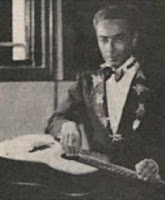
Introduction
Gastão Bueno Lobo was a guitarist, Hawaiian guitarist, composer and radio musician, active above all in the first decades of the twentieth century. His career ran through choro, tango, variety music, Brazil's first major radio stations and a long period of international work.
In Brazil, he became known especially for his use of the Hawaiian guitar, an instrument still uncommon in the country. Pixinguinha also credited Gastão with introducing the banjo into Brazilian musical circles, recalling that he already knew him as a guitarist before his work at Rádio Mayrink Veiga.
A Biography Still Being Reconstructed
Gastão Bueno Lobo's date of birth was itself surrounded by contradictory information for decades.
Later publications placed his birth around 1910. Reports published after his death, in 1939, gave his age as 48, which would point to 1891. Subsequent research in the press, however, located a tribute published on 10 September 1904 for his nineteenth birthday. That document indicates that Gastão was born on 10 September 1885.
Other records found in the late nineteenth-century press identify his mother as Maria Isabel do Carmo and his father as Antônio José Leite Lobo, a naval officer. By 1896, Gastão and his brother Antônio already appeared in documents relating to the guardianship of the couple's children.
Given the available documentation, 1885 is currently the best-supported date, though divergences remain across the biographical sources.
The Guitar and the Travels
Gastão was active as a guitarist long before the beginning of his recording career.
In February 1909, the Rio press recorded his participation in the Carnival festivities, accompanying the singer Nhozinho on guitar alongside the flautist Fontenelle. Years later, Orestes Barbosa would include him among the leading guitarists of Rio's musical life, next to names such as João Pernambuco, Tute, Jacy Pereira, Donga and Rogério Guimarães.
In 1911, Gastão left Brazil. Passenger records show him passing through Belém and embarking for Lisbon. There are later accounts that he also performed in the United States, Japan and other countries, but the full itinerary of these travels has not yet been documented.
In 1915, his name appears again in a list of passengers disembarking at the port of Santos. It was during this period of travel that he is said to have come into contact with the Hawaiian guitar, the instrument that would become his principal artistic signature.
His time in Hawaii is mentioned by different sources, but the details of the trip have not yet been located in enough contemporary documentation to establish a precise chronology.
The Hawaiian Guitar
The Hawaiian guitar was played horizontally, with the strings stopped by a steel bar, producing glissandos and a sonority very different from that of the conventional guitar.
Gastão became one of the first Brazilian musicians to explore the instrument professionally. In 1935, the magazine O Malho went so far as to highlight his specialisation, observing that he was, at that moment, one of the country's few musicians associated with the Hawaiian guitar.
Decades later, the researcher Ary Vasconcelos would identify Gastão as the musician responsible for introducing the Hawaiian guitar into Brazilian music, and particularly into the world of choro.
Among the musicians who later distinguished themselves on the instrument were Garoto (Aníbal Augusto Sardinha) and Poli (Ângelo Apolônio). Garoto would come to work directly with Gastão at Rádio Mayrink Veiga.
Les Loups and Oscar Alemán
One of the most singular chapters of his career began with his encounter with the young Argentine guitarist Oscar Alemán, then frequently billed as Oscar Moreira.
Together they formed the duo Les Loups, combining Hawaiian guitar and guitar. By 1926, the pair were already performing in São Paulo, Santos and Rio de Janeiro. Advertisements of the period promoted them as specialists in guitar and Hawaiian guitar, and their performances appeared among films, theatre companies, singers, dancers and variety acts.
Still in 1926 they travelled on to Salvador and Recife. The following year they continued performing in Rio and took part in shows alongside artists such as João Pernambuco, Luperce Miranda and the Oito Batutas.
At the end of 1927, Les Loups arrived in Buenos Aires. The duo performed in important venues in the city and recorded for Victor Argentina, leaving recordings of tangos, waltzes and fox-trots. Gastão also composed works for the duo's repertoire, some in partnership with Oscar Alemán.
In 1929, the two joined the company of the American artist Harry Fleming on an international tour. The tour passed through countries including Spain, Portugal, Belgium, Switzerland, the Netherlands, Germany and Italy. The partnership ended around 1931, and Oscar Alemán remained in Europe, where he would develop an important career in jazz. Gastão returned to Brazil.
The Return to Brazil and the 1932 Recordings
Back in Rio de Janeiro, Gastão quickly moved into radio and the recording industry.
In 1932 he recorded the tangos "Confesión" and "La cumparsita" for Columbia, with the Hawaiian guitar as solo instrument.
That same year saw the appearance of some of his most important Brazilian recordings. He recorded the choro "Macio", his own composition, and the waltz "Noite azul", written with Valdo Abreu. These were followed by "Olhos passionais", composed with De Chocolat, and "Sonho que passou", written with Jacy Pereira.
He also took part in recordings connected to other composers and performers, using the Hawaiian guitar as a new voice within the small string ensembles that circulated on radio and on 78-rpm records.
Rádio Mayrink Veiga
From the 1930s onward, Gastão became a constant presence at Rádio Mayrink Veiga, one of the most important stations of the period.
In 1933, the schedule placed him alongside musicians and singers such as Pixinguinha, Luperce Miranda, Tute, Silvio Caldas, Castro Barbosa, Custódio Mesquita and Patrício Teixeira.
The following year he began directing his own Orquestra Original, a regular presence in the station's programmes. In 1935 he also formed a Conjunto Havaiano, initially with musicians such as Nelson Alves, Henrique Brito and Zezinho (José do Patrocínio Oliveira).
In 1936, a new line-up of the ensemble brought together Gastão Bueno Lobo, Laurindo Almeida, Garoto and Aimoré. The combination drew some of the leading guitarists and string players of that generation around the Hawaiian sonority.
Gastão also played in the Mayrink Veiga regional — the small ensemble of plucked strings and percussion that accompanied soloists on radio — alongside Pixinguinha, Luperce Miranda, Tute and Laurindo Almeida, a line-up that gathered some of the central musicians of choro and Brazilian radio in the 1930s.
The Partnership with Laurindo Almeida
In the final years of his career, Gastão worked frequently with Laurindo Almeida, then a young guitarist who would later build an extensive international career.
The two played together on Mayrink Veiga programmes, in public performances and in the Conjunto Havaiano. In 1937 they came to work regularly as a duo, combining Hawaiian guitar and guitar.
On 20 May 1938, Gastão held what would be his last recording session as a soloist. On the choro "Inspiração", a composition by Laurindo Almeida, Gastão played Hawaiian guitar accompanied by Laurindo and Tute on guitars.
The other side of the record held "Saudade que passa", with Laurindo as soloist and Gastão and Tute accompanying. The record was released by Odeon.
Gastão and Laurindo also co-wrote "Se recordar é viver", later recorded by Roberto Paiva.
The Final Years
During 1938 and 1939, Gastão's presence on radio programmes became less frequent, though he remained connected to Mayrink Veiga and continued to perform.
In June 1939, Gastão Bueno Lobo died by suicide. The news had wide repercussions in radio circles, and texts published at the time emphasised his standing among musicians and his command of the Hawaiian guitar.
His death closed a career that had begun in the guitar circles of early twentieth-century Rio, passed through theatres and variety companies, travelled across several countries and arrived at the centre of the Brazilian Radio Era.
Selected Works
Among the compositions identified as Gastão Bueno Lobo's are:
| Title | Co-authorship | Notes |
|---|---|---|
| "Macio" | — | choro |
| "Noite azul" | Valdo Abreu | waltz |
| "Olhos passionais" | De Chocolat | |
| "Sonho que passou" | Jacy Pereira | |
| "Pampeira" | Rogério Guimarães | |
| "Se recordar é viver" | Laurindo Almeida | later recorded by Roberto Paiva |
| "Guarda na boca esse beijo" | César Ladeira | |
| "És a areia, sou o mar" | Jacy Pereira | lyrics by Alberto Ribeiro |
| "Hawayanita" | — | Les Loups repertoire |
| "Criollita" | — | Les Loups repertoire |
| "Guitarra que llora" | — | Les Loups repertoire |
| "Nadando em mar de rosas" | Oscar Alemán | |
| "La porteña es una papa" | Oscar Alemán | |
| "Vividor" | Oscar Alemán |
Selected Discography
With Les Loups
| Record | Label | Year |
|---|---|---|
| "Hawayanita" / "Criollita" | Victor | — |
| "Guitarra que llora" | Victor | — |
| tangos, waltzes and fox-trots recorded in Argentina | Victor | 1927–1929 |
In Brazil
| Record | Label | Year |
|---|---|---|
| "Confesión" / "La cumparsita" | Columbia | 1932 |
| "Noite azul" / "Macio" | Columbia | 1932 |
| "Olhos passionais" / "A abelha e a flor" | Columbia | 1932 |
| "Sonho que passou" / "Luizinha" | Columbia | 1932 |
| "Inspiração" / "Saudade que passa" | Odeon | 1938 |
Sources
- Instituto Casa do Choro — collection of works, composers and historical documentation on choro. Available at: casadochoro.com.br
- Instituto Moreira Salles — Discografia Brasileira; phonographic documentation and collections relating to Brazilian popular music. Available at: ims.com.br
- Dicionário Cravo Albin da Música Popular Brasileira — biographical and discographic entries. Available at: dicionariompb.com.br
- Biblioteca Nacional — Hemeroteca Digital Brasileira.
- Museu da Imagem e do Som do Rio de Janeiro — testimonies and documentation relating to Pixinguinha and Gastão Bueno Lobo.
- VASCONCELOS, Ary. Carinhoso, etc.: história e inventário do choro. Rio de Janeiro: Gráfica Editora do Livro, 1984, v. 1, p. 30.
- MELLO, Jorge Carvalho de. Hemerographic research on Gastão Bueno Lobo.
- Research published in the journal Opus on the Brazilian guitar, with documentation of the Les Loups performances.
Suggested course
Move from editorial context into guided study with synchronized score and structured steps.
All courses
Browse the public course catalog connected to the content hubs.