Choropedia
Gaó: Brazilian Pianist and Composer
Discover the story of Gaó, a Brazilian pianist and composer who shaped popular music from the 1920s.
Introduction
Odmar Amaral Gurgel, known as Gaó (Salto, São Paulo, 12 February 1909 – Mogi das Cruzes, September 1992), was a pianist, conductor, arranger and composer. His career ran through the different professional settings of twentieth-century Brazilian music: silent cinema, radio, the recording industry, the casinos, the large orchestras and, later, the long-playing record.
Working first in São Paulo and afterwards in Rio de Janeiro and the United States as well, Gaó was involved in the formation of the first large popular-music orchestras in São Paulo and in an extensive output of arrangements and recordings. As a pianist, he left solo recordings of his own compositions and of works by other authors; as a conductor, he accompanied singers, directed ensembles and worked for decades in radio and for record companies.
Training and early years
Gaó was born into a family of teachers and musicians. As a boy he took part in the musical life of Salto, and at eleven he was already standing in for his father at the head of the small orchestra that accompanied films at the town's cinema. His first compositions date from this same period.
In the first half of the 1920s he moved to São Paulo to further his studies. He attended the Conservatório Dramático e Musical de São Paulo and worked as a sheet-music demonstrator at Casa Di Franco, a shop on Rua São Bento that also served as a meeting point for the city's musicians. There he lived in an environment where scores, instruments, composers and performers circulated daily.
His stage name came from the inversion of his initials. Odmar Amaral Gurgel signed O.A.G.; placed in reverse order, the letters formed G.A.O., which became Gaó.
Radio and the record industry
In 1926, Gaó joined Rádio Educadora Paulista, beginning a career tied directly to the expansion of radio in Brazil. Over the following years he worked at stations such as Cruzeiro do Sul and Cosmos, in São Paulo, and later at Rádio Ipanema and Rádio Nacional, in Rio de Janeiro.
The period coincided with the consolidation of electrical recording and with the growth of record companies in the country. Gaó became one of the musicians associated with Columbia in São Paulo, working not only as a pianist but also as an arranger, conductor and artistic director. His work ranged from small ensembles to the orchestral formations used in recordings and radio programs.
Some of his first recordings as a solo pianist appear in 1931. For Columbia he recorded the pieces Jaci, Saudades and Ilusão que se vai, by Jaime Redondo, as well as the fox-trot Nola, by Felix Arndt. In the same period he recorded compositions of his own, such as the choros Quando o banjo toca and Teimoso.
The Colbaz Orchestra
One of the central chapters of his career was the creation and direction of the Orquestra Colbaz, an ensemble formed in the early 1930s and linked to Columbia's recordings.
The group brought together instruments characteristic of choro and of the salon orchestras. On the historic recording of Tico-tico no fubá, the line-up features Gaó on piano, Atílio Grany on flute, Zezinho on bandolim, Petit on guitar, Jonas Aragão on alto sax, José Rielli on accordion and Ernesto Trepiccione on violin.
In 1931 the Colbaz made the first recording of Tico-tico no fubá, by Zequinha de Abreu, released by Columbia on disc 22029-B, with the waltz Branca on the other side. The recording preceded by several years the international circulation that would turn Zequinha's composition into one of the best-known Brazilian pieces abroad.
The Casa do Choro also documents the presence of the accordionist José Rielli in the Colbaz, as well as the later participation of musicians such as Copinha in the Orquestra Columbia directed by Gaó. These ensembles brought the conductor into contact with different generations of São Paulo instrumentalists.
Pianist, composer and arranger
Alongside his work as a conductor, Gaó maintained an output of his own for piano and other ensembles. His compositions include Arreliento, Cabeludo, Caboclo feliz, written with Luiz Peixoto, Diamante azul, Mimoso, Minha garota sincopada, Paisagem tropical, Suspirando and Teimoso.
His work as an arranger also extended to the repertoire of other composers. The Casa do Choro collection preserves, for example, scores of works by Ernesto Nazareth in arrangements by Gaó, among them the Brazilian tango Tenebroso and the waltz Genial.
Teimoso, recorded by the composer himself at the piano, is one of the pieces now recovered from the pianistic repertoire tied to São Paulo choro of that period. The piece continues to circulate in contemporary studies devoted to Brazilian piano.
From Rio de Janeiro to the Cassino da Urca
In the second half of the 1930s, Gaó expanded his activity in Rio de Janeiro. In 1937 he formed a new orchestra and choir, accompanying recordings by performers such as Lamartine Babo, Silvino Neto and Cândido Botelho. The following year he continued producing arrangements and accompaniments for a range of artists and genres.
During the 1940s he also worked for Odeon and directed the orchestra of the Cassino da Urca, one of Rio's principal entertainment venues at the time. On recordings from those years his orchestra appears accompanying names such as Trio de Ouro, Odete Amaral, Léo Albano and Heleninha Costa.
His activity was not limited to accompanying singers. Gaó wrote arrangements, rehearsed ensembles, conducted and played piano, combining roles that were common among the conductors employed by the radio stations, casinos and record companies of the period.
The United States and the return to Brazil
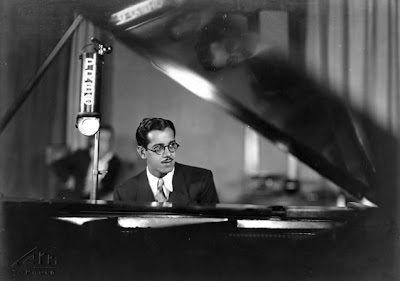
In 1945, Gaó traveled to the United States. Documents from the time record his presence in the country, and the Instituto Moreira Salles collection preserves a photograph of the conductor at the piano in New York. After a brief return to Brazil in 1946, he remained abroad for part of the following years.
By the 1950s he was once again part of the Brazilian circuit. He worked for the Organizações Victor Costa and was active at Rádio Record. In 1954 he took part in the program Quando os maestros se encontram, on Rádio Nacional, and continued making recordings with his orchestra, accompanying artists such as Hebe Camargo and Norma Ardanuy.
The LPs
With the consolidation of the LP, Gaó returned to documenting his work on records devoted to piano and orchestra.
In 1960 he released Gaó viaja pelo mundo, on Odeon, bringing together Brazilian and international repertoire. Four years later came Gaó, seu piano e orquestra, which features compositions of his own such as Diamante azul, Mimoso and Minha garota sincopada, alongside pieces such as Odeon, by Ernesto Nazareth, and Samba em prelúdio, by Baden Powell and Vinicius de Moraes.
In 1966 he released The Melodic Sound of Gaó's Piano and The Ipanema Strings, with repertoire by authors such as Pixinguinha, Ernesto Nazareth, Bororó, André Victor Corrêa and Álvaro Sandim. The following year he recorded Valsas brasileiras, devoted to composers such as Nazareth, Zequinha de Abreu, Custódio Mesquita and Antenógenes Silva. In 1969 came Bem brasileiro, gathering choros, sambas and instrumental pieces from different periods.
A Bandinha da Turma da Mônica
At the beginning of the 1970s, Gaó's output took a rather different turn. Together with Mauricio de Sousa and Wilma Camargo, he took part in the creation of the songs dedicated to the characters of Turma da Mônica.
The LP A Bandinha da Turma da Mônica, released in 1971 by Fermata, contains twelve tracks, each devoted to one character: Mônica, Bidu, Magali, Horácio, Cascão, Tina, Chico Bento, Cebolinha, Astronauta, Jotalhão, Piteco and Anjinho. Gaó, Mauricio de Sousa and Wilma Camargo appear in the composition credits, with arrangements and conducting by Hector Lagna Fietta.
Some of these songs would remain tied to the characters' audiovisual world in the years that followed, so that a conductor formed in the musical environment of the 1920s and 1930s also became part of the musical history of one of the major creations of Brazilian comics.
Final years
Gaó later settled in Mogi das Cruzes, where he remained involved with music and teaching. In 1974 his home town awarded him the title of Honorary Citizen of Salto. Years later, his name was given to the Auditório Gaó, attached to the city's municipal conservatory.
He died in Mogi das Cruzes in September 1992. The collections preserved in Brazilian institutions bring together photographs, recordings, scores and documents relating to a career that followed much of the transformation of the professional world of Brazilian music over the course of the twentieth century.
Selected works
- Arreliento
- Cabeludo
- Caboclo feliz, with Luiz Peixoto
- Diamante azul
- Marcha Caloric
- Mimoso
- Minha garota sincopada
- Paisagem tropical
- Quando o banjo toca
- Suspirando
- Teimoso
- Você é minha felicidade
Selected discography
- Gaó viaja pelo mundo — 1960
- Gaó, seu piano e orquestra — 1964
- The Melodic Sound of Gaó's Piano and The Ipanema Strings — 1966
- Valsas brasileiras — 1967
- Bem brasileiro — 1969
Sources
- Instituto Casa do Choro. Collection and score catalogue, in particular the records relating to the Orquestra Colbaz, José Rielli, Copinha and Gaó's arrangements of works by Ernesto Nazareth.
- Instituto Moreira Salles. Acervo José Ramos Tinhorão, photographic documentation of Gaó, and Discografia Brasileira.
- Instituto Moreira Salles. Rádio Batuta, documentation on Tico-tico no fubá.
- Dicionário Cravo Albin da Música Popular Brasileira. Entry "Gaó".
- BESSA, Virgínia de Almeida. A escuta singular de Pixinguinha: história e música popular no Brasil dos anos 1920 e 1930. Research on the professional music environment in São Paulo and Gaó's formation.
- Instituto Piano Brasileiro. Discography and documentation on Gaó's pianistic repertoire.
Suggested course
Move from editorial context into guided study with synchronized score and structured steps.
All courses
Browse the public course catalog connected to the content hubs.