Choropedia
Dilermando Reis: Brazilian Guitarist
Discover Dilermando Reis, a key figure in Brazilian guitar history.
Introduction
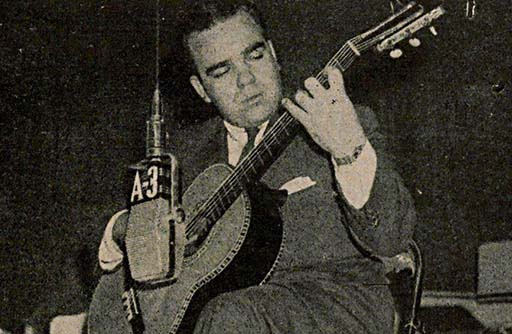
Dilermando dos Santos Reis (Guaratinguetá, São Paulo, September 22, 1916 – Rio de Janeiro, January 2, 1977), known as Dilermando Reis, was a guitarist, composer, arranger and teacher, and is considered one of the central figures in the history of the Brazilian guitar.
His career was deeply bound up with radio, the recording industry and the establishment of the guitar as a solo instrument in Brazil. As a composer and performer, he left behind a repertoire that has crossed generations and remains current among students, concert players and musicians working in choro.
Formative years
Dilermando began learning guitar in childhood with his father, Francisco Reis, an amateur guitarist and seresteiro (serenader). The family environment brought him into early contact with waltzes, modinhas (sentimental parlor songs), popular songs and serenades.
At fifteen he attended a performance by the guitarist Levino da Conceição, who was passing through Guaratinguetá. He became Levino's student and began accompanying him on performances and tours, broadening both his training and his knowledge of the guitar repertoire.
In 1933 he arrived in Rio de Janeiro with Levino. In the capital he grew close to João Pernambuco, one of the great names of the Brazilian guitar, and studied music theory with Bonfiglio de Oliveira.
His formation thus drew on different worlds: the oral learning of the seresta (serenade tradition) and of choro, contact with major popular guitarists, and formal study of theory and repertoire.
Radio
In his first years in Rio de Janeiro, Dilermando worked as a teacher in musical instrument shops, which also served as important meeting points for musicians and students.
In the mid-1930s he began appearing on radio programs, at first accompanying singers.
During a break in one of these broadcasts, he was overheard playing alone by the radio producer Renato Murce, who recognized the guitar's potential as a main attraction. From that point on, Dilermando took on an increasingly prominent role as a soloist.
He worked at stations such as Rádio Transmissora, Rádio Clube do Brasil and, later, Rádio Nacional.
He also worked as an accompanist and performed at the Cassino da Urca, moving among leading singers, instrumentalists and conductors of Brazilian popular music.
Sua Majestade, o Violão
Between 1956 and 1969, Dilermando hosted the program Sua Majestade, o Violão ("His Majesty, the Guitar") on Rádio Nacional.
The program was of considerable importance in bringing the instrument to a broad audience at a time when radio occupied a central place in Brazilian culture.
The guitar, long associated with serenades, informal gatherings and the accompaniment of singers, appeared there as the protagonist.
Dilermando performed his own compositions, works by other Brazilian composers and adaptations of international repertoire, helping to widen the perception of what the instrument could do.
Composer
Dilermando wrote choros, waltzes, guarânias (a lyrical genre of Paraguayan origin), boleros, toadas (slow, narrative rural songs), maxixes (an early Brazilian urban dance) and sambas-canções (slow, song-oriented sambas).
His first record, released in 1941, carried two of his own compositions: the choro Magoado and the waltz Noite de Lua.
In the years that followed he recorded works such as Vê se te Agrada, Doutor Sabe Tudo, Xodó da Baiana, Promessa, Tempo de Criança, Dois Destinos and Ausência.
Among his best-known compositions is also the waltz Se Ela Perguntar, written with Jair Amorim.
Much of this repertoire remains tied to guitar teaching and continues to be performed by musicians of different generations.
Performer of the Brazilian repertoire
Dilermando also played an important part in promoting the work of other composers.
His recordings of Sons de Carrilhões, by João Pernambuco, and Abismo de Rosas, by Canhoto, became reference points in the Brazilian guitar repertoire.
Over the course of his career he also performed works by Ernesto Nazareth, Pixinguinha and other foundational figures of Brazilian instrumental music.
In 1972 he released Dilermando Reis Interpreta Pixinguinha, with versions of works such as Carinhoso, Lamentos, Segura Ele, Chorei and Proezas de Solon.
The following year he recorded Homenagem a Ernesto Nazareth, accompanied by Dino 7 Cordas (Dino "Seven Strings"), performing pieces such as Odeon, Brejeiro, Apanhei-te, Cavaquinho and Escorregando.
Dilermando and accompaniment
Although he became known primarily as a soloist, Dilermando maintained a strong connection to the tradition of accompaniment.
One of his principal partners was Meira, a foundational figure of the Brazilian guitar.
On many recordings, Dilermando took the melody and the solo passages while Meira built the harmonic and rhythmic foundation. This combination produced important documents of the guitar-duo tradition in choro and in Brazilian popular music.
Later on, Dilermando would also work with Dino 7 Cordas on recordings devoted to the Brazilian instrumental repertoire.
Teacher
Teaching accompanied Dilermando throughout much of his career.
His students included musicians such as Bola Sete and Darci Vilaverde, along with numerous students who sought him out because of the visibility he had achieved on radio and on record.
Among his students was also Maristela Kubitschek, daughter of President Juscelino Kubitschek.
His work as a teacher helped transmit a guitar tradition that brought together popular repertoire, instrumental technique and formal musical knowledge.
Dilermando went so far as to organize an orchestra made up of ten guitars, exploring the instrument beyond its traditional use as a soloist or accompanist.
Major works
Among his principal compositions are:
- Magoado
- Noite de Lua
- Vê se te Agrada
- Dois Destinos
- Tempo de Criança
- Doutor Sabe Tudo
- Flor de Aguapé
- Xodó da Baiana
- Promessa
- Se Ela Perguntar
- Uma Valsa e Dois Amores
- Ausência
Selected discography
- Magoado / Noite de Lua – 1941
- Vê se te Agrada / Doutor Sabe Tudo – 1948–1949
- Xodó da Baiana / Promessa – 1950–1951
- Ausência – 1960
- Dilermando Reis Interpreta Pixinguinha – 1972
- Homenagem a Ernesto Nazareth – 1973
Over the course of his career, Dilermando recorded dozens of 78 rpm discs and several LPs, bringing together his own compositions, works by other Brazilian guitarists, popular songs and transcriptions of international repertoire.
Sources
- Instituto Casa do Choro. Biographical entry, catalogue of works and sheet music archive on Dilermando Reis.
- Dicionário Cravo Albin da Música Popular Brasileira. Entry "Dilermando Reis."
- Instituto Moreira Salles. Discografia Brasileira, iconographic archive and records relating to Dilermando Reis's career.
Suggested course
Move from editorial context into guided study with synchronized score and structured steps.
All courses
Browse the public course catalog connected to the content hubs.