Choropedia
Déo Rian: Choro Musician
Learn about Déo Rian, a key bandolinist in choro music, his career, discography, and contributions.
Introduction
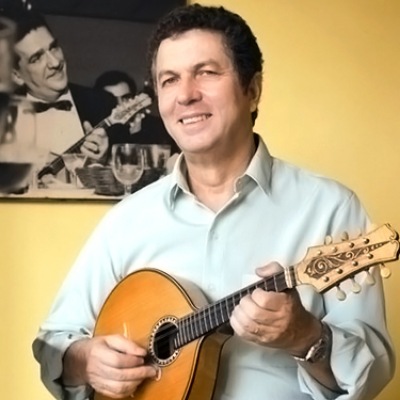
Déo Rian (Déo Cesário Botelho, Rio de Janeiro, 26 February 1944) is a Brazilian mandolinist and composer, one of the leading mandolin players linked to the tradition of choro (an instrumental Brazilian genre born in nineteenth-century Rio de Janeiro) in the decades following Jacob do Bandolim and Luperce Miranda.
Raised in Jacarepaguá, in Rio de Janeiro, he grew up surrounded by musicians and family gatherings. While still young he met Jacob do Bandolim, with whom he became close, and later took over as lead soloist of the ensemble Época de Ouro. Throughout his career he devoted a significant part of his work to performing and preserving Jacob's repertoire, while also building a discography of his own as both performer and composer.
Childhood in Jacarepaguá
Music was part of Déo Rian's family even before he was born. His great-grandparents and grandparents were connected to choro and hosted saraus (informal musical gatherings held in private homes) in Jacarepaguá. His father, Inácio, worked at the Central do Brasil railway and, in his free time, sang and played the pandeiro (Brazilian frame drum). Uncles and other relatives played guitar, cavaquinho (a small four-string Brazilian instrument related to the ukulele) and wind instruments.
Déo began on the cavaquinho, taught by an uncle. As a teenager he started attending rodas de choro (informal circles where choro musicians play together) around the neighborhood, mixing with musicians who kept alive a musical tradition that predated the genre's professionalization on the major stages.
At fifteen he moved to the mandolin. He was guided by Moacir Arouca and later studied with Luperce Miranda, one of the instrument's great names in the first half of the twentieth century.
The encounter with Jacob do Bandolim
On 26 February 1961, on the very day he turned seventeen, Déo Rian met Jacob do Bandolim. Both lived in Jacarepaguá and, in the following years, Déo became a regular visitor at the musician's home.
The relationship was never structured as a formal course of study. Jacob offered advice on technique, repertoire and details of the instrument, and Déo closely followed the gatherings and saraus held at his house.
There he came into contact with figures such as Dorival Caymmi, Radamés Gnattali, Almirante, Tia Amélia and Paulo Tapajós. This circle also brought him closer to the work of Pixinguinha, a composer Jacob particularly admired.
Jacob advised the young musician not to depend financially on the mandolin. Déo followed the recommendation: he studied Economics and worked in the profession alongside his musical career.
Professional beginnings and the first record
Déo Rian began his professional career in 1962 at Rádio Mauá, as a member of the Regional de Darly do Pandeiro. The group accompanied singers on the program Sambas e Outras Coisas.
Late in the decade he was heard at a roda by the composer and double bass player Dalton Vogeler. The encounter opened the way for his entry into RCA Victor and for the adoption of the stage name Déo Rian, suggested by Vogeler.
In 1970 he released his first LP, Ernesto Nazareth, devoted entirely to the work of the Rio de Janeiro composer. The record presented Déo as a soloist and brought together different instrumental line-ups around Nazareth's repertoire.
In the following years he took part in projects connected to the revival of choro in Rio de Janeiro. In 1973 he appeared in the show Sarau, alongside Paulinho da Viola, Elton Medeiros and other musicians.
Época de Ouro
After the death of Jacob do Bandolim in August 1969, Época de Ouro suspended its activities. When the ensemble resumed performing, Déo Rian took over as lead mandolinist.
In 1974 the group released a new album with Déo at the front, joined by César Faria and Damásio on guitars, Dino Sete Cordas, Jonas Silva on cavaquinho and Jorginho do Pandeiro. The repertoire included works by Jacob, Villa-Lobos, Henrique Alves de Mesquita, Paulinho da Viola, Chico Buarque and other composers.
In 1976 he took part in the LP Clube do Choro. The following year the ensemble released Época de Ouro interpreta Pixinguinha e Benedito Lacerda, on which Déo shared the solos with instrumentalists such as Abel Ferreira, Carlos Poyares, Zé Bodega and Orlando Silveira.
Déo remained with the group until 1977.
Noites Cariocas and Jacob's unrecorded works
On leaving Época de Ouro, Déo Rian formed his own regional (the small ensemble format typical of choro), Noites Cariocas.
With this group he carried out one of his projects most directly linked to preserving Jacob do Bandolim's work. In 1980 he released Inéditos de Jacob do Bandolim, gathering compositions that had never received commercial recordings.
Decades later the project continued. In 2007 came Inéditos de Jacob do Bandolim – Volume II, with new pieces found in handwritten scores and preserved documents of the composer. The record featured arrangements and guest appearances by musicians such as Cristóvão Bastos, Maurício Carrilho, Luciana Rabello, Pedro Amorim, Marcelo Bernardes and Dirceu Leite.
Déo's connection to Jacob's memory also extended to institutional work. In 2011 he was elected president of the Instituto Jacob do Bandolim, an organization dedicated to preserving, organizing and disseminating the musician's work and archive.
International recordings and performances
Déo Rian's career reached beyond the Brazilian choro circuit. His first LP, devoted to Ernesto Nazareth, was released in Japan, and during the 1990s the mandolinist undertook several tours there.
In 1991 he performed in cities including Tokyo, Osaka, Kobe, Kyoto and Nagoya. He returned to Japan in 1992 and again in 1995, and also performed in Santiago, Chile, in 1994.
In 1993 he recorded the album Delicatesse with Raphael Rabello, an encounter between mandolin and seven-string guitar in a repertoire oriented toward concert music.
Three years later he shared the CD Choro em Família with his son Bruno Rian. Father and son also took part in creating Grupo Sarau, which for years maintained regular performances in Rio de Janeiro with a rotating cast of musicians connected to choro.
Composer
Although much of Déo Rian's career is tied to interpreting the historical composers of choro, he also developed a body of work of his own.
His compositions include:
- Branquinha
- Bruno no Choro
- Choro Simples
- Chorões do Bandolim de Ouro
- Com Dor e Tudo
- Lembranças de um Violão
- O Pandeiro do Darly
- Pensando na Vida
- Querendo Bem
- Quando Me Lembro
- Memórias de um Bandolim
In 2015 the album Déo Rian – 70 Anos, recorded with Regional Imperial, gave particular space to this side of his output. The repertoire brought together several of his own compositions and co-written pieces, alongside a tribute written for him by Maurício Carrilho.
The records of recent decades
In 2012 Déo released Alma Brasileira, devoted mainly to the Brazilian waltz and to composers such as Ernesto Nazareth, Jacob do Bandolim, Radamés Gnattali and Amador Pinho. For some of the recordings he used a mandolin that had belonged to Jacob.
In 2015 came Déo Rian – 70 Anos, recorded with Regional Imperial — João Camarero, Júnior Pita, Lucas Arantes, Rafael Toledo, Marcus Thadeu and Edu Guimarães — with a guest appearance by guitarist Rafael Mallmith. The encounter placed Déo alongside musicians of a later generation of choro, under Camarero's musical direction.
Three years later he released Memórias de um Bandolim, once again bringing together his own compositions and pieces by Jacob do Bandolim, Pixinguinha and Ernesto Nazareth.
These works extend a path that began in the rodas of Jacarepaguá in the 1950s and passed through radio, Época de Ouro, the choro revival projects of the 1970s, the international tours and successive generations of instrumentalists.
Selected discography
- Ernesto Nazareth — 1970
- Choros de Sempre — 1974
- Déo Rian Toca Roberto Carlos — 1975
- Saudades de um Bandolim — 1976
- Inéditos de Jacob do Bandolim — 1980
- Déo Rian — 1992
- Delicatesse, with Raphael Rabello — 1993
- Choro em Família, with Bruno Rian — 1996
- Inéditos de Jacob do Bandolim – Volume II — 2007
- Alma Brasileira — 2012
- Déo Rian – 70 Anos, with Regional Imperial — 2015
- Memórias de um Bandolim — 2018
Sources
- Instituto Casa do Choro. Author archive and catalogue of works by Déo Rian.
- Instituto Moreira Salles. Rádio Batuta: Conjunto Época de Ouro; Conjunto Época de Ouro interpreta Pixinguinha e Benedito Lacerda; Vibrações – O som de Jacob do Bandolim.
- Instituto Moreira Salles. José Ramos Tinhorão Collection, records relating to Déo Rian and Época de Ouro.
- Discografia Brasileira. Um bandolim e boas histórias: memórias do choro nos 80 anos de Déo Rian.
- Discografia Brasileira. Phonographic records of Déo Rian.
- Dicionário Cravo Albin da Música Popular Brasileira. Entry "Déo Rian".
Suggested course
Move from editorial context into guided study with synchronized score and structured steps.
All courses
Browse the public course catalog connected to the content hubs.