Choropedia
Dante Santoro - Brazilian Musician
Discover Dante Santoro, a renowned flutist and composer from Brazil.
Introduction
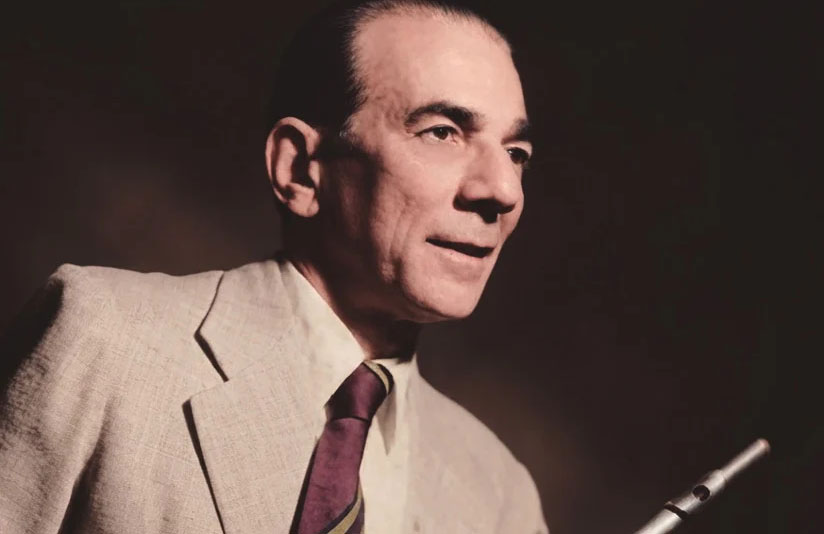
Dante Italino Santoro (Porto Alegre, 18 June 1904 – Rio de Janeiro, 12 August 1969) was a flutist, composer, and ensemble leader. His career links the musical tradition of Rio Grande do Sul to the professional world of Rio de Janeiro radio, where he became one of the most sought-after instrumentalists of his generation.
Known first as Canário Rio-Grandense (the Canary of Rio Grande do Sul) and later as Bico de Ouro (Golden Beak), he distinguished himself both as a soloist and as leader of the Regional Dante Santoro. Over more than three decades at Rádio Nacional, he accompanied singers, took part in live programs, and helped establish the regional (a small ensemble of flute, plucked strings, and percussion) as one of the foundational formats of Brazilian popular music.
Formative Years in Porto Alegre
Dante Santoro grew up in a family of Italian descent, in a household where music was part of everyday life. He took up the flute at around the age of ten and studied music theory with Octávio Dutra, a central figure in the urban popular music of Porto Alegre during the first decades of the twentieth century.
While still a teenager, he took part in the founding of the Centro Musical Porto-Alegrense, an association created in 1920 to organize and represent the city's musicians. Between 1921 and 1922 he was a member of Os Batutas, an ensemble and carnival group directed by Octávio Dutra.
In this period he moved between concerts, serenades, radio appearances, and popular groups. His repertoire included concert music, waltzes, polkas, and choros (the instrumental genre that emerged in nineteenth-century Rio de Janeiro), an experience that allowed him to develop a versatile profile before moving to Rio de Janeiro.
Arrival in Rio de Janeiro
Dante performed in Rio de Janeiro as early as the late 1920s, while still keeping up his activities in Porto Alegre. He settled permanently in the federal capital in the early 1930s, when the growth of radio stations was opening a new market for professional instrumentalists.
He worked at stations such as Rádio Cajuti, Philips, Rádio Club, Rádio Sociedade Guanabara, and Rádio Educadora. He also appeared in casinos and theaters, as part of the entertainment circuit that fed Rio's musical programming.
In 1936 he joined the newly inaugurated Rádio Nacional. Besides playing in the station's orchestra, in 1938 he took over the direction of its regional ensemble.
The Regional Dante Santoro
The Regional Dante Santoro became one of the most active groups at Rádio Nacional. The ensemble accompanied singers, soloists, and acts of the most varied styles, often with no need for previously written arrangements.
Over the years, musicians such as Valzinho, César Faria, Jorginho do Pandeiro, Lino do Cavaquinho, and Dominguinhos passed through the group. Its lineup varied, but it preserved the structure characteristic of the regionais, based on flute, cavaquinho (a small four-string guitar), violões (Brazilian acoustic guitars), and percussion.
The group backed names such as Francisco Alves, Orlando Silva, Sílvio Caldas, Dircinha Batista, Gilberto Alves, and Jararaca e Ratinho. The routine included daytime and evening programs, live broadcasts, and performances that demanded quick sight-reading, command of repertoire, and the ability to adapt.
Dante remained with Rádio Nacional until the end of his life, completing roughly 33 years at the station.
Recordings and Compositions
Dante Santoro's recording career began in 1934, when he recorded the waltzes Beatriz and Saudades do Jango for Victor, both by Octávio Dutra. The session featured Luperce Miranda on bandolim (Brazilian mandolin) and guitarists Tute and Manoel Lima.
That same year he recorded Hilda, the first of his own compositions to be released. From then on he built a repertoire made up mainly of choros and waltzes, alternating recordings as a soloist with work alongside his regional.
Among his best-known works are:
- Só na minha flauta
- Olhos magos
- Harmonia selvagem
- Quando a minha flauta chora
- Flauta selvagem
- Inferno de Dante
- Não tem pra ti
- Teu feitiço
- Vidas mal traçadas
- Lágrimas de rosa
Written with Kid Pepe, Lágrimas de rosa gained national prominence through Orlando Silva's 1937 recording. Another notable work was Vidas mal traçadas, co-written with Sila Gusmão, released by Francisco Alves in 1948 and later recorded by Dante's own regional.
The holdings preserved in the Discografia Brasileira bring together dozens of compositions and recordings made between the 1930s and the 1950s. His final recording session took place in 1956, when he recorded the polka Mate amargo, written with Ghiaroni, and the waltz Posso sofrer.
Sources
- Instituto Casa do Choro. Biographical entry and catalogue of works of Dante Santoro.
- Instituto Moreira Salles. Discografia Brasileira and Acervo José Ramos Tinhorão.
- Acervo Dante Santoro, Choro Patrimônio project, Universidade Federal de Pelotas.
- Arthur de Faria. "Dante Santoro, o Canário Rio-Grandense," from the series Porto Alegre: uma biografia musical.
Suggested course
Move from editorial context into guided study with synchronized score and structured steps.
All courses
Browse the public course catalog connected to the content hubs.