Choropedia
Copinha - Brazilian Flutist
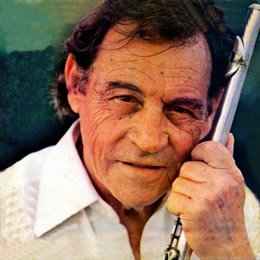
Nicolino Cópia, known as Copinha, was a key Brazilian flutist in the 20th century.
Introduction
Nicolino Cópia, known as Copinha (São Paulo, March 3, 1910 – Rio de Janeiro, March 4, 1984), was a flutist, saxophonist, clarinetist, composer, arranger and conductor. One of the great Brazilian flutists of the twentieth century, he had a career that ran through choro (Brazil's oldest urban instrumental genre), radio, the big orchestras, bossa nova and some of the landmark recordings of Brazilian popular music.
Although he was at home on several wind instruments, it was on the flute that he built his identity. His precise, elegant phrasing made Copinha a musician especially prized both as a soloist and as an accompanist.
Training and early years
The son of Italian immigrants and one of nine siblings involved with music, Copinha began studying at the age of seven, guided by his older brother, Vicente. By nine he was already playing the flute and accompanying the guitarist Américo Jacomino, "Canhoto", in serenatas (nighttime serenades performed beneath a window). Years later he would recall that the repertoire of these serenades depended on who was being honored: for a girl who liked tango, he played tango; for another who preferred choro, he played choro. He was versatile.
He later studied clarinet and saxophone at the Conservatório Dramático e Musical de São Paulo. In the 1930s he began his professional career in cinemas and on radio programs, playing alongside musicians such as Garoto and Armandinho.
As a member of the Orquestra Colúmbia, led by maestro Gaó, he moved to Rio de Janeiro in that same decade. In his new city he began working in theaters, casinos and nightclubs, and also played with Pixinguinha at the Dancing Eldorado.
From the orchestras to the major studios
In the 1940s, Copinha formed his own orchestra and became one of the leading accompanists for the singers of the period. Over the years he worked with figures such as Francisco Alves, Carmen Miranda, Orlando Silva, Aracy de Almeida and Dorival Caymmi.
As the music industry changed, he adapted to the recording studios as well, becoming one of the most sought-after instrumentalists in the country. His flute appears on essential records by several generations of artists, from Elizeth Cardoso and João Gilberto to Cartola, Paulinho da Viola, Chico Buarque, Milton Nascimento, Gilberto Gil and Caetano Veloso.
One of his best-known appearances is the introduction to Chega de Saudade, on João Gilberto's first LP, from 1959. Copinha also took part in Canção do Amor Demais, by Elizeth Cardoso, a record decisive for the emergence of bossa nova.
Copinha and *choro*
Despite his intense activity as a studio musician and conductor, Copinha maintained a deep connection with choro. His formation came from the tradition of wind and string ensembles, from the serenatas and from his contact with musicians such as Canhoto, Garoto and Pixinguinha.
In 1977 he took part in the historic Choro na Praça, recorded live at the Teatro João Caetano. The event brought together some of the genre's leading soloists, among them Waldir Azevedo, Abel Ferreira, Paulo Moura, Joel Nascimento and Zé da Velha. Copinha also performed two of his own compositions, Amolador and Margarida.
In the final years of his career he grew close to a new generation of chorões (choro musicians). On the 1981 album Amando Sempre, he was accompanied by young musicians such as Raphael Rabello and Luciana Rabello, performing works by Radamés Gnattali, Pixinguinha, Garoto and Patápio Silva, along with his own compositions. The flutist and saxophonist Eduardo Neves recounted that, still a teenager, he sought Copinha out after seeing him on television and went on to study with him. More than technique, he would later recall, what he received from the master was "the poetry of music."
This connection between different generations is one of the hallmarks of his career. Copinha was part of professional music-making from the 1930s onward, shared the stage with some of the great names of the velha guarda (the "old guard" of early choro and samba), and continued to occupy a prominent place in choro until the early 1980s.
Composer
Copinha left around twenty compositions, among them choros, waltzes and pieces in a seresteiro (serenading) vein. His works include:
- Amando Sempre
- Amolador
- Margarida
- Será que é isso?
- Saudade (de Carolina)
- Reconciliação
Remembered above all as a performer and accompanist, Copinha left a decisive contribution to the Brazilian flute tradition. His presence links different moments in the history of choro, from the São Paulo serenatas and his time alongside Pixinguinha to the rodas (informal circles where musicians play together) and recordings of the generation of Raphael Rabello and Luciana Rabello.
Selected discography
- Choro na Praça — 1977
- Copinha interpreta Bonfiglio de Oliveira — 1979
- Amando Sempre — 1981
Sources
- Instituto Casa do Choro. Acervo de Nicolino Cópia, o Copinha.
- Instituto Moreira Salles. Rádio Batuta and record collection, particularly the recordings Choro na Praça and Amando Sempre.
- COPINHA. A música brasileira deste século por seus autores e intérpretes: Copinha. São Paulo: SESC São Paulo / Fundação Padre Anchieta, 2000. Original recording of the program MPB Especial, TV Cultura, October 2, 1974. Directed by Fernando Faro.
- FIGUEIREDO, Afonso Cláudio Segundo de. Improvisação no Saxofone: a prática da improvisação melódica na música instrumental do Rio de Janeiro a partir de meados do século XX. Rio de Janeiro: UNIRIO, 2005. Doctoral dissertation in Music.
Suggested course
Move from editorial context into guided study with synchronized score and structured steps.
All courses
Browse the public course catalog connected to the content hubs.