Choropedia
Chiquinho do Acordeom: Brazilian Accordionist
Discover Chiquinho do Acordeom, a key figure in choro music.
Introduction
Romeu Seibel, known as Chiquinho do Acordeom (Santa Cruz do Sul, November 7, 1928 – Rio de Janeiro, February 13, 1993), was a Brazilian accordionist and composer. He became one of the essential figures in the history of the accordion in choro and in Brazilian instrumental music.
His career was closely tied to some of the leading musicians of his generation, especially Garoto, Fafá Lemos, and Radamés Gnattali. With them, he helped explore an accordion no longer associated only with dance halls and regional music, but integrated into the language of small instrumental ensembles and into the conversational quality that defines choro.
From Rio Grande do Sul to Rádio Nacional
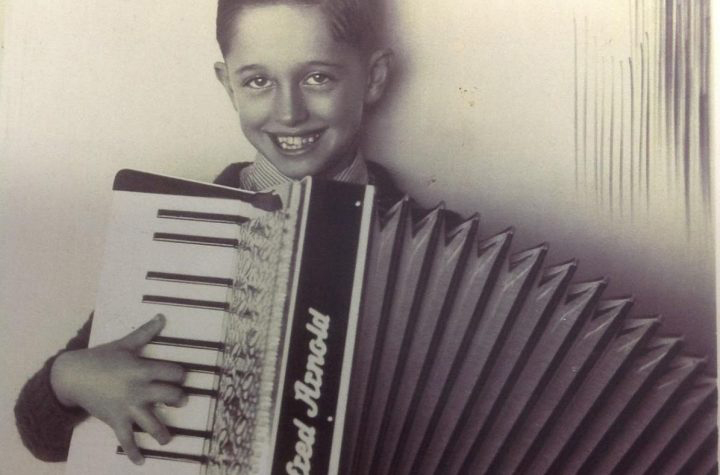
Chiquinho began playing the accordion as a child. At the age of eight he was given his first instrument by his father, and in 1937 he started studying with Marieta Heuser, one of the most respected teachers in the region.
In 1949, after an initial stay in Rio de Janeiro with his trio, Chiquinho decided to move to the city for good in search of new professional opportunities. He began by playing in nightclubs and soon joined the regional (the small ensemble of strings and percussion typical of choro) led by Claudionor Cruz.
Shortly afterward he joined Rádio Nacional, one of the main centers of Brazilian music at the time. There he worked alongside instrumentalists, composers, and arrangers connected to samba and choro — an environment that proved decisive for the development of his musical language.
In 1952 he became a member of the Trio Surdina, alongside Garoto on guitar and Fafá Lemos on violin. Formed out of the radio program Música em Surdina, the trio developed a chamber-like sound built on dialogue and countermelodies among the three instruments.
This lineup was particularly significant for the accordion. In Chiquinho's hands the instrument could accompany, answer the melody, or take the lead line itself, occupying a role similar to that of the instruments traditionally associated with the regionais of choro.
Chiquinho and Radamés Gnattali
From the 1950s onward, Chiquinho established a long-lasting partnership with Radamés Gnattali. He played in his instrumental groups and was part of the Sexteto Radamés Gnattali, which toured Europe in 1960.
In 1977, Radamés wrote for him the Concerto para acordeom e orquestra de cordas (Concerto for accordion and string orchestra), casting the accordion as a solo instrument in a work that brings together elements of concert music and the language of Brazilian popular music.
The accordion in choro
Although the accordion has occupied many different spaces in Brazilian music, from Luiz Gonzaga to dance bands, Chiquinho became a particular point of reference within choro.
His instrument appears fully integrated into the tradition of the regionais and into Radamés's ensembles, sharing the stage with guitars, cavaquinho (small four-string guitar), bandolim (Brazilian mandolin), and percussion. Chiquinho helped demonstrate that the accordion could take part naturally in the language of choro.
His importance is also recognized by later generations. The accordion would remain present in choro through musicians such as Sivuca, Dominguinhos, Orlando Silveira, and many others, forming a tradition that is still active today.
Composer and later work
Chiquinho also left behind compositions of his own and several collaborations. Among them are São Paulo quatrocentão, with Garoto, Esquina da saudade, with Radamés Gnattali and Alberto Ribeiro, and Acalanto para Juliana and Rabo de fita, with Sivuca.
In 1984 he joined Sivuca on the album Sivuca & Chiquinho do Acordeom, devoted to instrumental music. In the final years of his career he continued recording and resumed his partnership with Radamés on the project Retratos, alongside Raphael Rabello and the Orquestra de Cordas Brasileiras.
Between the Trio Surdina, Radamés's ensembles, and decades of recordings, Chiquinho helped establish the accordion once and for all as one of the possible voices of Brazilian choro.
Sources
- Instituto Casa do Choro — Chiquinho do Acordeom collection and documentation on Radamés Gnattali.
- Instituto Moreira Salles — Rádio Batuta, Discografia Brasileira, and music collection.
- Dicionário Cravo Albin da Música Popular Brasileira — entry on "Chiquinho do Acordeom."
- Acervo Radamés Gnattali — documentation and catalog of works.
Suggested course
Move from editorial context into guided study with synchronized score and structured steps.
All courses
Browse the public course catalog connected to the content hubs.