Choropedia
Canhoto do Cavaquinho: A Choro Legend
Discover the legacy of Canhoto do Cavaquinho, a key figure in choro music.
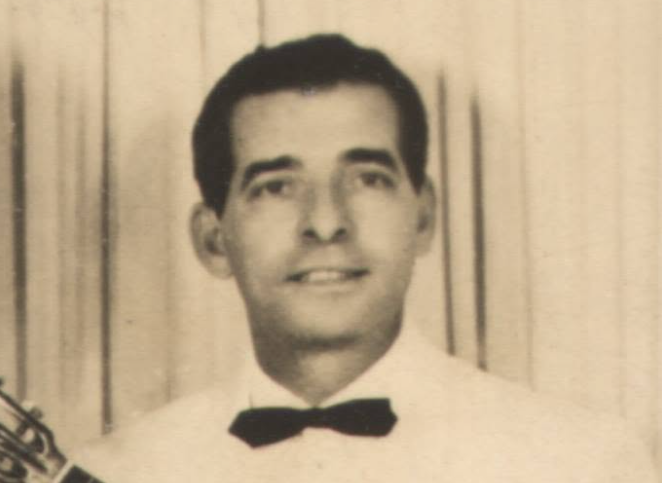
Waldiro Frederico Tramontano, known as Canhoto do Cavaquinho (Rio de Janeiro, August 9, 1908 – November 24, 1987), was one of the leading accompaniment cavaquinho players of Brazilian popular music and a decisive reference in the consolidation of the so-called cavaco-centro (the cavaquinho as the rhythmic-harmonic center).
His career spanned the formation of the great regional ensembles, the Radio Era and decades of recordings of Brazilian music. Alongside Dino and Meira, he formed an accompaniment trio that became a model for generations of musicians and helped establish a way of organizing the rhythmic and harmonic foundation of choro.
The Cavaquinho from Childhood
Canhoto lost his father at the age of seven and, as the eldest of six siblings, began early on to help support the family, working as a ball boy on golf courses and delivering bread.
The cavaquinho, however, was already part of his life. The instrument had been given to him by his father, and the musical gatherings that took place in his home awakened his interest when he was still a boy. In testimony given decades later, Canhoto recounted that he was eight years old when he began to learn and that "Flor do Abacate", by Álvaro Sandim, was the first choro he remembered accompanying.
Being left-handed, he began by inverting the strings of the instrument. After he already knew the positions, he received advice from a guitarist known as Seu Oscar: it would be better to learn using the normal string arrangement, so that he could play on any cavaquinho.
Canhoto then had to learn everything again. He came to hold the instrument as a left-hander, but keeping the string order used by right-handed players — a characteristic he would preserve throughout his career.
From Amateur to Professional Musician
At the end of the 1920s, Canhoto worked in the public health service of Rio de Janeiro. It was during this period that he expanded his contact with the city's rodas (jam sessions) and musicians.
At one of these gatherings he met Russo do Pandeiro, who played with Benedito Lacerda. According to Canhoto himself, it was Russo who invited him to join the flutist's ensemble — a moment he considered decisive for his professionalization.
Canhoto joined Gente do Morro, the ensemble led by Benedito Lacerda, between 1931 and 1932. In 1934, after a tour, the group adopted the name Conjunto Regional de Benedito Lacerda.
The moment coincided with the expansion of Brazilian radio. The regionais became indispensable at the stations, accompanying singers, soloists, musical programs and live broadcasts. For musicians like Canhoto, this transformation opened the possibility of making choro a permanent profession.
Dino, Meira and Canhoto
In 1937 two fundamental changes occurred in the lineup of the Regional de Benedito Lacerda: the arrival of the guitarists Horondino José da Silva, Dino, later celebrated as Dino Sete Cordas, and Jayme Thomás Florence, Meira.
The partnership of Dino, Meira and Canhoto was born.
The three would work together for approximately four decades. In testimony from 1978, Canhoto recalled that they had started out single, grown old together and, throughout all that time, had never had a serious quarrel or argument.
Their rapport had a very concrete musical consequence. Meira provided firm harmonic and rhythmic guidance on the six-string violão. Canhoto established the rhythmic-harmonic center on the cavaquinho. With this structure working precisely, Dino gained the freedom to develop his countermelodies and baixarias.
A musician who later studied how this formation worked went so far as to observe that Dino and Meira "seemed like a single person."
What Is the Cavaco-Centro?
In the early choro ensembles, the cavaquinho occupied an intermediate position between the melody and the bass lines of the violão. Its function was to provide chords while, at the same time, helping to maintain the pulse.
Hence the idea of center: the instrument functions as a link between rhythm and harmony.
In the earliest formations, this rhythmic responsibility could be quite constant. With the incorporation of the pandeiro and other percussion instruments into the ensembles, especially during the transformations of the 1920s and 1930s, the cavaquinho gained more freedom to vary its patterns and dialogue with the other members of the rhythm section.
It was in this function that Canhoto became a reference.
His cavaquinho did not seek to fill every space. On the contrary, it worked in close relation with the violões and the percussion, sustaining the ensemble and choosing the moments in which it could intervene rhythmically.
Canhoto's Language
One of the characteristics identified in Canhoto's recordings is the so-called palhetada alternada (alternate picking).
In the movement of the pick, the return from the high strings to the low ones could function merely as a preparatory motion. Canhoto frequently transformed this return into an effective articulation, incorporating it into the rhythmic design.
The recurrence of this gesture produced an accent distinctive enough to help researchers recognize his presence even in recordings whose credits do not identify the musicians. The technique can be heard clearly, for example, in his accompaniment of "Doce de Coco".
But his style was not restricted to a single levada. Canhoto adapted his picking to choros, sambas, maxixes, polcas, baiões and other genres, also using off-beats, small counterpoints and two-note interventions.
Harmonically, his language favored clarity. Analyses of his recordings identify a strong presence of triads and a relatively economical use of more dissonant chords. This simplicity did not mean harmonic poverty. Within the regional, it helped produce a solid foundation over which the violões could develop their lines and counterpoints with greater freedom.
The Regional do Canhoto
With the departure of Benedito Lacerda in the early 1950s, leadership of the ensemble passed to Canhoto.
On March 16, 1951, the Regional do Canhoto debuted on Rádio Mayrink Veiga. The lineup that would become best known brought together Canhoto on cavaquinho, Dino and Meira on violões, Altamiro Carrilho on flute, Orlando Silveira on accordion and Gilson de Freitas on pandeiro, later replaced by Jorginho do Pandeiro.
The following month, the group made its first recording of its own, with "Gracioso" and "Meu Limão, Meu Limoeiro", the latter with an arrangement by Canhoto.
Over the following years, the regional became one of the great accompaniment ensembles of Brazilian music. In addition to its own discography, its members appear on hundreds of recordings by singers and instrumentalists.
With the closing of Rádio Mayrink Veiga in 1965, the ensemble's permanent tie to the station ended, but Canhoto continued to take part in recordings and performances in the following decades.
From Jacob and Pixinguinha to Cartola
Canhoto's career spanned different generations of Brazilian popular music. His cavaquinho can be heard alongside some of the leading singers and instrumentalists of the twentieth century.
The Regional do Canhoto took part in recordings with names such as Jacob do Bandolim, Pixinguinha, Altamiro Carrilho and Luiz Gonzaga, as well as accompanying numerous performers connected to the radio. His extensive documented discography includes hundreds of appearances.
In the 1970s, Dino, Meira and Canhoto once again formed that historic foundation on recordings by Cartola. On the sambista's first album, released in 1974, the three appear together on several tracks, including "Amor Proibido", accompanied by the pandeiro of Gilberto D'Ávila.
The presence of the trio so many years later demonstrates the longevity of a formation created back in the 1930s.
Composer
Although he built his reputation primarily as an accompanist, Canhoto also left some compositions.
Among them are "Canhotinho", "Gingando", "Visitando", "Lenço Branco" and "Teco-Teco", some in partnership with musicians of his circle, such as Dino, Meira and Orlando Silveira.
The Casa do Choro catalogue preserves scores of "Canhotinho" and "Gingando."
Legacy
In 1977, forty years after the meeting of Dino, Meira and Canhoto, the musicians were reunited for a tribute in the show O Fino da Música.
In presenting the trio to the audience, Altamiro Carrilho recalled the number of singers, soloists and recordings they had sustained over the decades and described them as "pillars of Brazilian popular music."
The expression sums up Canhoto's career well.
His importance came not from a pursuit of the cavaquinho's prominence, but from the transformation of accompaniment into a specialty. In his way of playing, rhythm and harmony met at the center of the regional. The result became a school and helped establish a cavaquinho language that remains present in Brazilian choro.
Sources
- Instituto Casa do Choro — Archive, entry on Canhoto do Cavaquinho and catalogue of works, with scores of "Canhotinho" and "Gingando." Available at: casadochoro.com.br
- Instituto Moreira Salles — José Ramos Tinhorão archive and the feature "O Regional do Canhoto," Rádio Batuta. Available at: ims.com.br
- RIBEIRO, Jamerson Farias. O cavaco rítmico-harmônico na música de Waldiro Frederico Tramontano (Canhoto): a construção estilística de um "cavaco-centro" no choro. Master's dissertation, Escola de Música da UFRJ, 2014. — Central source, with testimony from Canhoto himself, interviews with musicians and documents from the Tramontano family archive.
- RIBEIRO, Jamerson Farias. "A construção estilística do cavaquinho e os processos de transmissão musical no choro: a relação Álvares-Galdino-Canhoto." Música Popular em Revista, v. 6, n. 1, 2019.
- Memória do Cavaquinho Brasileiro — Entry on Waldiro Frederico Tramontano (Canhoto).
- Discografia Brasileira — Phonographic records and appearances by Canhoto.
Suggested course
Move from editorial context into guided study with synchronized score and structured steps.
All courses
Browse the public course catalog connected to the content hubs.