Choropedia
Armandinho - Brazilian Musician and Composer
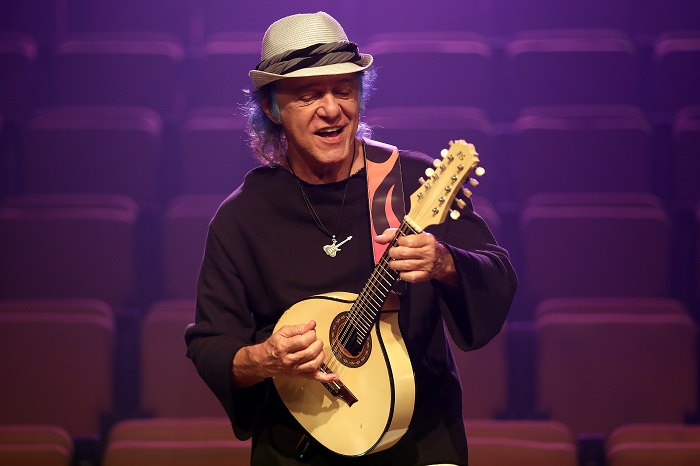
Armandinho is a Bahia-born musician known for his work with the guitarra baiana and bandolim.
Introduction
Armando da Costa Macedo, known as Armandinho (Salvador, Bahia, 22 May 1953), is a Brazilian instrumentalist, composer and singer. A bandolim (Brazilian mandolin) and guitar player, he became one of the central figures in the development of the guitarra baiana (Bahian electric guitar) and built a career that brings together choro, frevo, rock and Brazilian instrumental music.
The son of Osmar Macedo, one of the creators of the trio elétrico (the amplified sound-truck ensemble of Bahian carnival) alongside Dodô, Armandinho grew up in an environment where the bandolim, choro and experimentation with electric instruments were part of everyday life. That combination would prove decisive for his musical language.
Formative years
Armandinho began playing the bandolim as a child, guided by his father. In 1962 he took part in the Trio Elétrico Mirim, and a few years later formed the rock group Hell's Angels, an experience that added the language of the electric guitar to the Brazilian references of his upbringing.
In 1968 he gained national visibility by appearing on A Grande Chance, the television programme hosted by Flávio Cavalcanti on TV Tupi. His performance on the bandolim led to a contract with the network and to his first professional recordings.
From early on, his instrumental vocabulary drew on two strands that would remain inseparable throughout his career: on one side, the phrasing of the bandolim and the tradition of musicians such as Jacob do Bandolim and Garoto; on the other, the sonority, attack and freedom associated with the electric guitar.
The trio elétrico and the guitarra baiana
From the 1970s onward, Armandinho took on a prominent role in the Trio Elétrico de Dodô e Osmar, which would come to be known as the Trio Elétrico de Armandinho, Dodô e Osmar. Alongside his brothers and musicians such as Moraes Moreira, he took part in the transformation of the trio elétrico into a format increasingly close to that of a band.
He also played a decisive role in the development of the guitarra baiana, an instrument derived from the early electric instruments created by Dodô and Osmar. Armandinho helped consolidate its identity, expand its technical possibilities and develop models with greater range, including the five-string version.
In his hands, the guitarra baiana came to incorporate resources drawn from rock guitar without abandoning its tuning in fifths or its phrasing rooted in the bandolim. Choros, frevos and virtuosic passages could thus gain amplification, greater sustain and a new sonic intensity.
A Cor do Som
Between 1975 and 1977, Armandinho was part of Moraes Moreira's band, alongside Dadi Carvalho and Gustavo Schroeter. Out of that experience came A Cor do Som, formed in 1977 with Mú Carvalho and, later, Ary Dias.
One of the group's first performances took place at the Festival Nacional do Choro, with the composition Espírito infantil. The presence of guitarra baiana, electric bass, keyboards and drums at a festival dedicated to choro drew attention to a proposal that combined Brazilian instrumental music with instruments associated with rock.
A Cor do Som developed a language based on the encounter between frevo, choro, northeastern Brazilian rhythms, rock, jazz and Brazilian popular music. In 1978 the group performed at the Montreux Jazz Festival in Switzerland, and in the years that followed it achieved wide national recognition.
Armandinho remained in the line-up until 1982, leaving important recordings on albums such as A Cor do Som, Ao Vivo em Montreux, Frutificar, Transe Total and Mudança de Estação.
The bandolim and choro
Although the guitarra baiana became one of his most recognisable trademarks, Armandinho never abandoned the bandolim. In his instrumental career he deepened his engagement with the choro repertoire through encounters with musicians such as Raphael Rabello, Paulo Moura and Época de Ouro.
His dialogue with Raphael Rabello resulted in the album Raphael Rabello e Armandinho em Concerto, released in 1997 from a performance given in Rio de Janeiro in 1994. The repertoire brings together pieces by composers including Jacob do Bandolim, Waldir Azevedo and Osmar Macedo.
On Retocando o Choro (1999), Armandinho turned directly to the genre, performing works such as Lamentos, by Pixinguinha, Assanhado and Santa Morena, by Jacob do Bandolim, and Lamentos do Morro, by Garoto, alongside his own compositions and pieces connected to Bahian music.
His playing is marked by speed, improvisation and considerable technical command, carrying over to the bandolim and the guitarra baiana elements learned both in the choro tradition and on the electric guitar.
Major works
Among his compositions and collaborations are:
- Dança do Tempo
- Zanzibar
- Saravejo, with Pepeu Gomes
- Davilicença, with Moraes Moreira
- Não Vou Calar, with Fred Góes
His output spans different moments of Brazilian instrumental and popular music, bringing together pieces connected to choro, Bahian carnival and the experience of A Cor do Som.
Selected discography
- Brasileirô — 1989
- Instrumental no CBB: Época de Ouro e Armandinho — 1993
- Raphael Rabello e Armandinho em Concerto — 1997
- Retocando o Choro — 1999
- A Voz do Bandolim: Caetano & Gil — 2001
- Retocando o Choro ao Vivo — 2003
- Pop Choro — 2009
- Afrobossanova, with Paulo Moura — 2009
Sources
- Instituto Casa do Choro. Archive and documentation on Brazilian choro.
- Instituto Moreira Salles. José Ramos Tinhorão Collection and documentation on A Cor do Som and the guitarra baiana.
- Dicionário Cravo Albin da Música Popular Brasileira. Entries "Armandinho" and "A Cor do Som".
- Discografia Brasileira. Recordings by Armandinho Macedo.
- Secretaria de Cultura do Estado da Bahia. Interview with Armandinho Macedo.
- Cultura FM. Programme Supertônica: Armandinho Macedo, a guitarra baiana.
Suggested course
Move from editorial context into guided study with synchronized score and structured steps.
All courses
Browse the public course catalog connected to the content hubs.