Choropedia
Álvaro Sandim: Brazilian Composer and Trombonist
Álvaro Sandim was a Brazilian composer and trombonist known for his contributions to choro and carnival music.
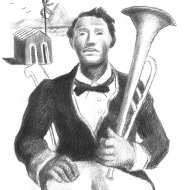
Introduction
Álvaro Sandim was a composer and trombonist from Rio de Janeiro, part of the generation of musicians who helped shape the language of choro in the first decades of the twentieth century. His career was deeply tied to the ranchos carnavalescos (carnival processional societies) of Rio de Janeiro, settings where instrumentalists, composers, and arrangers moved freely between carnival, dance halls, and rodas de choro (informal choro gatherings).
Although his known output is small, Sandim left behind one of the most enduring classics of that repertoire: Flor do Abacate.
From the ranchos to choro
The ranchos carnavalescos were associations that paraded through the streets of Rio de Janeiro, mainly between the late nineteenth century and the first decades of the twentieth. Despite the name, they had nothing to do with rural properties. They brought together musicians, singers, costumes, banners, and themed processions. Their lineups combined wind and string instruments with a repertoire of marches, maxixes (an early Brazilian urban dance genre), and other popular forms. It is no coincidence that many musicians essential to the formation of choro passed through these groups.
In 1911, Sandim was a member of the Sociedade Carnavalesca Ninho do Amor, where he performed alongside musicians such as the young Romeu Silva, who would later become a bandleader with an important career in Brazil and abroad.
Shortly afterward, he became involved with the rancho Flor do Abacate, originally based in Largo do Machado. The group gathered some of the finest instrumentalists of the period and maintained a strong rivalry with Ameno Resedá, another of the great carioca ranchos.
Sandim became the group's diretor de harmonia (harmony director) and played trombone in its orchestra. That position helps explain his music: it was born at the meeting point of instrumental writing, the band tradition, carnival, and the playing style of the chorões (choro musicians).
Flor do Abacate
In 1915, Sandim turned the name of his rancho into music. Flor do Abacate was composed as a tribute to the association and quickly outgrew the carnival world.
As early as 1916, the piece was recorded by Grupo Faceiro. Over the following decades it became part of the traditional choro repertoire, outliving the very rancho that gave it its name.
The work also caught Pixinguinha's attention. In 1947, he wrote an arrangement of Flor do Abacate for the Orquestra do Pessoal da Velha Guarda, a project dedicated to reviving the popular music of earlier carioca generations. The composition would appear again in recordings directed by Pixinguinha, among them the 1955 album A Velha Guarda.
This path helped turn a piece tied to the 1915 carnival into music passed down through successive generations of chorões.
Other works
Álvaro Sandim's surviving repertoire also includes Corbeille, a schottisch, and E vem vovó, a maxixe that was already circulating before Flor do Abacate.
E vem vovó was recorded in 1913 by Choro Carioca, a group whose members included a still-teenage Pixinguinha. The recording shows that Sandim was already part of the world of the first choro ensembles to reach records in Rio de Janeiro.
The works preserved today include:
- Corbeille — schottisch
- E vem vovó — maxixe
- Flor do Abacate — maxixe
The importance of Álvaro Sandim to choro
Sandim's career reveals a period when the boundaries between choro, maxixe, polka, dance-hall music, and carnival were still especially fluid. The same musicians might play in the ranchos, in the carnival societies, at balls, and in the small instrumental ensembles that would help consolidate choro.
Sandim belonged squarely to that world.
His known output is limited, but Flor do Abacate proved enough to keep his name alive. Recorded, arranged, and taken up again by different generations, the piece remains a link between the carioca carnival of the early twentieth century and the repertoire that still circulates in rodas de choro today.
Sources
- Instituto Casa do Choro — Álvaro Sandim collection and sheet music catalogue.
- Instituto Moreira Salles — Discografia Brasileira and Acervo Pixinguinha.
- Moraes, Eneida de. História do carnaval carioca. Rio de Janeiro: Record, 1987.
Suggested course
Move from editorial context into guided study with synchronized score and structured steps.
All courses
Browse the public course catalog connected to the content hubs.