Blog
The Brazilian Guitar School Overview
Explore the history of the Brazilian guitar and its unique language.
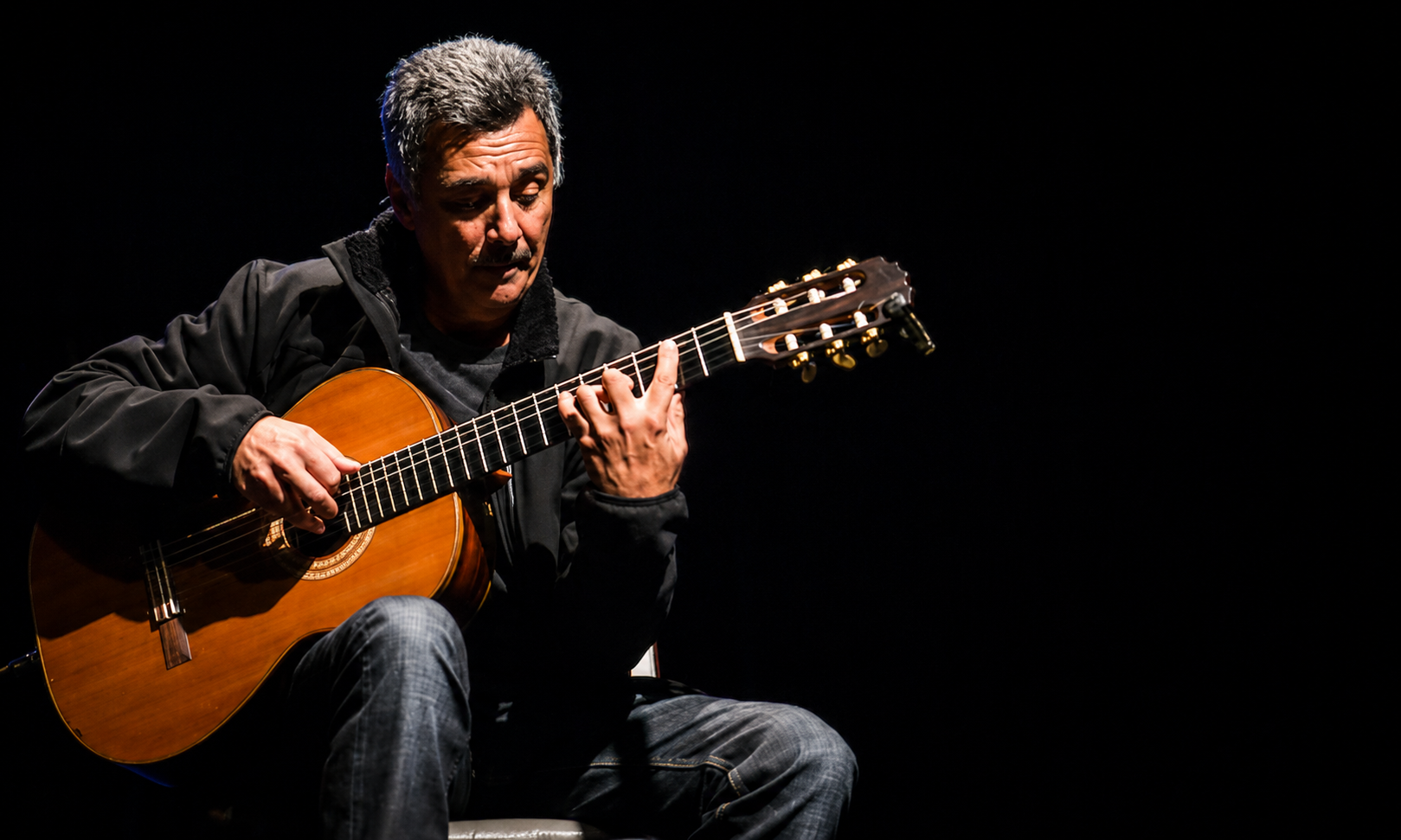
Few instruments are as deeply intertwined with the history of Brazilian music as the guitar. Present in choro, samba, Brazilian popular song, bossa nova, and concert music, the instrument developed a language of its own in Brazil, recognizable not only by the repertoire it plays, but by the way it accompanies, shapes bass lines, organizes rhythm and harmony, and turns multiple voices into music in the hands of a single player.
This language was not created by one musician or one generation. It was built over more than a century through the meeting of traditions that are often told as separate stories: the guitar of choro musicians and regional ensembles, the instrument of popular composers, the classical concert tradition, and, eventually, generations of musicians capable of bringing all these worlds together.
The Guitar in Choro
Before establishing itself onstage as a solo instrument, the guitar played a decisive role in choro ensembles. Alongside the cavaquinho, it provided the harmonic and rhythmic foundation over which the flute, mandolin, and other instruments developed the melody.
But Brazilian guitarists gradually transformed this role.
In the first decades of the twentieth century, Tute, the artistic name of Arthur de Souza Nascimento, became one of the key figures in this history. A six- and seven-string guitarist, he was one of the pioneers in introducing the seven-string guitar into choro ensembles, using an additional bass string tuned to C.
More important than simply adding another low note to the instrument was the musical path this opened. The guitar could extend its range and develop bass lines with greater freedom, connecting one chord to another.
Tute helped establish the foundations of an accompanying style that would be profoundly developed by the next generation.
Meira and Dino: Accompaniment Becomes a Language
Beginning in the 1930s, Jayme Florence, known as Meira, and Horondino José da Silva, known as Dino 7 Cordas, took this language to another level.
For decades, they formed one of the most important guitar duos in Brazilian music. Meira organized the harmonic and rhythmic foundation, while Dino filled the spaces with bass lines that connected chords, anticipated harmonic movement, and engaged in dialogue with the melody.
The bass was no longer merely the root of the chord.
It became a second voice.
This principle became one of the most recognizable characteristics of Brazilian accompaniment: while one guitar sustains the rhythm and harmony, another can create genuine counterpoint in the lower register.
Dino took this technique to an extraordinary level. His celebrated baixarias, melodic and contrapuntal bass lines characteristic of Brazilian guitar accompaniment, were not ornaments added to the music, but part of the very architecture of the arrangement. The bass could move chromatically, answer the soloist, fill a pause, or lead the harmony toward the next chord.
The influence of this school would spread through samba and choro and reach later generations directly.
There is also a crucial pedagogical connection: Meira taught Baden Powell and, decades later, Raphael Rabello.
The family tree of Brazilian guitar was beginning to emerge.
Another Tradition: The Guitar as a Concert Instrument
While this language was developing in choro rodas, regional ensembles, radio studios, and recording sessions, another transformation was taking place in concert music.
In the early twentieth century, Heitor Villa-Lobos recognized possibilities in the guitar that transcended the division between popular and classical music.
His guitar works, particularly the 12 Études, composed in the 1920s, explored the instrument's idiomatic resources through writing of considerable technical complexity. Open strings, symmetrical patterns, shifts across the fingerboard, arpeggios, and effects arising from the guitar's own mechanics ceased to be limitations and became forces shaping the compositions themselves.
Villa-Lobos was not trying to make the guitar imitate the piano or the orchestra. He wrote from what the instrument itself knew how to do.
This principle would become fundamental for generations of Brazilian composers and guitarists.
But the separation between the popular guitar and the concert guitar was never absolute.
And it is precisely in the territory between these two worlds that some of the most important figures in this story emerge.
Garoto and the Birth of the Modern Brazilian Guitar
Aníbal Augusto Sardinha, known as Garoto, occupies a unique position in this genealogy.
A multi-instrumentalist deeply connected to Brazilian urban popular music, Garoto knew the languages of choro, samba, and accompaniment from the inside. At the same time, his guitar writing incorporated sophisticated harmony, voice leading, and highly refined instrumental techniques.
Pieces such as Jorge do Fusa, Desvairada, Lamentos do Morro, and Sinal dos Tempos reveal an instrument that no longer fits comfortably within the division between popular and classical music.
Decades later, Baden Powell would summarize the importance of this transformation by saying that Garoto had created a true school of modern guitar playing for Brazilian guitarists.
This may be one of the keys to understanding the entire story.
Garoto did not abandon choro in order to reach concert music. He carried his experience as a popular musician with him and expanded its harmonic, formal, and instrumental possibilities.
Radamés Gnattali and the Bridge Between Worlds
Few composers did as much to bring these traditions together as Radamés Gnattali.
A pianist, composer, arranger, and conductor, Radamés moved continuously between radio, popular music, chamber music, and symphonic writing. The guitar occupied an important place within this universe.
He wrote for some of the great Brazilian guitarists of different generations. Dança Brasileira, from 1946, was written for Laurindo Almeida; Tocata em ritmo de samba, from 1954, for Garoto. Later, he would write études and other works dedicated to guitarists such as Turíbio Santos, Sérgio Abreu, Barbosa-Lima, and Waltel Branco.
With Radamés, rhythmic and harmonic elements of Brazilian popular music could enter concert structures without surrendering their identity.
And this story would eventually meet choro once again.
When Raphael Rabello became close to Radamés, he encountered not merely a composer, but a living connection to Garoto and to several decades of the instrument's history.
In 1982, the two recorded Tributo a Garoto together.
The lines of this genealogy were beginning to intersect.
Baden Powell: Rhythm, Harmony, and Identity
If Garoto opened new paths for the modern popular guitar, Baden Powell transformed those possibilities into a deeply personal language with enormous international reach.
His musical education helps explain this synthesis.
As a student of Meira, Baden directly inherited a tradition connected to choro and samba accompaniment. But his guitar playing also absorbed elements of the classical repertoire, bossa nova, jazz, and, decisively, Afro-Brazilian rhythms and traditions.
In his hands, accompaniment and solo playing often ceased to be separate functions.
The thumb could construct bass lines while the other fingers articulated syncopated chords and melodic fragments. Percussiveness became part of the phrasing. Harmony did not interrupt rhythm, and rhythm did not function merely as accompaniment.
In the Afro-sambas, composed with Vinicius de Moraes, this language found one of its most influential expressions.
Baden showed the world that a Brazilian guitarist could walk onto a stage alone and carry with him an extraordinary amount of musical information: bass, harmony, rhythm, melody, and improvisation.
Brazilian guitar playing was also becoming a popular concert language.
Raphael Rabello: When the Seven-String Guitar Becomes a Solo Instrument
It is with Raphael Rabello that several strands of this history come together almost literally.
Raphael entered the world of choro at a very young age and studied with Meira. He deeply absorbed the language of Dino 7 Cordas and became an exceptional accompanist.
But he did not accept that the seven-string guitar should remain confined to that role.
He brought an extraordinarily virtuosic solo technique to the instrument and incorporated elements of classical guitar, flamenco, and other traditions without abandoning the vocabulary developed within choro.
A study devoted to the transformation of the seven-string guitar summarizes this synthesis through a particularly revealing statement: according to Guinga, Raphael's guitar playing was the result of a fusion between Dino 7 Cordas and Baden Powell.
The phrase is almost a genealogy in miniature.
From Dino came the architecture of the baixarias, counterpoint, and the experience of the accompanist. From Baden came the power of the Brazilian solo guitar. And through Meira, there was a direct connection between the generations.
Through Radamés Gnattali, Raphael also drew closer to Brazilian concert music and to the world of Garoto.
The seven-string guitar, which had entered choro to extend the lower register of the accompaniment, was now at center stage performing solo repertoire.
It was a historic transformation.
A School Without a Conservatory
It may be more accurate to speak of a Brazilian school of guitar playing not as a single institution or method, but as a tradition transmitted from musician to musician.
Part of it was taught formally. Another part traveled through choro rodas, radio ensembles, records, recordings, and direct contact between generations.
Tute influenced the language that Dino would later develop.
Meira played alongside Dino for decades and taught Baden Powell and Raphael Rabello.
Garoto created a language that impressed Baden and would later be revisited by Raphael.
Radamés wrote for Garoto and, decades later, worked directly with Raphael.
Each generation inherited a vocabulary and reorganized it.
It is precisely this continuity that allows us to speak of a school.
Yamandu Costa and the Contemporary Brazilian Guitar
When Yamandu Costa emerged at the end of the twentieth century, he inherited an instrument whose Brazilian identity had already been shaped by many generations.
His playing incorporates elements of choro, samba, the music of southern Brazil, Latin American traditions, and the concert repertoire. Playing primarily the seven-string guitar, Yamandu simultaneously explores deep bass registers, chords, melodies, percussion, and dramatic dynamic contrasts.
But perhaps his historical importance lies less in creating a rupture than in showing just how far this tradition could go.
The instrument that, with Tute, gained an additional bass string to expand its accompanying role became capable, a century later, of filling major concert halls around the world on its own.
Between those two points lies a long chain of musicians.
There Is More Than One Lineage
This history, naturally, is larger than any selection of names.
João Pernambuco, Quincas Laranjeiras, Dilermando Reis, Laurindo Almeida, Luiz Bonfá, Bola Sete, Paulinho Nogueira, Rosinha de Valença, Turíbio Santos, Baden Powell, Sérgio and Eduardo Abreu, Egberto Gismonti, Paulo Bellinati, Marco Pereira, Guinga, the Assad brothers, and many others developed their own paths for the instrument.
There are also regional traditions that cannot be reduced to the history of Rio de Janeiro's choro scene.
For this reason, the Brazilian guitar school may be better understood not as a straight line, but as a network of lineages that continually intersect.
Choro developed a sophisticated language of accompaniment and bass lines.
The concert tradition expanded technique, repertoire, and instrumental writing.
Guitarist-composers brought composition and performance closer together.
Samba deepened the instrument's rhythmic dimension.
Garoto and Radamés helped dissolve boundaries.
Baden transformed this synthesis into a profoundly Brazilian solo language.
Raphael united the accompanist and the concert soloist within the seven-string guitar.
And later generations continued expanding this vocabulary.
A Brazilian Instrument
The guitar was not born in Brazil. But few cultures have transformed the way it is played so profoundly.
In Brazil, accompaniment means much more than supplying chords. The bass can sing. An inversion can lead toward the next harmony. Rhythm can be distributed between thumb and fingers. A melody can emerge from within a chord. Solo and accompaniment can happen simultaneously.
It is a conception of the instrument built collectively.
That is why, when a Brazilian guitarist walks onto an international stage today, more than a century of history exists within that instrument.
Somewhere in its lower register, we can still recognize the role that Tute began to explore and Dino transformed into a language. In the independence of its voices lies the tradition of the great accompanists. In its instrumental ambition echo Villa-Lobos, Garoto, and Radamés. In its rhythmic power and its conception of the guitar as a complete musical world, we hear Baden and Raphael.
What began in choro rodas, backyards, regional ensembles, radio studios, and concert halls ultimately produced something greater than a collection of remarkable musicians.
It produced a school.
And it made the Brazilian guitar one of the world's great traditions of the instrument.
Suggested course
Move from editorial context into guided study with synchronized score and structured steps.
All courses
Browse the public course catalog connected to the content hubs.